


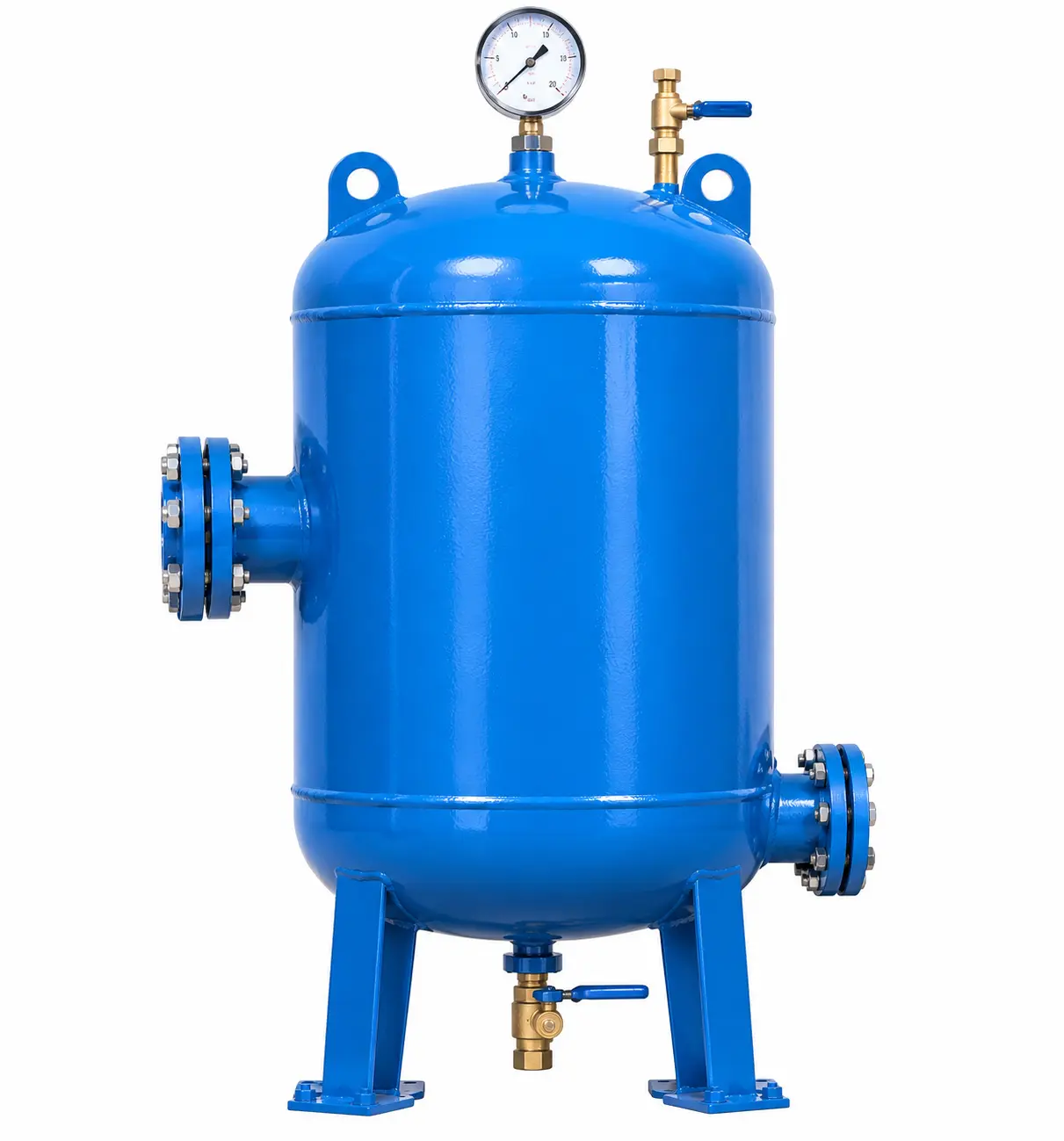
What Is a Surge Vessel?
A surge vessel (sometimes called a surge tank, hydropneumatic tank, or accumulator) is a specialized pressure container connected to a liquid pipeline or hydro system. Its primary purpose is to absorb and control sudden pressure fluctuations (hydraulic transients), most notably the destructive phenomenon known as water hammer.Why Are Surge Vessels Needed?
When fluid is moving through a pipeline, it possesses kinetic energy. If a valve closes abruptly, a pump trips unexpectedly, or a system rapidly changes speed, that massive column of moving water has nowhere to go instantly.This sudden stoppage creates severe pressure waves:
- Positive Pressure Surges (High Pressure): Can violently rupture pipes, burst fittings, and destroy pump housings.
- Negative Pressure Surges (Low Pressure / Vacuum): Can cause the water column to separate, creating vapor pockets that collapse violently or cause pipeline walls to collapse inward.
- Surge vessels act as hydraulic "shock absorbers" to smooth out these extreme peaks and valleys.
How Surge Vessels Work
Most modern industrial surge vessels are closed, pressurized containers containing two distinct components separated by a gas cushion or a bladder:- The Liquid Section: Connected directly to the main pipeline, allowing water to flow freely in and out.
- The Gas Cushion: Typically pre-charged compressed air or nitrogen trapped inside the vessel (often separated from the water by a heavy-duty rubber bladder or membrane).
The Working Cycle:
- During Normal Operation: The system maintains an equilibrium where pipeline pressure balances the compressed gas cushion and water volume.
- During a High-Pressure Surge (Positive Transient): Excess water is forced into the vessel. This compresses the gas cushion. Because gas is compressible (unlike water), it acts like a spring, storing the hydraulic energy and dramatically lowering the peak pressure spike experienced by the pipeline.
- During a Low-Pressure Drop (Negative Transient): As pressure drops or a pump shuts off, the compressed gas expands, pushing the stored water back into the pipeline to maintain flow continuity and prevent vacuum conditions.
Why Surge Pressure and Water Hammer Happen
Surge pressure is a transient: a short-lived change in pressure caused by a sudden change in fluid velocity. Understanding it explains why a surge vessel is needed at all.Fluids moving through a pipe have kinetic energy. If the velocity changes quickly, that energy converts into pressure. The size of the pressure change follows the Joukowsky relationship, which links the pressure rise to the fluid density, the wave speed and the change in velocity:
ΔP = ρ · a · Δv
Here ρ is fluid density, a is the pressure wave speed in the pipe and Δv is the change in flow velocity. In steel water pipes, wave speeds of 1,000 m/s or more are normal, so even a 1 m/s velocity change can produce roughly 10 bar of pressure rise. Plastic pipes have lower wave speeds, but surge can still be damaging.
Common causes of surge
- Pump trip or power failure: the pump stops delivering flow, the column of water keeps moving, and a low-pressure wave forms on the discharge side. When the flow reverses, a high-pressure wave follows.
- Rapid valve closure or opening: fast-acting valves stop flow abruptly.
- Pump start-up against an empty or partly filled line: air pockets and rapid filling create pressure spikes.
- Check valve slam: flow reversal closes the valve violently.
- Changes in demand: sudden load changes in industrial or fire-water systems.
- Column separation: when pressure falls below vapor pressure, the liquid vaporizes, and the collapse of the vapor cavity creates a severe pressure peak.
What surge can damage
Repeated or severe transients cause burst pipes, cracked flanges, loosened supports, ruptured gaskets, damaged pump impellers and failed instruments. They also shorten asset life through fatigue, even when no single event causes obvious failure. Low-pressure transients are just as dangerous: they can collapse thin-walled pipes, pull in contaminants through joints and cause cavitation.How a Surge Vessel Works
A surge vessel works as a hydraulic shock absorber. It is connected to the pipeline through a short branch, with the lower part holding liquid and the upper part holding a compressed gas volume. Because gas is compressible and liquid is not, the gas acts as a spring that stores and releases energy.Normal operation
During steady flow, the gas pressure inside the vessel equals the line pressure. The liquid level in the vessel stays roughly constant, and the vessel does nothing visible.When pressure drops
If a pump trips, line pressure begins to fall. The gas expands and pushes liquid out of the vessel into the pipeline. This supplies flow downstream, slows the deceleration of the water column and keeps pressure from falling to vapor pressure. In effect, the vessel acts as a temporary pump.When pressure rises
As flow reverses or the check valve closes, pressure climbs. Liquid flows back into the vessel and compresses the gas. The gas absorbs the energy of the returning water column, and the pressure peak is cut down to a level the pipe can handle.Why the connection matters
Most designs fit a throttling element, such as an orifice, a nozzle or a differential check valve, in the vessel connection. A restricted outflow path lets the vessel respond quickly while a larger inflow path prevents the gas volume from being compressed too violently. Choosing the right orifice size is a core design decision: too large and the vessel oscillates with the pipeline; too small and it cannot protect against the peak.Gas side control
Depending on the design, gas is supplied by a compressor, a nitrogen bottle bank or a pre-charged bladder. In compressor-fed vessels, a level controller keeps the gas-liquid interface within limits, because gas slowly dissolves into the liquid or leaks away over time. In bladder and diaphragm vessels, a flexible barrier separates the two phases and removes this problem.Types of Surge Vessels
Surge vessels are grouped by how the gas and liquid are kept apart, how the gas is supplied and how the vessel is oriented. The table below compares the four designs you will meet most often.| Type | How It Works | Best For | Main Limitation |
|---|---|---|---|
| Bladder Surge Vessel | A rubber bladder holds pre-charged nitrogen inside a steel shell | Water supply, wastewater, small to medium lines | Bladder wear; size limits for very large volumes |
| Diaphragm Surge Vessel | A flexible diaphragm divides gas and liquid | Compact installations, low to medium volumes | Diaphragm fatigue under heavy cycling |
| Air-over-Water (Compressor-Fed) | Gas and liquid share the space; a compressor tops up air | Large water transmission mains | Needs compressor, level control and regular checks |
| Nitrogen-Charged Piston or Hydropneumatic Vessel | Gas charged from cylinders; level held by control system | Oil and gas, chemical, high-pressure service | Higher cost; gas supply management |
Bladder and diaphragm vessels
These are the simplest to operate. The flexible element keeps gas from dissolving into the liquid, so there is no need for a compressor. They suit clean water and chemically compatible fluids. Elastomer selection matters: EPDM, butyl, nitrile and other grades each tolerate different temperatures and chemicals.Air-over-water vessels
Large water mains often use vertical or horizontal steel vessels where air sits directly above the water. Compressors, level sensors and control valves keep the air volume in range. This design can deliver very large gas volumes, which long, high-flow pipelines need.Nitrogen systems
In oil, gas and chemical service, an inert gas is preferred because it avoids oxygen in contact with hydrocarbons. Banks of nitrogen cylinders or a nitrogen generator feed the vessel, and level instrumentation keeps the interface in position.One-way and two-way surge tanks
A related family is the open or closed surge tank. A one-way surge tank only feeds water into the line when pressure falls below the tank level, while a two-way tank also accepts water when pressure rises. These rely on elevation and are described further in the comparison section.Orientation
Vertical vessels have a small footprint and allow clean gas-liquid separation. Horizontal vessels suit sites with limited headroom and give better stability, though they may need a larger liquid surface area to maintain gas volume.Key Components of a Surge Vessel
A complete surge vessel package is more than a steel shell. Each part affects performance, safety and service life.- Pressure shell: the main body, built to a pressure vessel code, with dished or elliptical heads and a corrosion allowance.
- Inlet and outlet connection: a flanged nozzle linking the vessel to the pipeline, sized to limit friction losses while allowing fast response.
- Throttling device: an orifice plate, nozzle or differential check valve that controls flow in and out.
- Bladder or diaphragm: the flexible barrier in non-compressor designs, selected for fluid, temperature and cycle life.
- Gas valve and charging connection: used to pre-charge nitrogen or air to the design pressure.
- Level instruments: level transmitters or sight glasses that show the gas-liquid interface.
- Pressure gauges and transmitters: monitor vessel and line pressure.
- Safety relief valve: protects the vessel from over-pressure and is mandatory under most codes.
- Isolation and drain valves: allow safe maintenance and draining.
- Compressor and control panel (where used): maintain gas volume automatically.
- Internal and external coatings: epoxy, rubber lining or galvanizing protect against corrosion.
- Supports and lifting lugs: legs, skirts or saddles carry the weight of a vessel that is often very large when full.
Applications of Surge Vessels Across Industries
Wherever liquid moves through a long or high-energy pipeline, a surge vessel can reduce risk. The most common uses are listed below.Water supply and distribution
Municipal water transmission mains use surge vessels at pumping stations and high points. They protect against pump trips, which are the most frequent cause of damaging transients in these systems, and reduce the risk of main bursts and contamination from negative pressure.Wastewater and sewage pumping
Rising mains carry heavy, solids-laden flow, and check valve slam is a constant concern. Surge vessels designed with wide openings and suitable linings protect pumps and force mains from repeated shock.Oil and gas
Crude oil, refined product and LNG transfer lines, loading arms and pipeline terminals use surge vessels to handle valve closure transients, particularly in marine loading where emergency shutdown must act quickly.Chemical and petrochemical plants
Dosing, process feed and cooling circuits benefit from surge control, with materials such as stainless steel, duplex alloys or lined carbon steel for aggressive fluids.Power generation
Boiler feedwater, condensate and cooling water systems use surge vessels to protect pumps and heat exchangers from sudden load changes. Hydropower plants use related surge tanks to manage waterway transients.Mining and slurry
Long slurry and dewatering lines face large inertia loads. Surge vessels with abrasion-resistant linings help avoid blockages and hammer.Irrigation and agriculture
Large irrigation schemes with pumped mains and many valves use surge protection to prevent bursts when sections open or close.Fire protection and district cooling
Fire pump systems and district cooling loops use compact bladder vessels to stabilize pressure and absorb pump start-up shock.Benefits of Using a Surge Vessel
A surge vessel is an investment in reliability. The main benefits are:- Protects pipelines and pumps: it limits both pressure peaks and negative pressure, preventing bursts, collapse and cavitation damage.
- Lowers lifetime cost: fewer repairs, leaks and unplanned shutdowns more than offset the purchase cost on most long pipelines.
- Allows lighter pipe class: with transients controlled, designers can sometimes specify a lower pressure rating for pipe and fittings.
- Improves safety and water quality: it prevents negative pressure that can draw contaminants into a water main and reduces the risk of leaks of hazardous fluids.
- Works without relying on elevation: unlike a surge tower, a pressurized vessel can sit at ground level on flat terrain.
- Fast response: gas compression and expansion act within milliseconds, faster than most mechanical devices.
- Compact footprint: a pressurized vessel is far smaller than an open tank of equivalent protection.
- Fits many fluids and conditions: with the right material and liner, it handles clean water, sewage, slurry, chemicals and hydrocarbons.
- Supports compliance: many utility and industrial standards expect documented transient analysis and protection.
Surge Vessel Design and Sizing Considerations
Sizing a surge vessel is a transient analysis task, not a catalogue lookup. The vessel volume, gas pre-charge and connection restriction must be tuned together, and the result must be checked against the worst credible event.Step 1: Define the system
Collect pipeline length, diameter, wall thickness, material, elevation profile, pump curves, rotating inertia, valve data, fluid properties and normal and maximum flow. Wave speed must be calculated from the pipe and fluid properties, not guessed.Step 2: Identify the worst case
The governing event is usually a simultaneous pump trip at maximum flow, but valve closure, start-up filling and the loss of one of several pumps should also be modelled. Operating at both low and high water levels can change the result.Step 3: Run a transient simulation
Software based on the method of characteristics is the industry norm. Run the unprotected case to see the maximum and minimum pressures and where they occur along the pipe profile.Step 4: Set pre-charge pressure
The gas pre-charge is usually set a little below the minimum steady-state pressure at the vessel location so that the vessel is ready to discharge as soon as pressure begins to fall. The initial gas volume follows the gas law:P_1 V_1^{n} = P_2 V_2^{n}
where n is the polytropic exponent, typically between 1.0 (isothermal, slow events) and 1.4 (adiabatic, fast events). Designers often use values near 1.2 for fast surge to stay conservative.
Step 5: Choose volume and orifice
Iterate vessel volume and orifice size until the simulation keeps pressures within the allowed band, usually between the pipe's pressure rating and a safe minimum above vapor pressure. Check results with different orifice losses for inflow and outflow.Step 6: Verify and add margin
Check sensitivity to pipe roughness, wave speed, pump inertia and gas temperature. Add a safety margin, and confirm that the vessel remains effective if the gas charge is partly lost.Practical design rules
- Place the vessel as close as possible to the pump discharge or the point of greatest risk.
- Avoid long, narrow connection pipes that add inertia and delay response.
- Provide enough liquid volume that the vessel does not run empty during the first reverse-flow period.
- Design the shell for the maximum surge pressure, not only the steady-state pressure.
- Allow space for inspection, bladder replacement and the lifting of internals.
Surge Vessel vs Surge Tank vs Accumulator vs Air Vessel
These terms overlap, and suppliers use them differently. The practical distinctions are below.| Device | Principle | Typical Use | Key Difference |
|---|---|---|---|
| Surge Vessel | Pressurized gas cushion on the line | Pumped pipelines of all sizes | Works at any elevation; sealed to atmosphere |
| Surge Tank (Open) | Water column open to atmosphere at a high point | Hydropower, gravity and long mains | Needs height and land; no pressurized gas |
| Air Vessel | Older term for an air-cushion vessel, often on reciprocating pump lines | Piston pump discharge, small mains | Usually smaller, with simple air charge |
| Hydraulic Accumulator | Gas-charged device storing hydraulic energy | Hydraulic systems, high pressure, small volume | Built for power storage, not large pipeline transients |
| Pulsation Dampener | Gas cushion smoothing cyclic flow | Dosing and reciprocating pump outlets | Targets frequent pulses, not rare surge events |
| Surge Relief Valve | Opens to discharge fluid to release pressure | Back-up protection, fuel lines | Does not help with low-pressure transients |
Which should you choose?
Choose a surge vessel when you need protection against both high and low pressure, have limited space or elevation, and want a response that works even if power fails. Choose an open surge tank when the terrain offers a convenient high point and the system is large. Use a relief valve as a secondary measure or when only over-pressure is a concern. Many large systems combine several devices, for example a surge vessel plus air valves and slow-closing check valves, to cover different failure modes.Materials, Codes and Standards
Because a surge vessel is a pressure-containing device, it must be designed, fabricated and tested to a recognized code.Materials of construction
- Carbon steel: the default for water and general service, usually with internal epoxy or rubber lining and external paint.
- Stainless steel (304, 316, duplex): for corrosive, hygienic or marine service.
- Lined or clad steel: economical for aggressive chemicals or slurry.
- Elastomers for bladders and diaphragms: EPDM for water, nitrile for oils and fuels, butyl for low gas permeability, and fluoroelastomers for harsh chemicals. Check temperature range and drinking-water approvals where relevant.
Common design codes
- ASME Boiler and Pressure Vessel Code, Section VIII: widely used in North America and many other markets.
- EN 13445 and the Pressure Equipment Directive (PED): for Europe, with CE marking.
- AD 2000 Merkblatt: a German code still used for some projects.
- PD 5500: a British code for unfired pressure vessels.
- IS 2825 and local statutory rules: relevant in India alongside project specifications.
- AWWA guidance (such as M51): for air valves and surge in water systems.
Installation, Operation, Maintenance and Troubleshooting
Installation best practice
- Mount the vessel on a level, load-rated foundation, allowing for the weight of the vessel when full.
- Keep the connecting pipe short, straight and at least as large as the vessel nozzle.
- Install isolation valves so the vessel can be serviced without draining the main line, and make sure they are locked open in service.
- Fit a relief valve, drain and vent, and route discharge to a safe location.
- Pre-charge the gas side to the design pressure before filling with liquid.
- Commission with a documented checklist, and record pre-charge pressure, level and settings.
Routine maintenance
- Check gas pre-charge pressure at least every six months, or as the manufacturer advises. Gas loss is the most common cause of poor protection.
- Inspect bladders and diaphragms at the intervals specified, and replace them proactively, often every five to ten years depending on service.
- Test level instruments, pressure transmitters and relief valves.
- Inspect coatings, welds, supports and flanges for corrosion or leaks.
- Service compressors, filters and dryers on air-over-water systems.
- Keep a maintenance log and repeat statutory pressure vessel inspections as the local authority requires.
Troubleshooting guide
| Symptom | Likely Cause | Action |
|---|---|---|
| Pressure spikes still occur | Low gas pre-charge or undersized vessel | Recharge; recheck with transient analysis |
| Water in the gas side | Bladder or diaphragm rupture | Isolate, drain and replace the element |
| Vessel cycles or oscillates | Orifice too large | Adjust or replace the throttling device |
| Frequent compressor running | Gas leaks or dissolving air | Check seals and fittings; review level control |
| Noise or vibration in line | Vessel isolated or empty | Open isolation valves; restore gas volume |
| External corrosion | Coating damage | Clean, recoat and inspect wall thickness |
Safety reminders
Never open or service a charged vessel. Depressurize the gas side, isolate the liquid side and follow lock-out procedures. Work on pressure vessels must be done by trained personnel.Choosing a Surge Vessel Manufacturer and Understanding Cost
Surge vessel prices vary widely, from a few thousand dollars for a small bladder unit to several hundred thousand dollars for a large, code-stamped, instrumented system. Treat any figure as a rough guide, and request a formal quotation for your design conditions.What drives cost
- Vessel volume and design pressure, which set shell thickness and weight
- Material and lining or coating system
- Bladder or diaphragm material and size
- Applicable code, inspection and certification level
- Instrumentation, compressor and control panel scope
- Transport, installation and commissioning
- Spare parts and service contracts
How to evaluate a supplier
- Transient analysis capability: can the supplier model your system or review your consultant's model?
- Code and quality credentials:ask for ASME U-stamp, PED or equivalent certification and an ISO 9001 quality system.
- Reference projects: look for similar fluid, size and pressure, and request customer contacts.
- Material traceability and test records: insist on material certificates and weld inspection reports.
- Delivery and spares: large vessels have long lead times, and bladders should be available for the life of the plant.
- After-sales support: commissioning help, training and inspection services reduce risk.
- Warranty terms: check duration, scope and conditions on elastomer parts.
Questions to ask before you buy
What is the maximum and minimum pressure after protection? What happens if gas pre-charge is lost? How is the vessel inspected without long outages? What is the expected replacement interval for the bladder, and what does it cost?Frequently Asked Questions About Surge Vessels
What is a surge vessel used for?
A surge vessel protects pipelines, pumps and valves from pressure transients such as water hammer by absorbing and releasing fluid against a compressed gas cushion.What is the difference between a surge vessel and a surge tank?
A surge vessel is a sealed, pressurized vessel with a gas cushion, while a classic surge tank is open to the atmosphere and depends on elevation. Many people use the terms loosely, so check the actual design.How does a bladder surge vessel work?
A flexible bladder holds pre-charged nitrogen inside a steel shell. When pressure falls, the gas expands and pushes liquid into the line; when pressure rises, liquid compresses the gas and absorbs the peak.Where should a surge vessel be installed?
Usually close to the pump discharge, downstream of the check valve, or at other points that transient analysis identifies as high risk, such as high points and changes in slope.How do you size a surge vessel?
Through a transient simulation using pipeline data, pump inertia and worst-case events, followed by iteration of vessel volume, gas pre-charge and orifice size until pressures stay within safe limits.What gas is used in a surge vessel?
Air is common in water systems, while nitrogen is preferred where oxygen is undesirable, for example with hydrocarbons, or where long-term gas retention matters.How often should a surge vessel be inspected?
Check pre-charge pressure about every six months, carry out detailed internal inspections at statutory intervals, and replace bladders or diaphragms before their expected end of life.Can a surge vessel fail?
Yes. Loss of gas charge, a ruptured bladder, blocked connections, corrosion and closed isolation valves are common reasons for reduced protection, which is why regular checks matter.Is a surge vessel the same as an expansion vessel?
No. An expansion vessel absorbs slow thermal expansion in closed heating or cooling circuits, while a surge vessel handles fast hydraulic transients in pumped pipelines.Do all pipelines need a surge vessel?
No. Short, low-velocity systems may rely on slow-closing valves, soft-start pumps or flywheels. A transient study tells you whether surge protection is needed and which device fits best.Conclusion
A surge vessel is one of the most effective ways to protect a pumped pipeline from the sudden pressure swings that cause bursts, leaks and pump damage. By using a compressed gas cushion to absorb and release energy, it limits both pressure peaks and dangerous low-pressure events, and it keeps working during power failure when other devices may not.Getting the best result depends on three things: a proper transient analysis, a design matched to the fluid and site conditions, and regular maintenance of gas charge and flexible elements. Skipping any of them can leave a vessel that looks installed but fails to protect.
If you are planning a new pipeline or upgrading an existing one, start with a surge study, shortlist suppliers with strong engineering support and recognized pressure vessel certification, and set up an inspection plan from day one. The cost of good surge protection is small compared with the cost of one major failure.

