


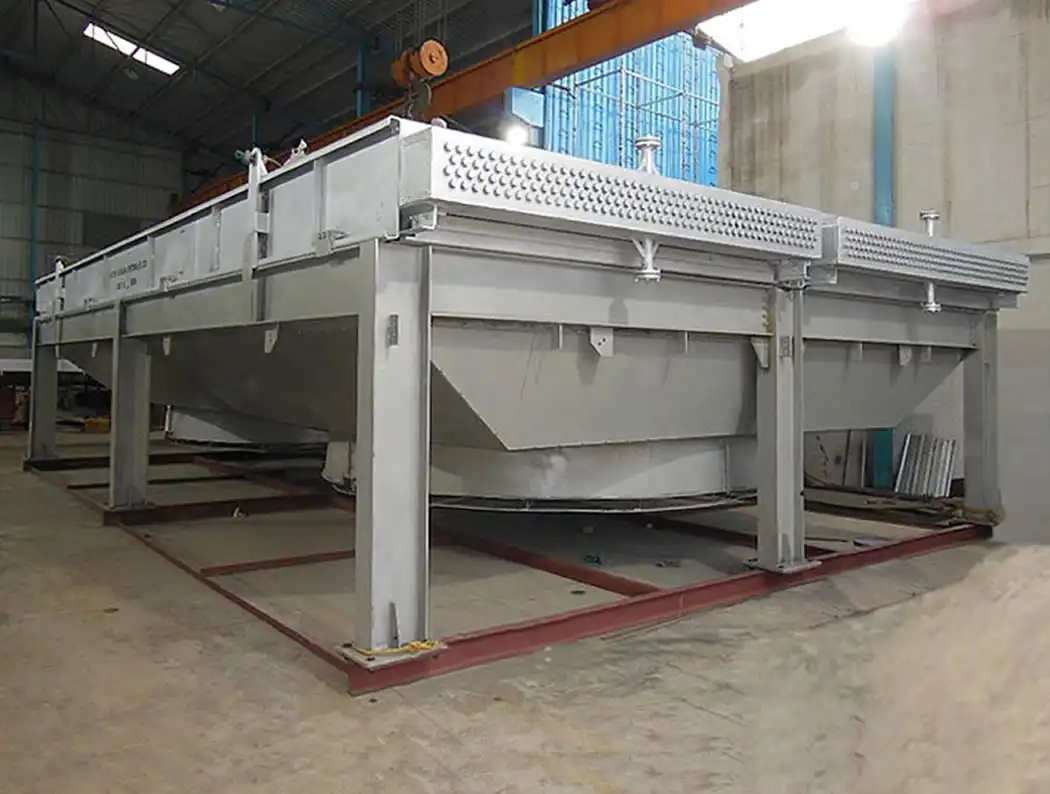
Air fin cooler -Types, Works, Uses
An Air Fin Cooler (also known as an Air-Cooled Heat Exchanger or Fin Fan Cooler) is an industrial device that cools hot process liquids or gases by forcing ambient air over a bundle of finned tubes. It is widely used when water is scarce or temperatures make water-based cooling impractical.How It Works
- The Process: Hot fluid flows through a matrix of tubes.
- Surface Extension: Metal fins (usually aluminum or steel) are attached to the outside of the tubes to drastically increase the surface area available for heat transfer.
- Airflow: Fans blow cooler atmospheric air across these finned tubes, absorbing heat from the process fluid and releasing it into the atmosphere.
Key Components
- Finned Tubes: Modular tube bundles, often crafted from stainless steel, carbon steel, or copper with aluminum fins.
- Fans: High-powered axial fans push (forced draft) or pull (induced draft) air through the unit.
- Header Box: Manifolds that direct the process fluid into and out of the tube bundles.
What is an Air Fin Cooler?
An air fin cooler is a highly efficient air-cooled heat exchanger used to remove heat from process fluids by utilising ambient air as the cooling medium. Instead of relying on water, an air fin cooler uses finned tubes and high-performance fans to increase the heat transfer surface area and enhance airflow. This design enables rapid and reliable cooling even in demanding industrial environments.At its core, an air fin cooler works by allowing hot process fluid to flow through finned tubes while atmospheric air passes over them. The fins significantly expand the contact surface, enabling greater heat dissipation in less time. Because of this efficient mechanism, air fin coolers are widely used in petrochemical plants, refineries, power generation units, gas compression stations, HVAC systems, and various manufacturing industries.
These coolers are constructed from durable materials like carbon steel, stainless steel, aluminium, or copper alloys, ensuring strong performance and long operational life. The engineering behind fin attachment—whether by extrusion, roll forming, or welding—demonstrates the precision and reliability required in modern heat transfer applications. Overall, air fin coolers serve as a dependable, low-maintenance, and environmentally friendly solution wherever effective air-based cooling is essential.
How does a air fin cooler work?
An air fin cooler operates on a straightforward yet highly efficient heat transfer mechanism that uses ambient air to cool hot process fluids. Instead of depending on water, the system uses finned tubes, powerful fans, and a well-engineered air flow pattern to achieve reliable and consistent cooling. This makes air fin coolers a preferred choice in refineries, petrochemical plants, gas processing units, and industrial facilities located in regions with limited water resources.Why Use Fins?
Because air is a relatively poor conductor of heat, it requires a much larger surface area to effectively cool a liquid or gas. The external metal fins attached to the tubes increase the surface area for heat exchange by 15 to 20 times, compensating for air's thermal inefficiency.The Step-by-Step Process
- Hot Fluid Circulation: Hot process fluid or gas enters the system and is distributed into the tube bundle.
- Forced Airflow: Large, motor-driven fans force or pull atmospheric air across the outside of the finned tubes.
- Heat Transfer: As the colder ambient air flows over the fins, thermal energy transfers directly from the hot fluid, through the tube wall, into the fins, and finally into the air stream.
- Exhaust and Return: The newly warmed air is safely vented into the atmosphere, while the cooled fluid continues through the system for its next cycle.
Key Fan Configurations
Forced Draft: Fans are placed below the tube bundles to push cold ambient air up and across the fins. This is generally more efficient for maintenance and fan longevity because the fans only handle cooler, ambient air.Induced Draft: Fans are placed above the tube bundles to pull ambient air upwards across the fins. This creates a more uniform airflow and better temperature distribution.
Components of Air Fin Coolers
An air fin cooler (Air-Cooled Heat Exchanger) cools process fluids by forcing ambient air across finned tubes. Its primary components include the tube bundle (where heat exchange occurs), the axial fans and drive systems (for airflow), header boxes (for fluid distribution), and structural framing.1. Tube Bundle (Core)
The bundle is the primary heat-transfer section, consisting of two main parts:- Finned Tubes: Hot process fluid flows through these. They are wrapped in thin metal fins (usually aluminum) to drastically increase the surface area, facilitating rapid heat dissipation into the surrounding air.
- Header Boxes: Located at the ends of the tubes, these chambers collect and distribute the fluid evenly across the tube bundle. They typically feature removable plugs or cover plates for easy cleaning and maintenance.
2. Air Moving Equipment
- Axial Fans: Large, adjustable-pitch fans (usually made of aluminum or fiberglass) that drive the air across the hot tubes. They are configured as either forced draft (pushing air from below) or induced draft (pulling air from above).
- Drive Assembly: Consists of an electric motor connected to the fan via a gearbox, drive shaft, or V-belts to control the fan speed and airflow.
- Fan Ring & Plenum: The housing that directs the air smoothly and prevents recirculation around the fan tips, optimizing aerodynamic efficiency.
3. Structural & Control Components
- Supporting Framework: A heavy-duty steel structure that elevates the tube bundle and houses the mechanical components.
- Louvers: Adjustable metal blades at the air inlet or outlet used to regulate airflow, control the cooling rate, and prevent process fluids from freezing during cold weather.
- Vibration Switches: Safety sensors mounted on the fan drive assembly to automatically trip and shut down the fan if excessive vibration or mechanical failure occurs.
- Bug Screens: Protective mesh screens placed at the air intake to prevent debris, insects, and leaves from entering and clogging the finned tube
Types of Air Fin Coolers
Air fin coolers come in a variety of designs, each tailored to meet specific cooling requirements, operating environments, and system configurations. They are typically classified based on draft type, tube arrangement, and fin construction. In addition, several specialized variants exist for demanding industrial applications. Understanding these types helps engineers and plant operators select the right cooler for performance, efficiency, and long-term reliability.1.By Draft Type
- Forced Draft Air Fin Cooler
In forced draft designs, fans are positioned below the tube bundle and push air upward through the finned tubes. This arrangement delivers strong airflow and is ideal for high-temperature or high-capacity operations. However, because the fans are exposed to hotter air, they may require more frequent maintenance. - Induced Draft Air Fin Cooler
Induced draft models have fans mounted above the tube bundle, pulling air through the fins and exhausting it. This setup provides more uniform airflow distribution, quieter operation, and better protection for the fins from environmental elements such as rain or debris. Though highly efficient, induced draft systems can involve higher installation costs due to additional ductwork. - Natural Draft Air Fin Coolers
Natural draft coolers rely solely on natural convection and do not require fans. They are typically used in large-scale facilities like power plants where passive airflow is sufficient. While low in energy consumption, they require significant vertical space.
2. By Tube Arrangement
- Horizontal Tube Arrangement
In this common layout, the tubes are aligned horizontally. This design simplifies maintenance, cleaning, and overall access to the tube bundle. It is widely used across refineries, chemical plants, and gas processing units. - Vertical Tube Arrangement
Here, the tubes are oriented vertically. This configuration is often selected for applications where space constraints or process flow patterns make vertical layouts more practical. It also allows for effective natural drainage and can reduce fouling in some services.
3. By Fin Construction
- Extruded Fins
Extruded fins are mechanically bonded or pressed onto the tubes, forming a strong, continuous contact surface. These fins offer exceptional thermal performance and durability, making them ideal for high-pressure and high-temperature applications. - Embedded Fins
Embedded fins are inserted into grooves cut into the tube wall and then mechanically locked in place. This design improves corrosion resistance and ensures a long-lasting bond, even under thermal cycling. - Other Fin Types (L-Fin, G-Fin, etc.)
Other fin styles—such as L-type and G-type—vary in manufacturing method and performance characteristics. Each type supports specific temperature, pressure, and corrosion conditions based on process requirements.
Other Common Types of Air Fin Coolers
- Axial Flow Air Fin Coolers- These coolers use an axial fan to move air in a straight path across the tube bundle. They are highly efficient and widely used, though they can produce higher noise levels.
- Plate Fin Coolers- Instead of tubes with fins, plate fin designs use stacked plates to increase surface area. These systems are compact and deliver excellent heat transfer, making them suitable for space-limited installations, though they typically cost more.
- Specialty Air Fin Coolers- Specialized units are engineered for unique industrial needs—for example, high-pressure coolers for petroleum refineries, compact skid-mounted coolers for offshore platforms, or custom modular units for limited space and mobility requirements
Applications of Air Fin Coolers
- Oil, Gas, and Petrochemical Plants: Cools crude oil, chemical streams, and natural gas. They are heavily utilized in refineries to maintain safe operating temperatures for equipment and high-pressure pipelines.
- Power Generation: Acts as air-cooled condensers to convert turbine exhaust steam back into water. They also regulate turbine lubricants and generator coolants.
- Industrial Machinery: Protects engines, compressors, and hydraulic systems from overheating by acting as jacket water coolers, intercoolers, and lube oil coolers.
- Chemical Processing: Manages and controls fluid temperatures within reactors and distillation columns.
- HVAC & Refrigeration: Essential for commercial chillers, large data center cooling units, and rooftop AC units.
- Heavy Manufacturing: Helps process industries—like steel, cement, and pulp/paper—cool heavy hydraulic fluids, lubricants, and process gases.
Advantages of Air Fin Cooler
Air fin coolers offer a host of benefits, making them a preferred choice for industries seeking efficient and sustainable cooling solutions. Their advantages span environmental, operational, cost, and performance aspects, providing significant value in industrial applications.- Zero Water Consumption: They eliminate the need for massive water supplies, cooling towers, and treatment chemicals, which is crucial for environmental sustainability and operations in water-scarce regions.
- Lower Maintenance: Unlike water-cooled systems, air fin coolers do not suffer from scaling, biological growth (algae), or chemical corrosion, significantly reducing cleaning and upkeep requirements.
- Lower Operating Costs: They entirely remove the need for water piping networks, water filtration systems, and large pumping stations, saving money on infrastructure and ongoing energy bills.
- Higher Environmental Safety: Because there is no water circuit, there is absolutely zero risk of process fluids leaking and contaminating water sources.
- Flexible Installation: They can be mounted almost anywhere, including on ground space or elevated pipe racks.
- Modular and Compact Design: The finned tubes provide a massive surface area, meaning the equipment takes up far less space than traditional bare-tube bundles.
Technical Specifications of Air Fin Coolers
The technical specifications of an air fin cooler can vary widely depending on industry requirements, process conditions, and cooling capacity. However, most systems follow standard engineering parameters to ensure safe, reliable, and efficient operation. These specifications typically cover heat transfer performance, operating limits, construction materials, fan and drive systems, and compliance with international design codes.General Specifications
- Heat Transfer Area: Generally ranges from 5 m² for compact units to over 500 m² for large industrial coolers.
- Flow Rate: Typically between 10 m³/h and 500+ m³/h per unit, with custom systems capable of handling higher flows.
- Operating Temperature Range: Most air fin coolers operate between 30°C and 350°C, depending on the materials and fin design.
- Pressure Tolerance: Designed to withstand 10 bar to over 80 bar, suitable for medium- and high-pressure applications.
- Dimensions: Small units may be around 1 meter in length, while large refinery-grade coolers can exceed 10 meters, depending on layout and duty requirements.
Design and Material Specifications
- Fin and Tube Construction:
- Fins: Typically produced using 99% pure aluminum, following standards such as ASTM SB-209 Alloy 1060 for optimum heat transfer efficiency.
- Bare Tubes: Common materials include carbon steel, stainless steel, copper, and alloy steels, chosen based on fluid characteristics and operating temperature.
- Fin Attachment Methods: Embedded, extruded, or welded fins are used depending on service conditions. Welded fins are preferred for temperatures above 400°C due to their superior bonding strength.
- Fan and Drive System:
- Fan Power: Ranges from 1 HP for small units to 100+ HP for large cooling systems.
- Draft Configuration: Available in forced draft or induced draft designs, with horizontal or vertical fan orientation.
- Drivers: Electric motors are most common, but steam or hydraulic turbines may be used in specialized plants.
- Design Codes & Standards:
Air fin coolers are commonly designed in accordance with global standards such as:
- API 661 – Air Fin Cooler in Refinery for General Services.
- ASME Section VIII – Rules for pressure vessel design and construction.
- Temperature Control Options:
To achieve precise control over cooling performance, the following features may be incorporated:
- Variable speed fans
- Variable pitch fan blades
- Adjustable louvers
- Air recirculation systems for cold climates
Documentation and Testing Requirements
- Material Certification: All raw materials, including tubes and fins, are supplied with mill test certificates (MTCs) verifying chemical composition and mechanical properties.
- Bonding Test: Embedded fin tubes undergo mechanical bond testing to ensure fin integrity.
- Hydrostatic Test: The complete assembly is pressure-tested to verify structural soundness and leakproof operation.
- Eddy Current Test: Tubes may undergo non-destructive eddy current testing to detect internal defects.
- Visual & Dimensional Inspection: All components are checked for compliance with design tolerances and surface quality.
- Manufacturer Guarantee: Reputed manufacturers provide warranties covering material quality, workmanship, and assembly, guaranteeing long-term reliability.
Selection Guidelines for Air Fin Cooler
Selecting the right industrial air fin cooler, also known as an air-cooled heat exchanger (ACHE), is critical for achieving optimal thermal performance, reliability, and cost efficiency. A careful evaluation of process requirements, mechanical design, and site conditions ensures the cooler meets both operational and environmental demands.- Process and Thermal Design Considerations
- Heat Duty and Fluid Properties: Determine the total heat to be removed and collect data on process fluid flow rate, inlet/outlet temperatures, density, viscosity, and thermal conductivity.
- Allowable Pressure Drop: Define the maximum permissible pressure drop for fluid flow, as it directly impacts pump power and heat transfer efficiency.
- Fouling Factors: Account for potential deposits inside tubes and on fins. High-fouling applications may require wider fin spacing or easier access for mechanical cleaning.
- Design Temperatures and Pressures: Ensure design margins exceed expected operating conditions, adhering to standards like API 661 for safety and reliability.
- Mechanical and Material Selection
- Material Compatibility: Choose tube, fin, and header materials based on fluid composition, operating temperature, and corrosion potential.
- Fin Type and Geometry: Select fin height, density, and type (extruded, embedded, or welded) to optimize heat transfer while managing fouling and pressure drop.
- Tube Diameter and Configuration: Standard tube sizes are typically 1 inch (25.4 mm) OD, often arranged in a staggered pitch to enhance airflow and heat exchange.
- Air fin cooler header box: Use plug headers for high-pressure/low-fouling applications and cover plate headers for low-pressure/high-fouling scenarios requiring frequent cleaning.
- Structural Integrity: Ensure the design accommodates mechanical stress, vibration, and includes platforms, ladders, and supports for safe operation and maintenance.
- Site and Environmental Factors
- Ambient Air Conditions: Consider local maximum temperatures, altitude, humidity, and wind exposure in the design.
- Draft Type:
Forced Draft: Fans below the tube bundle push air upward; easier maintenance and lower costs.
Induced Draft: Fans above the bundle pull air through; better air distribution, less recirculation, but harder fan access. - Winterization: In cold climates, include warm air recirculation or steam coils to prevent freezing or over-cooling of process fluid.
- Noise Considerations: Fan size, speed, and blade material (GRP or aluminum alloy) should be selected to manage operational noise levels.
- Commercial and Standards Considerations
- Design Codes: Adhere to standards such as API 661 and ASME Section VIII for design, fabrication, inspection, and testing.
- Total Evaluated Cost: Optimize design by considering initial equipment cost, shipping, erection, and long-term operating costs, rather than simply the lowest capital expenditure.
Installation Guidelines for Air Fin Cooler
Proper installation, operation, and maintenance of an air fin cooler are essential to ensure efficient cooling, safety, and long-term reliability. Following manufacturer instructions, industry standards such as API 661, and safety protocols will maximize performance and extend equipment life.- Installation Guidelines
- Location: Install the air fin cooler in an area with unobstructed access to fresh air, away from hot exhaust, dust, or corrosive vapors. Ensure enough space for maintenance, access platforms, and lifting equipment.
- Assembly: Only trained personnel should handle assembly using certified lifting tools. Align the unit precisely, tighten all bolts to the specified torque, and install fans, piping, and other components according to engineering drawings.
- Piping: Keep piping horizontal where possible, avoid fluid pockets, and ensure nozzle loads comply with vendor specifications to prevent stress and damage.
- Operational Guidelines
- Startup: Gradually introduce the process fluid to avoid thermal shock. Start fans carefully, taking into account fluid viscosity, and monitor for leaks, vibration, or unusual noise.
- Operation: Utilize fan controls to maintain target temperatures. In cold climates, consider steam coils or air recirculation to prevent freezing. Continuously monitor temperature, pressure, flow, and airflow for optimal performance.
- Safety: Follow safety protocols, wear appropriate PPE, and handle all fluids according to safety regulations.
- Maintenance Guidelines
- Regularly clean fins and surfaces to maintain heat transfer efficiency.
- Inspect fans, motors, and bearings for wear and lubricate moving parts as required.
- Check for leaks and ensure all connections remain secure to preserve operational reliability.
Common Issues & Solutions for Air Fin Cooler
Air fin coolers are reliable industrial heat exchangers, but like any equipment, they can experience issues that affect performance, safety, and longevity. Understanding common problems and their solutions ensures smooth operation and extends the life of the cooler.- Poor Cooling Performance or Reduced Airflow
- Cause: Fins, tubes, or filters clogged with dust, dirt, or mineral deposits; inadequate ventilation; for evaporative coolers, low water levels or pump issues.
- Solution: Clean fins, tubes, and filters thoroughly. Ensure proper ventilation around the unit. For evaporative systems, check water levels and verify pump operation.
- Excessive Vibration or Noise
- Cause: Unbalanced or damaged fan blades, loose fasteners, or worn motor bearings.
- Solution: Inspect fans and motors for damage or misalignment. Tighten all loose screws, bolts, and connections. Lubricate motor bearings if needed, but consult a professional for persistent vibration issues.
- Fluid Leaks
- Cause: Corrosion, cracks, or damage in tubes, headers, or seals.
- Solution: Identify and repair leaks immediately by tightening connections or replacing faulty seals. Regularly monitor pressure drop and inspect for corrosion or damage to prevent recurrence.
- Power Supply Issues
- Cause: Blown fuses, tripped circuit breakers, or damaged power cords.
- Solution: Replace blown fuses, reset circuit breakers, and inspect power cords for damage, replacing them if necessary.
- High Humidity Impact
- Cause: Air fin coolers may perform less efficiently in environments with high humidity.
- Solution: While this is an environmental factor, performance can be optimized by maintaining clean fins and tubes, ensuring proper airflow, and, if applicable, using cooler water in evaporative systems.
Future Trends of Air Fin Cooler
Modern air fin coolers, also known as air-cooled heat exchangers (ACHEs), are evolving rapidly to deliver higher efficiency, durability, and environmental performance. Innovations focus on smarter operations, advanced materials, hybrid cooling solutions, and energy-efficient technologies to meet the demands of modern industries.- Smart Monitoring and IoT Integration Sensors now monitor temperature, airflow, vibration, and pressure in real time. Predictive maintenance systems use this data to identify potential issues before failures occur. Remote monitoring and control allow operators to adjust fan speeds dynamically, improving efficiency while reducing energy consumption.
- Advanced Fin Design and Materials New fin designs, such as micro-channel, wavy, or serrated fins, enhance heat transfer performance. The use of durable alloys and specialized coatings increases resistance to corrosion and fouling, minimizing maintenance requirements and extending service life.
- Hybrid Cooling Systems In extremely hot environments, hybrid systems that combine air cooling with minimal water sprays are gaining popularity. This approach maintains high cooling performance while conserving water compared to traditional water-cooled solutions.
- Energy-Efficient Components Variable speed fans allow the system to match cooling output with real-time demand, reducing energy usage. Aerodynamically optimized fan blades enhance airflow, lower power consumption, and minimize noise levels, contributing to more sustainable operations.
- Sustainable Integration Air fin coolers are increasingly integrated with renewable energy solutions and water-saving strategies. These upgrades support environmental goals and help industries comply with sustainability regulations while maintaining reliable thermal management.
Conclusion
Air fin coolers are a vital component in modern industrial heat management, offering efficient, reliable, and environmentally friendly cooling solutions across diverse sectors such as petrochemical, power generation, and HVAC systems. With advanced designs, durable materials, and innovative features like smart monitoring, hybrid cooling, and energy-efficient fans, these coolers deliver superior performance while reducing water usage and operational costs.Proper selection, installation, operation, and maintenance are crucial to maximizing their efficiency and longevity. By understanding their components, working principle, types, technical specifications, and advantages, industries can optimize heat transfer, minimize downtime, and achieve long-term cost savings.
As technology continues to evolve, future trends in air fin coolers—including IoT integration, advanced fin designs, and sustainable solutions—will further enhance efficiency, durability, and environmental performance. In summary, investing in a high-quality air fin cooler ensures reliable thermal management, operational safety, and a sustainable approach to industrial cooling
Frequently Asked Questions (FAQs) About Air Coolers
1. Which is the no. 1 brand in air coolers?The leading brand for industrial air coolers in India is United Cooling Systems Pvt. Ltd., known for high-quality, efficient, and durable cooling solutions.
2. How does a air fin cooler work?
A air fin cooler works by passing hot fluid through finned tubes while air is blown across the fins by axial fans. Heat transfers from the fluid to the fins and then to the air, efficiently cooling the process fluid without using water.
3. Which type of air cooler is best?
The best type depends on your application:
- Forced Draft: Fans below the bundle push air; cost-effective and easy to maintain.
- Induced Draft: Fans above the bundle pull air; better air distribution, less recirculation, and protection from environmental elements.
- Hybrid/Axial Flow: Ideal for high-temperature fluids, limited space, or high-efficiency requirements.
Air coolers are designed for industrial or large-scale process cooling, handling high temperatures and large fluid volumes. AC units are meant for human comfort in smaller spaces and are not suitable for industrial fluid cooling.
5. Which brand is the best cooler?
For industrial applications, United Cooling Systems Pvt. Ltd. is the recommended choice due to its reliable performance, high efficiency, and durable construction.
6. What is the best cheapest cooler?
United Cooling Systems offers cost-effective models that provide reliable cooling for industrial applications while maintaining efficiency and low operating costs. Selecting a model depends on the process requirements and available space.
7. Which company is better for coolers?
For industrial air coolers, United Cooling Systems Pvt. Ltd. is considered a top choice due to its experience, product quality, and customer support.
8. How to choose a good cooler?
When selecting an air cooler, consider:
- Cooling capacity and heat duty required
- Type of draft (forced or induced)
- Material and corrosion resistance
- Energy efficiency and maintenance requirements
- Brand reliability—United Cooling Systems provides proven solutions for industrial cooling needs.

