


What Is an Air Blast oil Cooler?
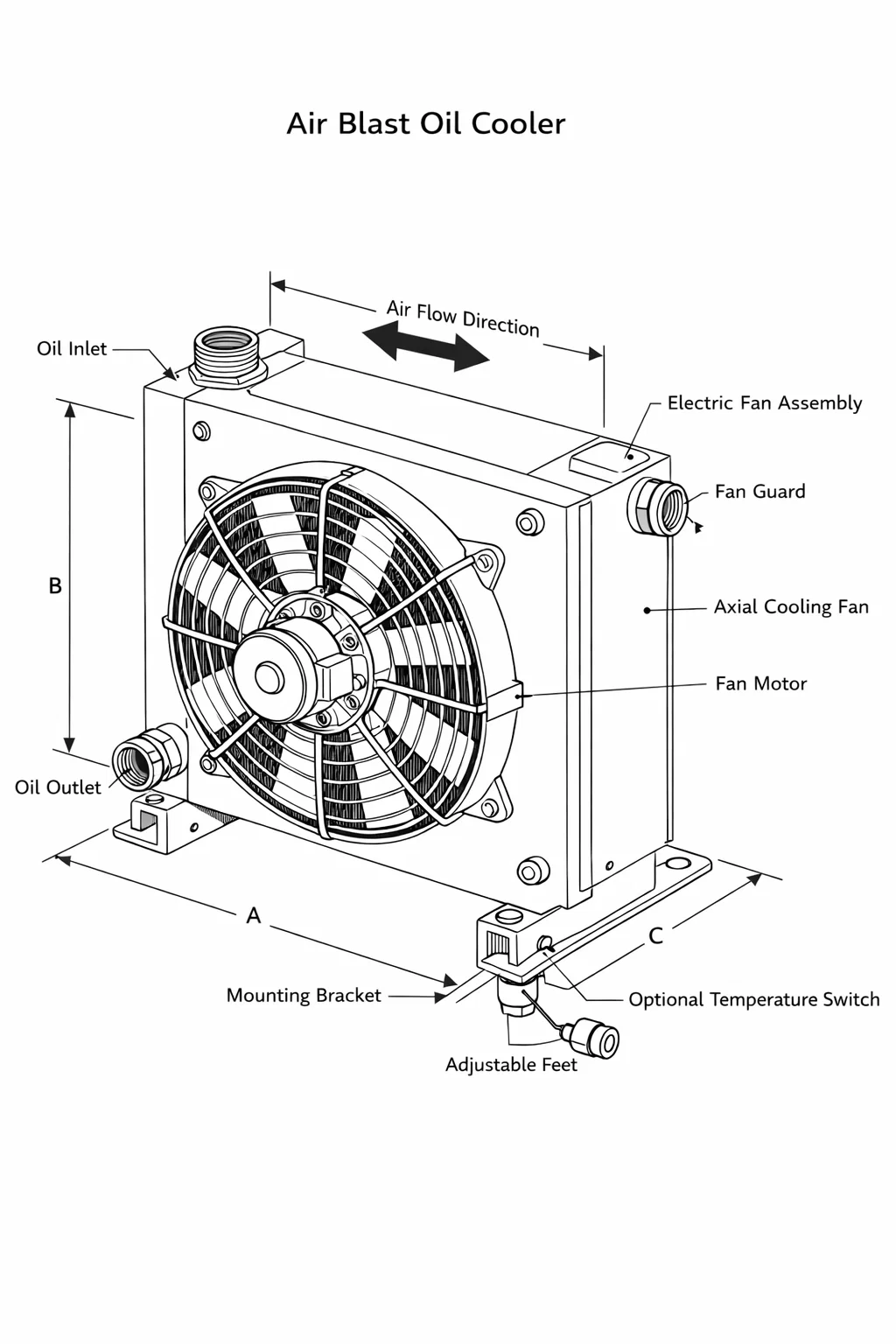
An air blast oil cooler is a heat exchanger that cools industrial or automotive fluids (such as hydraulic, lubricating, or cutting oil) by blowing ambient air over a finned core. It is highly efficient for heavy-duty applications, particularly where water is scarce, expensive, or prone to freezing.Depending on the cooling capacity, materials, and design, prices typically start at around ₹5,000 for smaller units and can exceed ₹20,000 for heavy-duty industrial models.
How to Select the Right Air Blast Oil Cooler
Choosing the correct air blast oil cooler requires evaluating your system's operating conditions to ensure efficient cooling performance. Before selecting a model, consider the following factors:
- Oil Flow Rate: Measure the oil flow in liters per minute (LPM).
- Oil Reservoir Capacity: Determine the total volume of oil in the hydraulic or lubrication system.
- Operating Temperature: Identify both the maximum oil temperature and the desired operating temperature.
- Power Supply: Select the appropriate fan motor based on your available power source, such as 230V single-phase or 415V three-phase.
Air blast oil cooler manufacturers
Popular Ready-to-Order Air Blast Oil Coolers If you are looking to purchase standard units immediately, several verified options are available at United cooling systems:100 Lpm Hydraulic Oil Air Cooler - Voltage: 415V Volt (V):
- Application & Build: Floor-mounted aluminum fin-and-tube core explicitly configured for medium-duty mining applications.
- Performance: Rated for handling up to 100 LPM oil flow and temperatures up to 120°C.
- Application & Build: Robust horizontal base-mounted unit optimized for heavy-duty ISO VG 46/68 industrial oils.
- Performance: Operates safely at a maximum structural pressure of up to 16 bar.
- Application & Build: Lightweight, high-strength aluminum layout integrated with a 24V DC motor drive.
- Performance: Combines 10 HP power with a 305mm fan assembly to manage flow distributions between 20 to 100 LPM.
How to Select the Right Air Blast Oil Cooler
Selecting the right air blast oil cooler requires evaluating your system's specific heat dissipation, oil flow rate, operating temperature, and ambient conditions. Proper sizing prevents viscosity breakdown, extends equipment life, and ensures optimal thermal efficiency.Key Sizing and Selection Criteria
To correctly select and size an air blast oil cooler, you must calculate and define the following variables:- Heat Load (kW or kcal/hr): The amount of thermal energy your system generates that needs to be removed to keep the oil at a safe operating temperature.
- Oil Flow Rate (LPM or GPM): The volume of oil circulating through your system per minute. Maximum Oil Temperature vs. Target: The highest running temperature of the oil versus your ideal target temperature (typically between 50°C to 80°C).
- Maximum Ambient Temperature: The highest expected air temperature in your local operating environment (this dictates the cooling delta).Operating Pressure: Ensure the selected cooler’s core and fittings are rated for your system's maximum pressure.
- Power Supply: Determine if your fan motor will run on 230V single-phase or 415V three-phase.
Core Materials and Fin Design
The durability and thermal conductivity of your cooler depend heavily on its build.- Materials: Copper and aluminum offer the best thermal conductivity. For harsh or dusty environments, specialized rugged fins or protective anti-corrosion coatings are strongly recommended.
- Layout: Axial fans are common for large airflow volumes, while centrifugal fans work best for tight spaces or systems that require high static pressure.
System Integration
Always review your hydraulic or engine system's space constraints before purchasing. Air blast coolers should ideally be mounted in a location with access to fresh, unrestricted ambient air. Avoid mounting locations where the cooler will ingest pre-heated air from other engine components or radiatorsProduct Details
| Parameter | Details |
|---|---|
| Model Name/Number | Custom /Client-Specified Model - varies by heat duty & size |
| Product Type | Air Blast Oil Cooler |
| Usage / Application | Cooling hydraulic oil, engine oil, compressor oil, and Industrial process. |
| Cooling type | Air cooled with forced airflow |
| Material of Construction | Galvanized steel / stainless steel frame; Aluminum / copper fin tubes |
| Pressure & Fan Drive | based on client requirements; Electric or hydraulic fan options |
| Brand | United Cooling Systems Pvt. Ltd. |
| Condition | New |
| stock | In stock |
Technical Specifications
| Parameter | Specification |
|---|---|
| Cooling Type | Air Cooled (Air Blast) |
| Oil Flow Rate | 20 – 500 LPM |
| Heat Dissipation Capacity | Up to 500 kW |
| Working Pressure | Up to 25 bar |
| Inlet Oil Temperature | Max. 120°C |
| Ambient Temperature | Up to 55°C |
| Fan Type | Axial Flow Fan |
| Power Supply | 415V / 3 Phase / 50 Hz |
| Construction Material | Carbon Steel / Aluminium |
| Mounting | Horizontal / Vertical |
Note: Specifications may vary based on application requirements and custom design.
Air Oil Cooler Construction and Design Features
Modern air blast lube oil cooler combine rugged construction with high thermal efficiency:- Finned tubes (aluminium, copper, or steel) for maximum heat transfer.
- Axial or forced-draft fans with low noise options.
- Heavy-duty frames in galvanized steel, aluminium, or stainless steel.
- Compact layouts such as flat-bed or V-type designs.
- Optional air blast air cooler spare parts availability for easy maintenance.
Operating Parameters of Air Blast Oil Coolers
An Air Cooled Oil Cooler is designed to remove heat from hydraulic and lubricating oil using forced ambient air. The following operating parameters define its performance and working conditions:- Heat Dissipation Capacity
- Typically ranges from 5 kW to 500 kW
- Depends on oil flow rate and temperature difference
- Oil Flow Rate
- Generally between 10 LPM to 500 LPM
- Higher flow rates require larger cooling surface area
- Oil Inlet Temperature
- Usually up to 120°C
- Designed to handle high-temperature hydraulic and lubrication systems
- Oil Outlet Temperature
- Controlled based on system requirement
- Typically reduced by 10°C to 30°C
- Working Pressure
- Standard design pressure: 10–25 bar
- Higher pressure designs available on request
- Air Flow Rate
- Depends on fan size and motor capacity
- Typically ranges from 1,000 to 20,000 m³/hr
- Ambient Temperature
- Designed for operation in ambient temperatures up to 50°C
- Power Supply
- Motor ratings vary from 0.25 HP to 10 HP
Types of Air Cooled Oil Coolers
Air Blast Oil Cooler
Used for cooling lubricating oil, gearbox oil, and compressor oil in industrial machinery.Hydraulic Oil Cooler / Hydraulic Air Cooler
Specifically designed for hydraulic systems, presses, power packs, and mobile equipment where oil temperature control is critical.Air Blast Coolers Transformer
Used in power transformers to maintain oil temperature, ensuring reliable operation and longer transformer life.Air Chillers (Above-Ambient Cooling)
Air blast coolers can act as air chillers for processes that only need cooling above ambient temperature without refrigeration.Air Blast Freezer (Special Applications)
In certain industrial or food handling applications, blast-type air cooling systems are adapted for rapid heat removal, often referred to as air blast freezer systems.Application Industries of air blast coolers
Air blast coolers are used across many industries:- Hydraulic power packs and presses.
- Oil & gas plants.
- Power generation and transformer cooling.
- Chemical and petrochemical industries.
- CNC machines and machine tools.
- Construction and mining equipment.
- Food processing and packaging lines.
- HVAC and industrial air cooler systems.
Oil Cooler Benefits
- Water-Free Cooling
No cooling towers, no makeup water, and no chemical treatment required. - Low Maintenance
Simple construction with fewer components reduces downtime and service costs. - Energy Efficient
Optimized fan design and fin geometry improve heat transfer while keeping power consumption low. - Environment Friendly
No water discharge, no chemicals, and no refrigerants. - Flexible Installation
Available in horizontal, vertical, or packaged skid-mounted designs.
Air Blast Cooler Spare Parts and Maintenance
Reliable performance depends on quality air blast air cooler spare parts, such as:- Fans and fan motors
- Finned tube bundles.
- Headers and seals.
- Temperature sensors and controls.
Why Choose the Right Air Blast Coolers Manufacturer
When selecting air blast cooler manufacturers, consider:- Experience in industrial heat exchangers
- Custom design capability
- Material and fan quality
- Noise control options
- After-sales service and spare parts support
Air Blast Coolers vs Water-Cooled Systems
| Feature | Air Blast Cooler | Water-Cooled System |
|---|---|---|
| Cooling Medium | Air | Water |
| Water Requirement | None | High |
| Maintenance | Low | High |
| Operating Cost | Low | Moderate to High |
| Environmental Impact | Minimal | Water discharge & chemicals |

