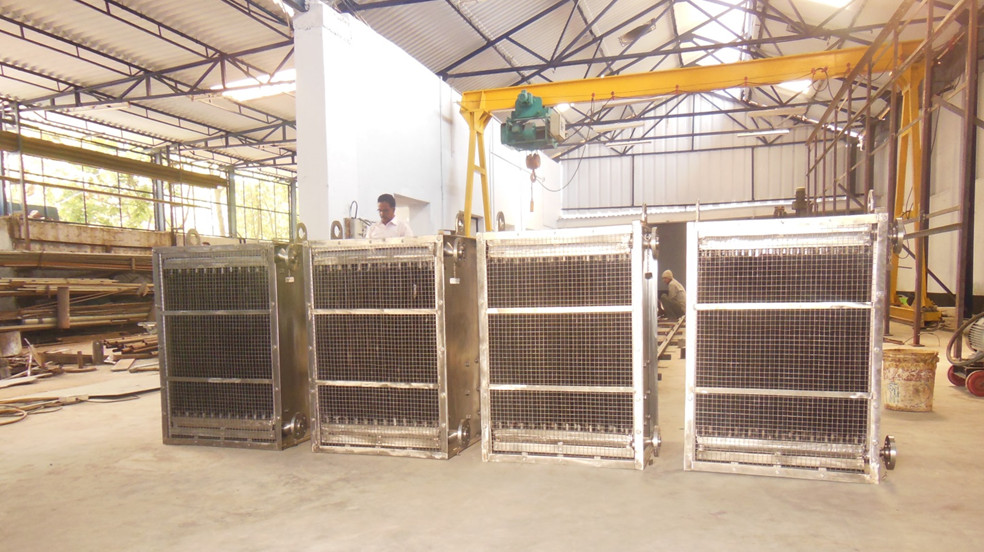
What Is an Oil Cooler?
An oil cooler is a small secondary radiator that removes extra heat from engine or transmission oil. Just like a radiator cools engine coolant, an oil cooler cools oil using either passing air or a secondary liquid to pull heat away from it.It is a heat exchanger that removes excess thermal energy from oil before it recirculates through an engine, transmission, differential, power steering system, or hydraulic circuit..
Oil performs several jobs at once, and heat threatens all of them:
- Lubrication — creating a thin film between moving metal surfaces to prevent metal-to-metal contact
- Cooling — oil itself absorbs and carries heat away from pistons, bearings, and gears (especially in air-cooled engines, where oil does much of the cooling work coolant would normally do)
- Sealing — helping piston rings maintain compression
- Cleaning — suspending contaminants and carrying them to the filter
- Cushioning — dampening shock loads between gears and bearings (particularly in transmissions and differentials)
Every one of these functions depends on the oil staying within its designed viscosity range. Heat is the primary enemy of that range, which is exactly why oil coolers exist.
Why Oil Temperature Matters (The Physics)
Oil viscosity is temperature-dependent — this is described by the oil's viscosity index (VI). As oil heats up, its molecules move faster and the fluid thins out. A thinner-than-designed oil film can rupture under load, allowing metal-to-metal contact.
Oil that runs too hot:
- Loses viscosity and film strength — the protective layer between bearings, cam lobes, and cylinder walls thins and can shear apart under load
- Oxidizes faster — heat accelerates the chemical breakdown of base oil and additive packages (detergents, anti-wear agents like ZDDP, viscosity modifiers), forming varnish and sludge
- Loses additive effectiveness — anti-wear and anti-foam additives degrade faster at sustained high temperatures
- Increases friction and wear — thinner oil films mean more direct contact and accelerated component wear
- Raises the risk of vapor lock or foaming — extreme heat can cause localized boiling or aeration, momentarily starving components of lubrication
- Shortens service life — oil that runs hot needs to be changed more frequently regardless of mileage
General safe operating ranges (these vary by oil type and manufacturer spec, so always defer to your owner's manual):
| System |
Normal Operating Range |
Concern Zone |
Danger Zone |
| Engine oil (conventional/synthetic) |
180–220°F (82–104°C) |
220–250°F (104–121°C) |
250°F+ (121°C+) |
| Automatic transmission fluid |
175–200°F (79–93°C) |
200–240°F (93–116°C) |
240°F+ (116°C+) — fluid life roughly halves for every 20°F above this |
| Air-cooled motorcycle engine oil |
200–230°F (93–110°C) |
230–260°F (110–127°C) |
260°F+ (127°C+) |
| Hydraulic fluid (industrial) |
120–140°F (49–60°C) |
140–180°F (60–82°C) |
180°F+ (82°C+) |
How Does an Oil Cooler Work? (Step-by-Step Mechanics)
- Diversion: Hot oil is diverted from the main circuit usually right after the oil pump or oil filter — through an adapter plate, remote fitting, or dedicated port.
- Transport: The oil travels through hoses or hard lines to the cooler core. Line diameter, length, and fitting size all affect flow rate and pressure drop.
- Heat exchange: Inside the core, oil is spread across a large internal surface area of tubes, fins, or stacked plates which maximizes contact between the hot oil and the cooling medium (air or liquid coolant). Heat naturally moves from the hotter oil to the cooler medium via conduction (through the core's metal walls) and convection (as air or coolant carries the absorbed heat away).
- Return: Cooled oil exits the core and returns to the main circuit engine, transmission pan, or hydraulic reservoir to continue lubricating.
- Continuous cycle: This process repeats continuously while the system runs, lowering the average operating temperature rather than eliminating heat instantly. This is why cooler sizing and airflow matter more than peak "cooling power" claims.
Key Engineering Factors That Determine Effectiveness
- Core surface area — more surface area exposed to airflow or coolant = more heat transfer
- Material thermal conductivity — aluminum (~205 W/m·K) and copper (~385 W/m·K) both transfer heat well; aluminum is lighter and more corrosion-resistant, copper transfers heat slightly faster but is heavier and costlier
- Airflow velocity and consistency (for air-cooled units) — turbulent or blocked airflow drastically reduces real-world performance versus lab ratings
- Oil flow rate and dwell time — oil needs enough time inside the core to shed heat, but not so much restriction that it starves the pump or filter
- Delta-T (temperature differential) — the bigger the gap between oil temperature and ambient air/coolant temperature, the faster heat transfers; this is why coolers are less effective in already-hot climates or engine bays
Types of Oil Coolers (In Depth)
1. Air-Cooled (Air-to-Oil) Coolers
The most common type for cars, trucks, and motorcycles. Oil flows through an external core mounted in the airflow path (usually in front of or near the radiator), and moving air pulls heat out of the oil as it passes through the fins.
- Pros: Simple, affordable, no extra coolant loop, no risk of oil/coolant cross-contamination, easy to mount
- Cons: Effectiveness depends heavily on airflow — much less effective at idle, low speed, or in stop-and-go traffic unless paired with an electric fan
- Typical use: Daily drivers, towing rigs, motorcycles, light performance builds
2. Liquid-Cooled (Oil-to-Water) Coolers
These use engine coolant instead of air to remove heat from oil, typically through a heat exchanger built into or near the oil filter housing (sometimes integrated into the engine block itself as a factory unit).
- Pros: Consistent cooling regardless of vehicle speed, faster oil warm-up in cold weather (heat can transfer both directions — coolant warms oil at cold start, then cools it once coolant is at operating temp), compact packaging
- Cons: Adds a connection point to the pressurized cooling system; internal gasket failure can let oil and coolant mix, which is a serious and expensive failure mode
- Typical use: OEM factory setups, engine bays with limited space for a separate air-cooled core
3. Tube-and-Fin Coolers
Oil travels through vertical tubes surrounded by cooling fins. Tubular aluminum cores remain a reliable choice for street and dual-purpose use because they combine solid heat transfer efficiency with forgiving airflow requirements — their vertical tube design allows oil to travel a longer internal path, increasing dwell time and thermal exchange even at lower air velocities. This makes them more tolerant of imperfect, turbulent underhood airflow than some flatter core designs.
- Best for: Daily drivers, towing setups, general street use, motorcycles
4. Plate-and-Fin / Stacked-Plate Coolers
Oil flows through thin, stacked plates with fins between them, maximizing surface area in a compact footprint. Stacked-plate units post impressive lab numbers, but their real-world effectiveness depends heavily on consistent, laminar (smooth, non-turbulent) airflow, something few street vehicles reliably deliver because of bumper cutouts, shroud gaps, and turbulent underhood conditions.
- Best for: Racing, track builds, and applications with clean, direct, high-speed airflow
5. Remote-Mount Coolers
Mounted away from the engine often in the front bumper opening or fender and connected via hoses or hard lines. Common for larger-capacity setups where space near the engine is tight.
- Pros: Flexible mounting location, can be sized larger without engine-bay space constraints
- Cons: Longer line runs mean more potential leak points and slightly slower oil warm-up
6. Sandwich-Plate (Thermostatic) Coolers
Mount between the oil filter and the engine block. A built-in thermostatic valve only routes oil through the external cooler once oil reaches a set temperature (commonly around 180–195°F), bypassing the cooler entirely during cold starts to protect oil pressure and speed up warm-up.
- Pros: Protects cold-start oil pressure, prevents over-cooling in mild weather, simple installation point
- Cons: Slightly more complex internally; valve can fail open or stuck closed over time
7. Transmission Oil Coolers
A dedicated cooler for automatic or manual transmission fluid, typically installed in front of or alongside the radiator, or as a stand-alone remote unit. Especially important for towing, heavy hauling, or performance transmissions, since transmission fluid breaks down even faster than engine oil under sustained heat fluid life can drop by roughly half for every 20°F (11°C) sustained increase above normal operating temperature.
- Sub-types: Tube-and-fin, plate-and-fin, and stacked-plate same core technology as engine oil coolers, just sized and plumbed for the transmission cooler lines
- Fan-assisted transmission coolers are common because transmissions generate significant heat even at low speed (e.g., towing uphill in stop-and-go traffic)
8. Hydraulic Oil Coolers
Used in industrial and heavy equipment forklifts, excavators, injection molding machines, hydraulic presses to cool hydraulic fluid, which is critical for keeping seals, pumps, valves, and actuators operating within spec. Industrial hydraulic coolers are often rated by BTU/hr or kW cooling capacity and sized specifically to the system's fluid flow rate (GPM/LPM) and duty cycle, rather than by vehicle fitment.
- Sub-types: Air-blast (fan-driven), water-cooled shell-and-tube, and combination units for continuous-duty industrial machinery
9. Power Steering Coolers
A smaller, specialized oil cooler for power steering fluid common on vehicles used for towing, off-roading, or with upgraded steering pumps, since overheated power steering fluid can cause pump whine, seal failure, and reduced steering assist.
Anatomy of an Oil Cooler (What's Actually Inside)
- Core — the finned or plated heat-exchange section where oil actually loses heat
- End tanks/headers — the inlet and outlet chambers that distribute oil evenly across the core
- Fittings — connection points for hoses or hard lines; common sizes include -6AN, -8AN, -10AN for performance applications, and push-on/barb fittings for OEM-style setups
- Mounting brackets — secure the cooler against vibration and road shock
- Thermostatic bypass valve (sandwich-plate units only) — regulates when oil is routed through the external core
- Fan (optional) — an electric fan forces airflow through the core at low speed or idle, often controlled by a temperature switch or manual override
Signs Your Oil Cooler Is Failing
Watch for these symptoms, which can point to a clogged, leaking, or failing oil cooler:
- Rising oil temperature gauge or dashboard warning light, especially under load
- Visible oil leaks near the cooler core, hoses, fittings, or sandwich plate
- Milky, frothy, or discolored oil (a strong sign coolant is mixing with oil in a liquid-cooled unit — sometimes called a "milkshake" on the dipstick)
- Coolant loss with no visible external leak (oil may be entering the cooling system through a failed internal gasket)
- Low oil pressure, especially at idle, caused by a clogged or internally collapsed cooler core
- Overheating engine or transmission, particularly during towing, hot weather, or extended highway driving
- Burning oil smell, which can indicate a leak dripping onto hot exhaust or engine components
- Transmission shifting erratically or harshly a symptom specific to overheated or contaminated transmission fluid from a failing transmission cooler
If you notice any of these especially oil-in-coolant or coolant-in-oil contamination, get it inspected quickly. A failed oil cooler can cause serious, expensive engine or transmission damage if ignored, sometimes within just a few miles of driving.
Do You Actually Need an Oil Cooler?
An aftermarket oil cooler is most valuable if you:
- Tow trailers, boats, or heavy loads regularly
- Drive in hot climates or frequently sit in stop-and-go traffic
- Track your car, race, or drive aggressively, generating sustained high RPM and heat
- Run a turbocharged or supercharged engine, which typically produces more underhood heat
- Ride a motorcycle, especially air-cooled V-twins that rely heavily on oil for cooling since they lack a coolant jacket
- Operate off-road or overlanding vehicles under sustained low-speed, high-load conditions where airflow is limited
- Have modified your engine for more power (forced induction, higher compression, aggressive tuning) without upgrading the factory cooling system
- Run heavy-duty or continuous-cycle hydraulic equipment, where fluid temperature directly affects seal and component life
If your vehicle is stock, mostly used for commuting, and never shows elevated oil temps on a gauge or scan tool, a factory cooling setup is usually sufficient and an aftermarket cooler may be unnecessary added complexity.
Oil Cooler vs. Radiator: What's the Difference?
| Feature |
Oil Cooler |
Radiator |
| Cools |
Engine, transmission, or hydraulic oil |
Engine coolant/antifreeze |
| Location |
Often in front of or near the radiator, or remote-mounted |
Front of the engine bay |
| Primary job |
Protects oil viscosity, film strength, and additive life |
Prevents the engine block/heads from overheating |
| Typical capacity |
Smaller core, lower fluid volume |
Larger core, higher fluid volume |
| Failure risk |
Oil leaks, restricted oil flow, internal coolant cross-contamination |
Coolant leaks, engine overheating, head gasket failure from over-temperature |
They work as a team coolant keeps the engine block and heads at a safe temperature, while the oil cooler keeps the oil itself from overheating and breaking down, since coolant alone doesn't fully manage oil temperature under sustained heavy load (especially in the oil pan, valve train, and turbocharger, where coolant doesn't directly circulate).
How to Size an Oil Cooler
Sizing is where most buyers go wrong; bigger isn't automatically better.
- Establish a baseline. Log oil temperature at sustained full load: steady 65–75 mph towing uphill, a hard track session, or extended low-speed off-road use. A cheap OBD scan tool or an in-line temp gauge/sensor works well for this.
- Compare against your target range. If temps stay under roughly 220–230°F even at full load, you likely don't need a cooler at all or a small one is plenty.
- Estimate the heat load. Higher horsepower, forced induction, high ambient temperatures, and heavy towing all increase the BTU/hr of heat the oil needs to shed. Manufacturers often publish cooler capacity in BTU/hr or by "cooling capacity per horsepower" as a rough street-use rule of thumb, many tuners size coolers around 1 row of core per roughly 100 horsepower for air-cooled tube-and-fin units, though this varies significantly by core design and airflow.
- Check available space and airflow path. A cooler that's too large for its mounting location can block radiator airflow, causing the engine to overheat even as oil temps improve a net loss.
- Don't over-cool. Oversized coolers, especially non-thermostatic ones, can keep oil too cold in mild weather or short trips, preventing it from reaching full operating temperature and allowing moisture and combustion byproducts to accumulate instead of burning off. A thermostatic (sandwich-plate) design largely solves this.
How to Choose the Right Oil Cooler (Buying Guide)
If you're shopping for an oil cooler, here's what actually matters, not marketing claims.
1. Know Your Actual Oil Temperature First
Before buying anything, log your oil temperature at full operating load. If temperatures consistently exceed roughly 230°F, you need real cooling capacity, not just "a bigger cooler."
2. Match Core Type to Your Use Case
- Daily driving / towing: Tube-and-fin, air-cooled, ideally thermostatic
- Track / racing with clean airflow: Stacked-plate or plate-and-fin
- Cold climates or inconsistent airflow: Liquid-cooled or thermostatic sandwich-plate
- Heavy equipment / industrial: Purpose-built hydraulic oil coolers sized to system GPM and duty cycle
3. Check Fitment and Mounting Space
Confirm the cooler physically fits your vehicle's front-end space, bumper opening, or engine bay before buying. Oversized coolers that block airflow to the radiator can cause coolant overheating a common and avoidable mistake.
4. Full-Flow vs. Bypass (Partial-Flow) Systems
- Full-flow kits route all oil through the cooler and filter effectively, but require careful balancing, since excess restriction can strain the oil filter and pump.
- Bypass/partial-flow systems only divert a portion of the oil, offering meaningful protection with lower risk of restriction, often a safer choice for DIY installs.
5. Fitting Type
- Push-on fittings are more universal and easier for DIY installs, using barbed connectors and clamps.
- AN fittings (Army-Navy spec, e.g., -6AN, -8AN, -10AN) are the performance-world standard, offering a more secure, leak-resistant, reusable connection but typically requiring adapters and specific tools to assemble correctly.
6. Material
- Aluminum cores are lightweight, corrosion-resistant, and now the industry standard for most street and performance applications.
- Copper/brass cores offer slightly better raw thermal conductivity but are heavier, costlier, and less common in modern kits.
7. Fan-Assisted vs. Passive
A fan-equipped cooler maintains airflow even at idle or low speed — important for stop-and-go traffic, towing, or motorcycles that don't get consistent ram-air at low speeds. Look for a thermostatically controlled fan switch rather than a constantly-on fan, to avoid unnecessary electrical load and over-cooling.
8. Reputable Brands to Know
Depending on your application, commonly recommended brands include:
- Mishimoto — performance-oriented street and track coolers with strong warranty support
- Derale — wide range for street use and racing, known for reliability and broad vehicle coverage
- Setrab — premium performance and industrial-grade coolers, popular for high-performance and motorsport builds
- Hayden Automotive — affordable, widely compatible street options, often OEM-replacement grade
- Mahle, AKG — OEM and industrial heat-exchanger manufacturers supplying factory and heavy-duty applications
- Tru-Cool — well regarded specifically for transmission cooler applications, particularly towing setups
- Jagg — a commonly recommended name for motorcycle oil coolers, particularly air-cooled V-twins like Harley-Davidson Twin Cam and Milwaukee-Eight engines
- Spal Automotive — known for cooling fans and hydraulic/industrial oil cooler assemblies
Always check specific reviews and compatibility for your exact make, model, and use case before purchasing thermal performance can vary significantly between real-world conditions and manufacturer lab specs.
9. Warranty and Support
Established brands typically offer 1–3 year warranties on cores and fittings. For track or heavy commercial use, check whether the warranty covers performance applications specifically, since some warranties exclude racing use.
Installation: Step-by-Step Detail
- Choose a mounting location with adequate, unobstructed airflow (for air-cooled units) or proximity to the coolant circuit (for liquid-cooled units). Avoid mounting directly against the radiator core without spacers, which can restrict radiator airflow.
- Tap into the oil circuit — usually via a sandwich adapter plate installed between the oil filter and engine block, or dedicated ports on the transmission pan/cooler lines, or a T-fitting on hydraulic return lines.
- Route and secure oil lines/hoses from the source to the cooler and back, using the correct fittings (AN or push-on). Keep lines away from exhaust components, sharp edges, and moving parts; use heat-shielding sleeves near exhaust routing.
- Mount the cooler securely using brackets rated for vibration and road shock — a cooler that flexes or vibrates excessively will eventually crack fittings or the core itself.
- Wire the fan (if equipped), typically through a relay and a temperature-activated switch, fused appropriately to protect the vehicle's electrical system.
- Refill oil to the correct level, accounting for the additional oil volume now held in the cooler and lines (often an extra 0.5–1.5 quarts depending on cooler size).
- Start the engine and check for leaks at every fitting under both idle and revved conditions.
- Bleed air from the system if required (more relevant for liquid-cooled and hydraulic setups) and recheck oil level after the first few minutes of running, since lines and the cooler core need to fill completely.
- Road test and monitor oil temperature and pressure gauges over the following days to confirm the system is working and there are no slow leaks.
Installation complexity varies a lot by vehicle and cooler type. Simple sandwich-plate kits are often DIY-friendly in an afternoon, while remote-mount, full-flow, or transmission cooler installs may be better left to a mechanic, especially if custom line routing, bumper modification, or fabrication is required.
Troubleshooting Common Oil Cooler Problems
| Symptom |
Likely Cause |
What to Check |
| Oil temp still high after install |
Restricted airflow, undersized core, thermostat stuck bypassing |
Confirm mounting position isn't blocked; verify thermostatic valve operation |
| Leak at fittings |
Under-torqued connection, wrong fitting type, worn washer/O-ring |
Re-torque to spec, replace crush washers/O-rings, confirm thread compatibility |
| Milky oil on dipstick |
Internal gasket failure in liquid-cooled unit |
Replace cooler/gasket immediately; flush oil and coolant systems |
| Low oil pressure after install |
Line restriction, wrong fitting size, air trapped in lines |
Check line diameter matches spec; bleed system; inspect for kinks |
| Oil temp too low / long warm-up |
Oversized cooler, no thermostatic bypass |
Add or replace with a thermostatic sandwich-plate unit |
| Fan not engaging |
Blown fuse, faulty relay, bad temp switch |
Test relay and switch continuity; check fuse and wiring |
Industrial and Hydraulic Oil Coolers (Beyond Automotive)
In industrial settings, oil coolers are sized very differently than automotive units by fluid flow rate (GPM/LPM), heat load (BTU/hr or kW), and duty cycle rather than vehicle fitment.
- Air-blast coolers use a fan to force air across a finned core common for mobile equipment (forklifts, excavators, agricultural machinery)
- Water-cooled (shell-and-tube) coolers use plant water or a chiller loop common in fixed industrial installations like injection molding or stamping presses, where consistent, high-capacity cooling is more important than compact size
- Sizing typically requires knowing the system's fluid flow rate, ambient temperature, and continuous vs. intermittent duty cycle manufacturers usually provide sizing charts or calculators for this
- Maintenance in industrial settings emphasizes regular fin cleaning (dust and debris buildup is a leading cause of reduced performance) and periodic fluid analysis to catch cross-contamination early
Maintenance Tips
- Inspect hoses and fittings periodically for leaks, cracks, chafing, or heat damage
- Keep the cooler core clean — bugs, dirt, road debris, and dust reduce airflow and cooling efficiency; compressed air or a soft brush works well
- Check for oil discoloration at every oil change as an early sign of internal cooler failure
- Replace worn hose clamps, crush washers, or fittings before they fail rather than after a leak appears
- If temperatures still run high after cooler installation, verify airflow isn't blocked, confirm correct line sizing, and check that a thermostatic valve (if equipped) is opening properly
- For liquid-cooled units, periodically check coolant condition for oil contamination as an early warning sign of internal gasket wear
How Much Does an Oil Cooler Cost?
Prices vary widely by application and quality:
- Basic sandwich-plate coolers (engine oil): roughly $30–$100
- Aftermarket transmission coolers: roughly $50–$200
- Performance tube-and-fin or stacked-plate kits: roughly $150–$500+
- Motorcycle-specific coolers: roughly $100–$400
- Professional installation labor: roughly $100–$400+, depending on complexity and whether custom fabrication is needed
- Industrial/hydraulic coolers: can range from a few hundred dollars to several thousand depending on capacity, cooling method, and controls integration
Total cost depends heavily on whether you DIY the install and how much custom fabrication, line routing, or bumper/fascia modification is needed.
Frequently Asked Questions
Does an oil cooler improve engine performance?
Indirectly, yes. By keeping oil viscosity stable and preventing thermal breakdown, an oil cooler helps maintain consistent lubrication and oil pressure, which protects horsepower and engine longevity, especially under sustained load.
Can I drive with a leaking oil cooler?
Not recommended. A leak can quickly cause low oil pressure or coolant/oil contamination, both of which risk serious engine damage. Have it inspected and repaired promptly.
Do all cars need an aftermarket oil cooler?
No. Most stock vehicles used for normal daily driving are adequately cooled by the factory system. Aftermarket coolers are most beneficial for towing, racing, hot climates, or modified/high-output engines.
What's the difference between an engine oil cooler and a transmission oil cooler?
They perform the same basic function heat exchange but cool different fluids for different systems. Many vehicles have both, especially trucks and SUVs rated for towing.
How long do oil coolers last?
With proper maintenance, a quality oil cooler can last the life of the vehicle. Failures are usually caused by physical damage (road debris, corrosion), leaks at fittings, or internal core degradation over many years.
Is a bigger oil cooler always better?
No. Oversized coolers can restrict airflow to the radiator, add unnecessary oil-line length (increasing warm-up time), risk over-cooling the oil in mild conditions, and increase system complexity without meaningful benefit if your actual oil temperatures don't warrant it. Match capacity to real, measured need.
Can an oil cooler cause engine overheating?
Indirectly, yes — if it's mounted in a way that blocks radiator airflow, or if it's leaking oil onto belts or electrical components. Proper sizing and mounting placement avoids this.
Do I need a thermostatic oil cooler?
If you drive in varied conditions (cold starts, short trips, and occasional heavy load), a thermostatic sandwich-plate design is generally preferable, since it protects cold-start oil pressure and prevents over-cooling during mild driving.
What's the difference between AN fittings and push-on fittings?
AN fittings are threaded, reusable, and more leak-resistant, favored in performance builds. Push-on fittings use barbed connectors and clamps, and are easier for DIY installs but generally considered less robust for high-pressure or high-vibration applications.