


What are Compact Heat Exchangers?
A compact heat exchanger is a type of heat exchanger designed to achieve a very high heat transfer surface area per unit volume. Unlike traditional shell-and-tube exchangers, compact designs maximize surface area in a small space, making them lightweight, efficient, and ideal for space-constrained applications.Key Definition
A heat exchanger is generally classified as compact if:
It has a surface area density greater than 700 m² per cubic meter (m²/m³).
This high area density allows superior heat transfer while maintaining a small footprint.
When Is a Heat Exchanger Classified as Compact?
A heat exchanger is classified as compact when it meets the following criteria:1. High Surface Area Density
- Typically greater than 700 m²/m³
- Some advanced designs exceed 2000 m²/m³
2. Small Hydraulic Diameter
- Flow passages are narrow
- Enhances turbulence and heat transfer coefficient
3. Lightweight Construction
- Often aluminum or stainless steel
- Thin plates or fins
4. High Thermal Effectiveness
Achieves high heat transfer rates with minimal size If a heat exchanger is large, bulky, and has low surface density, it does not qualify as compact.How Compact Heat Exchangers Operate
The working principle of a compact heat exchanger is similar to other heat exchangers: two fluids at different temperatures exchange heat without mixing.However, the compact design improves performance dramatically.
Step-by-Step Operation
1. Two Fluids Enter
One hot fluidOne cold fluid
2. Flow Through Narrow Passages
Separated by thin walls or platesOften enhanced with fins
3. Heat Transfer Mechanisms
Conduction through the separating wallConvection within fluid channels
Sometimes enhanced turbulence
4. Exit at Modified Temperatures Hot fluid cools down
Cold fluid heats up
Flow Arrangements
Compact heat exchangers commonly use:- Counterflow (most efficient)
- Crossflow
- Parallel flow (less common)
Compact Heat Exchanger Diagram
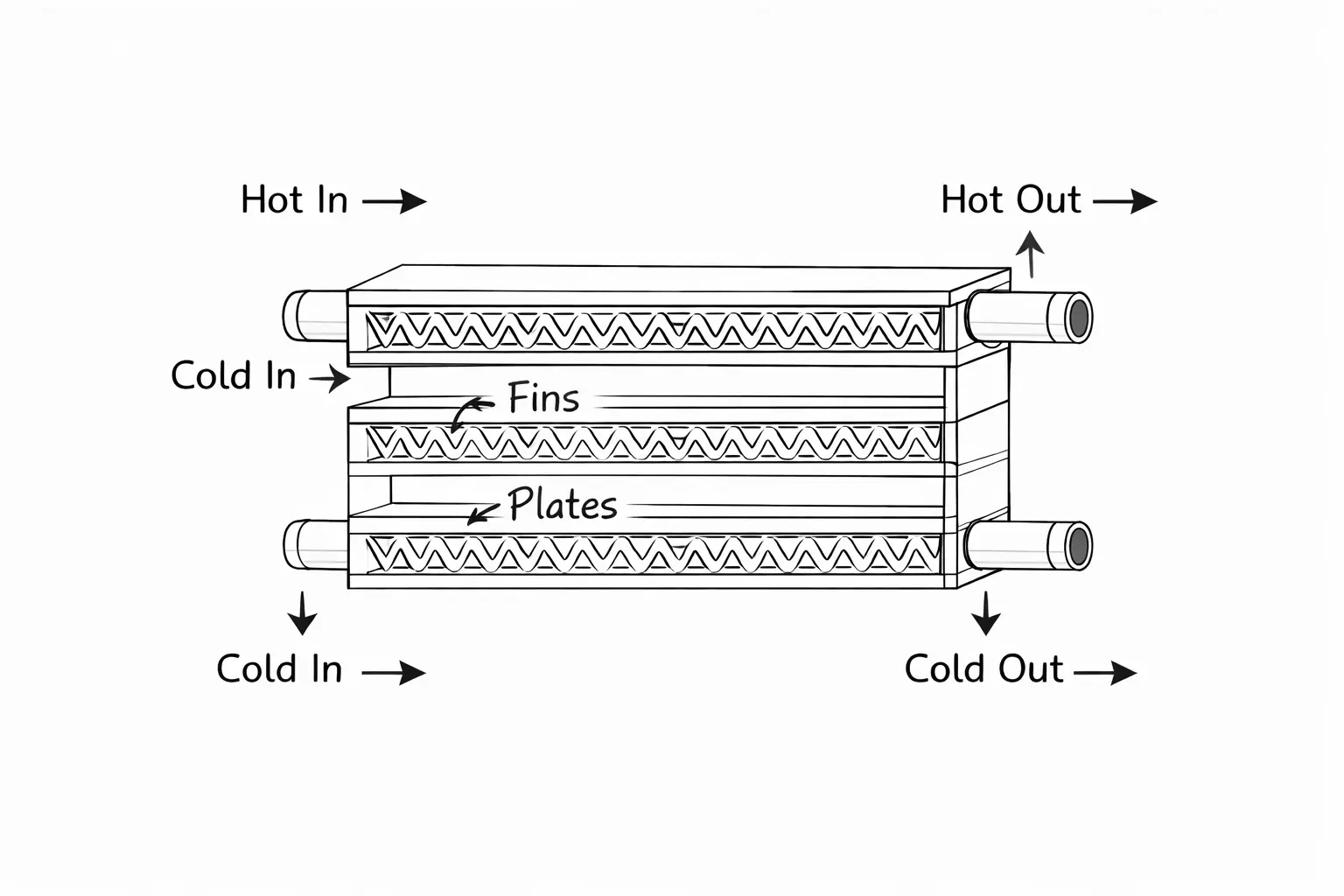 A typical compact heat exchanger diagram shows:
- Alternating fluid channels
- Thin separating plates
- Fins increasing surface area
- Inlet and outlet manifolds
- Core
- Fins
- Plates
- Headers
- Inlet/outlet nozzles
Types of Compact Heat Exchangers
1. Plate-Fin Heat Exchanger
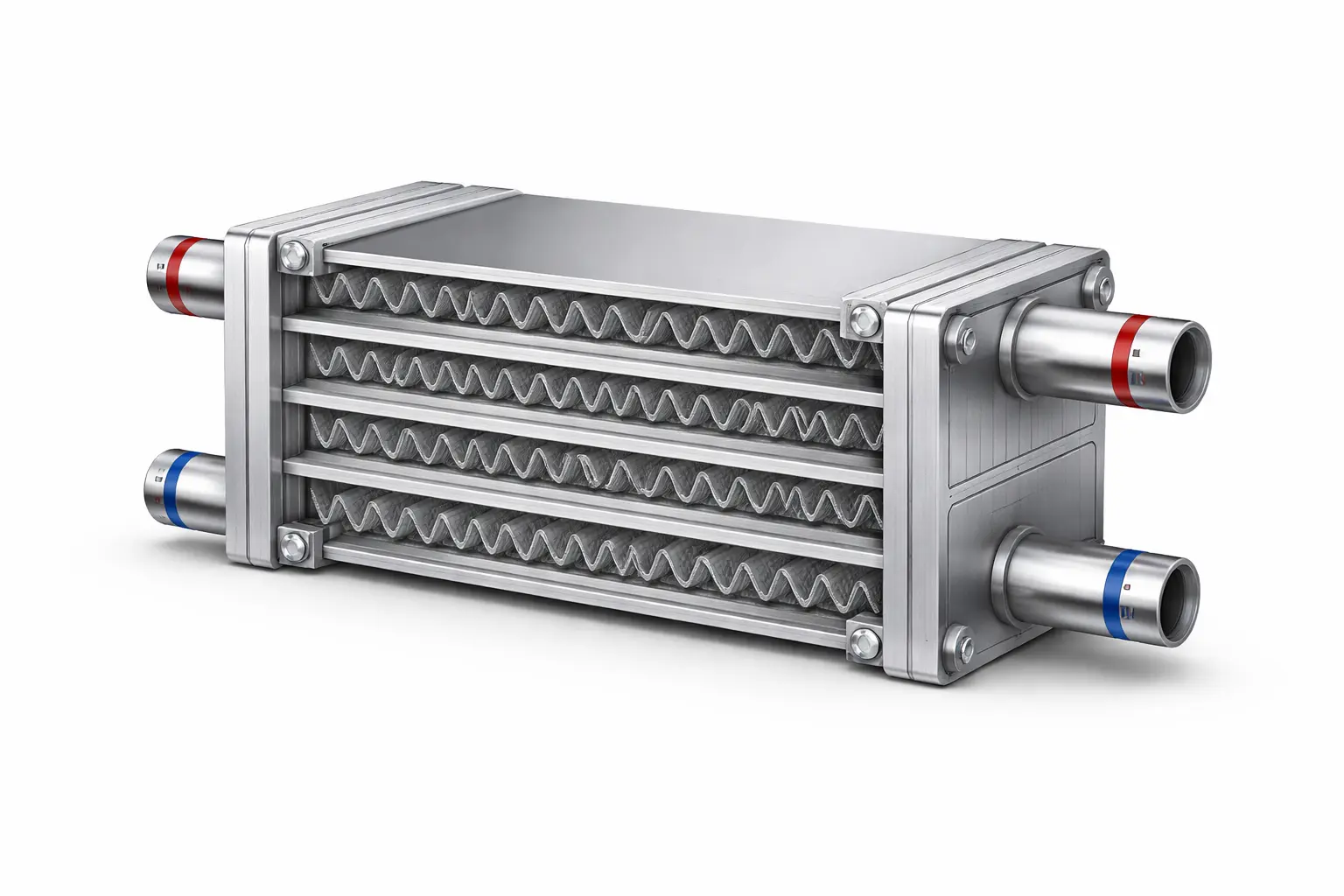 Most common compact type heat exchanger.
Features:
- Aluminum construction
- Fins between flat plates
- Very high area density
Applications:
- Aerospace
- Cryogenics
- Gas processing
2. Printed Circuit Heat Exchanger (PCHE)
Advanced compact heat exchanger.Features:
- Chemically etched microchannels
- Diffusion bonded plates
- Handles high pressure and temperature
Applications:
- Supercritical CO₂ systems
- Nuclear reactors
- Offshore processing
3. Microchannel Heat Exchanger
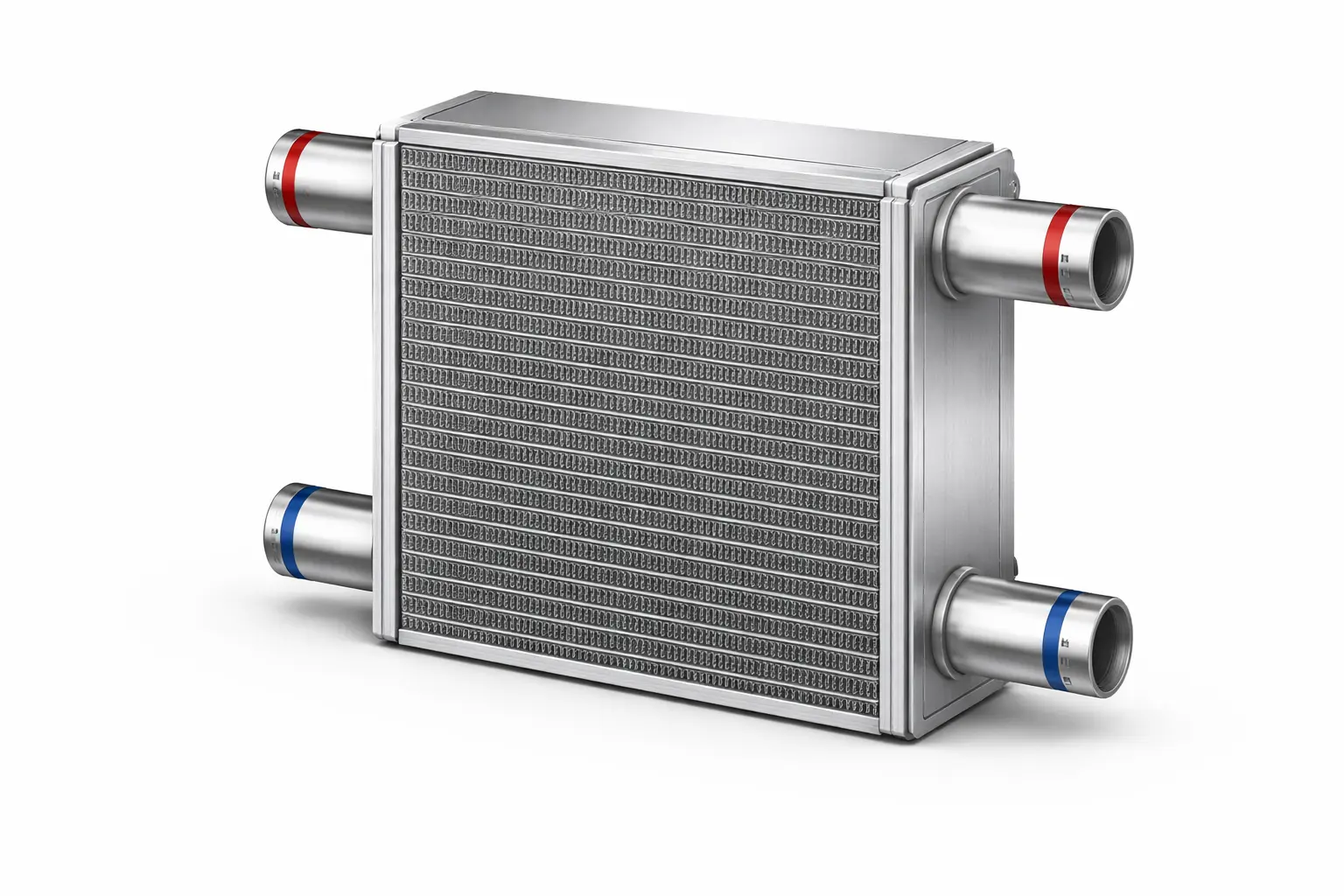 Common in HVAC and automotive industries.
Features:
- Flat multi-port tubes
- Aluminum construction
- Lightweight and corrosion resistant
Advantages of Compact Heat Exchangers
- High heat transfer efficiency
- Small footprint
- Lightweight
- Lower refrigerant charge
- Reduced material cost
- Faster thermal response
- Ideal for space-limited installations
When NOT to Use a Compact Heat Exchanger
Compact heat exchangers are not suitable in every scenario.1.Fluids Contain Large Particles
Narrow passages can clog easily.2. Heavy Fouling Expected
Cleaning is difficult compared to shell-and-tube designs.3. Easy Mechanical Cleaning Required
Shell-and-tube may be better.4. Very Low Pressure Drop Required
Compact units often have higher pressure drops.5. Extremely Viscous Fluids
Flow resistance becomes excessive.Applications of Compact Heat Exchanger
Compact heat exchangers are used in:Aerospace
- Aircraft environmental control systems
- Oil coolers
- Intercoolers
Automotive
- Radiators
- Condensers
- EV battery cooling
HVAC Systems
- Air conditioning units
- Heat pumps
Cryogenic Systems
- LNG processing
- Air separation plants
Energy Sector
- Supercritical CO₂ power cycles
- Waste heat recovery
Electronics Cooling
- Data centers
- High-power devices
Compact Type Heat Exchanger vs Traditional Heat Exchanger
| Feature | Compact Heat Exchanger | Shell-and-Tube Heat Exchanger |
|---|---|---|
| Size | Small | Large |
| Surface Area Density | Very High | Moderate |
| Cleaning | Difficult | Easier |
| Weight | Lightweight | Heavy |
| Cost | Higher Initial | Moderate |
| Pressure Handling | High (PCHE) | Very High |
Design Considerations
Engineers consider:- Heat duty
- Fluid properties
- Pressure drop limits
- Fouling factors
- Operating pressure
- Temperature limits
- Material compatibility
Materials Used
- Aluminum (most common)
- Stainless steel
- Titanium
- Nickel alloys
Thermal Performance Factors
Performance depends on:- Fin geometry
- Flow arrangement
- Reynolds number
- Surface enhancement
- Wall thickness
- Fluid properties
Industrial Standards
Compact heat exchangers follow:- ASME codes
- TEMA standards (where applicable)
- API standards (for oil & gas)
- ISO certifications
Future of Compact Heat Exchangers
The future is driven by:- Microfabrication technology
- Additive manufacturing
- Advanced materials
- Hydrogen energy systems
- Carbon capture plants
- Electric vehicle growth
Conclusion
A compact heat exchanger is an advanced, high-efficiency thermal device designed to deliver maximum heat transfer in minimal space. It is classified as compact when it offers exceptionally high surface area density and compact geometry.It operates by passing two fluids through narrow channels separated by thin walls, enabling efficient heat exchange. While highly efficient and space-saving, it is not ideal for fouling fluids or systems requiring easy mechanical cleaning.
From aerospace and cryogenics to HVAC and renewable energy systems, the application of compact heat exchangers continues to expand rapidly.
Understanding when to use — and when not to use — a compact heat exchanger is critical for optimal system performance.

