

07-10-2026
What is process equipment?
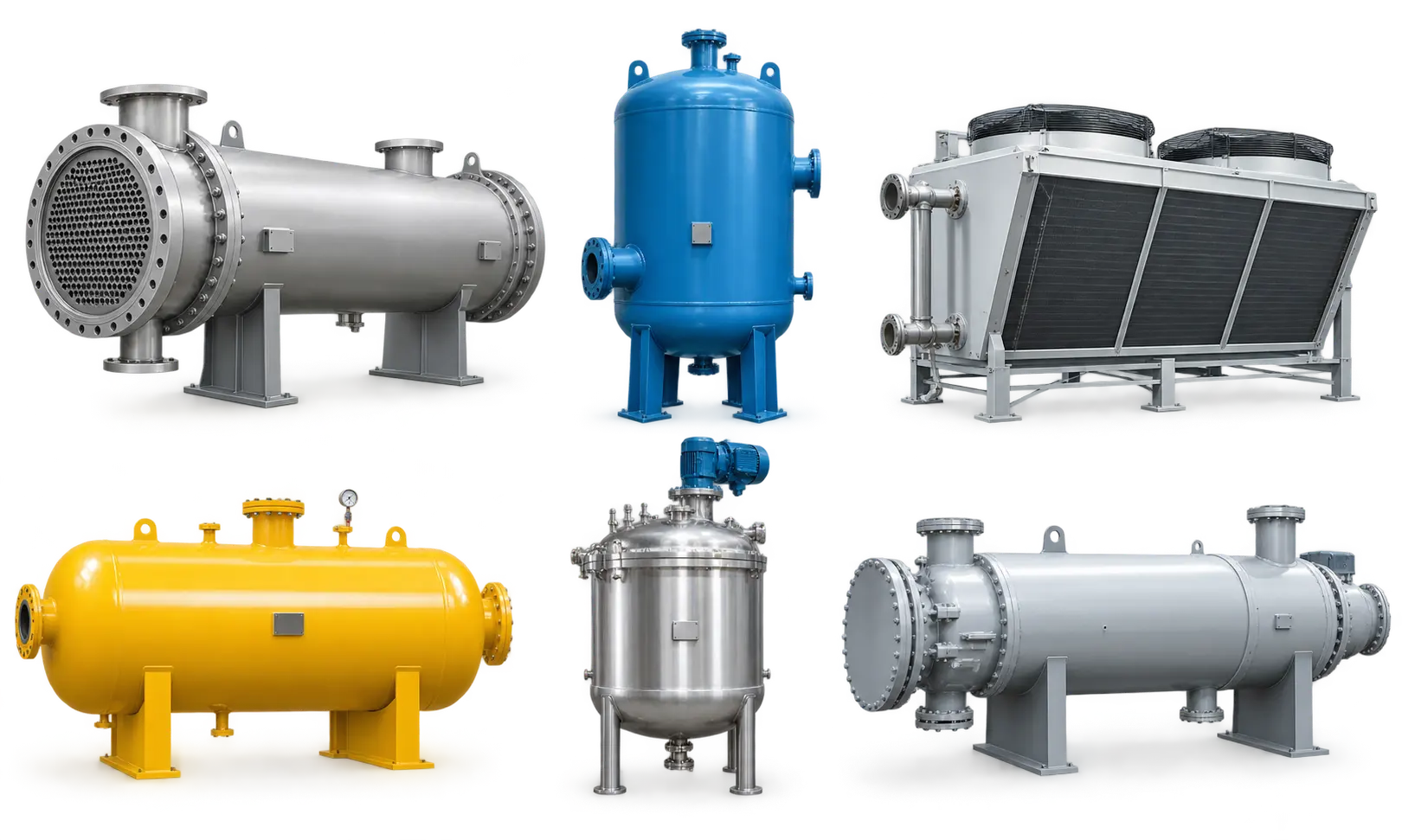
Process equipment refers to specialized machinery, vessels, and devices used in industrial plants to physically or chemically transform, handle, or transport raw materials into finished products.
Major Categories of Process Equipment
- Reaction Equipment: Reactors used for chemical synthesis, polymerization, and mixing under controlled pressure and temperature.
- Separation Equipment: Distillation columns, filters, centrifuges, and dryers that separate mixtures, remove impurities, or extract moisture.
- Heat Transfer Equipment: Heat exchangers, condensers, and evaporators that transfer thermal energy between fluids without mixing them.
- Fluid Handling Equipment: Pumps, compressors, and valves that move and regulate the flow of liquids and gases through a facility.
- Storage Equipment: Pressure vessels and low-pressure storage tanks designed to safely contain raw materials or finished products.
Operating Categories
- Static / Fixed Equipment: Stationary components like piping, storage tanks, and heat exchangers that do not move during operation.
- Rotating Equipment: Moving devices driven by external motors, such as pumps, compressors, and turbines, used to drive fluid.
Table of Contents
- What is process equipment?
- How does process equipment work?
- Key characteristics
- Types of process equipment
- Main components of process equipment
- Materials of construction
- Design codes and standards
- Fabrication, testing, and quality assurance
- Instrumentation and control
- Industries that use process equipment
- Benefits
- Common challenges and solutions
- Process equipment vs machinery
- How to choose process equipment
- Maintenance, inspection, and safety
- Future trends
- FAQs
- Conclusion
1. What Is Process Equipment?
Process equipment is the hardware used in the process industries to carry out physical or chemical changes on materials. The process industries include chemicals, petrochemicals, oil and gas, pharmaceuticals, food and beverage, water and wastewater treatment, power generation, pulp and paper, cement, and mining and metals.Simple explanation
Consider a dairy plant. Raw milk is received in a storage tank, pumped through a plate heat exchanger for pasteurization, cooled, homogenized, held in a buffer tank, and sent to filling. Every item in that chain is process equipment. The plant does not cut, bend, or assemble parts. It transforms the material itself, changing its temperature, composition, or physical state.Technical definition
Process equipment is any vessel, machine, or system designed to perform a unit operation (such as heat transfer, mixing, distillation, or filtration) or a unit process (such as a chemical reaction) on a material stream, usually within a closed system and under controlled operating conditions.Unit operation vs unit process
- A unit operation is a physical step: heating, cooling, mixing, evaporation, drying, filtration, distillation.
- A unit process is a chemical step: oxidation, hydrogenation, nitration, polymerization, fermentation.
What process equipment handles
- Liquids: solvents, acids, bases, water, oils, juices, syrups
- Gases and vapors: steam, hydrogen, nitrogen, natural gas, chlorine
- Solids and powders: granules, minerals, active pharmaceutical ingredients, fertilizers
- Slurries and pastes: suspensions, sludge, pulps, emulsions
Batch, semi-batch, and continuous operation
| Mode | How it works | Best suited for |
|---|---|---|
| Batch | Fixed quantity processed per cycle, then emptied | Pharmaceuticals, specialty chemicals, multi-product plants |
| Semi-batch | One reactant or product is added or removed during the cycle | Exothermic reactions needing controlled addition |
| Continuous | Constant feed and discharge at steady state | Fuels, bulk chemicals, fertilizers, water treatment |
Where the term comes from
"Process" refers to the series of operations that convert feedstock to product. In engineering practice, the term often covers everything inside the plant boundary that handles process fluids: vessels, exchangers, columns, reactors, tanks, pumps, compressors, piping, and instruments.How Does Process Equipment Work?
A process plant works as a chain of connected steps, each handled by one or more pieces of equipment.Typical process sequence
- Receiving and storage: raw materials arrive and are held in tanks, silos, or hoppers.
- Transfer: pumps, compressors, blowers, and conveyors move material through piping.
- Preparation: materials are heated, cooled, mixed, dissolved, or conditioned.
- Transformation: reactors convert materials chemically, or columns, evaporators, and dryers change them physically.
- Separation and purification: filters, centrifuges, distillation columns, and membranes isolate the target product.
- Finishing: the product is concentrated, crystallized, dried, granulated, or blended.
- Storage and dispatch: finished goods go to tanks, packaging, or loading.
- Utilities and control: steam, cooling water, compressed air, nitrogen, and power support the process while sensors and control systems keep conditions stable.
Example: solvent recovery plant
A mixed solvent from production is stored in a feed tank. A pump sends it through a preheater into a distillation column. The vapor rising from the column is condensed and collected in a reflux drum, with part returned as reflux and part drawn as purified solvent. The heavier liquid at the bottom leaves as residue. Every item (tank, pump, preheater, column, condenser, drum, reboiler) is process equipment, connected by piping and controlled by instruments.Core engineering principles
- Heat transfer. Governed by the relationship Q = U × A × ΔT(lm). Here Q is heat duty, U the overall heat transfer coefficient, A the surface area, and ΔT(lm) the log mean temperature difference. Heat moves by conduction, convection, and radiation.
- Fluid flow. Pressure drop, viscosity, density, and flow regime (laminar or turbulent) determine pump size, pipe diameter, and valve selection.
- Mass transfer. Components move between phases because of concentration or volatility differences. This underlies distillation, absorption, extraction, and drying.
- Reaction engineering. Kinetics, temperature, pressure, residence time, catalyst, and mixing determine conversion, selectivity, and yield.
- Mechanical separation. Gravity, pressure, centrifugal force, or membranes separate phases based on particle size and density.
- Material and energy balances. Every process is built on the conservation of mass and energy, which is used to size every item of equipment.
How plants are documented
- Block flow diagram (BFD): simple overview of process stages.
- Process flow diagram (PFD): major equipment, main streams, flow rates, temperatures, and pressures.
- Piping and instrumentation diagram (P&ID): every piece of equipment, line, valve, instrument, and control and safety loop.
- Equipment data sheets: design basis per item, including duty, design pressure and temperature, materials, nozzles, and codes.
- General arrangement and 3D models: physical layout, access, and maintenance space.
Key Characteristics of Process Equipment
- Duty-specific design: each item is sized for defined flow, temperature, pressure, and fluid properties.
- Code compliance: designed and built to ASME, TEMA, API, PED, IS, or equivalent standards.
- Corrosion resistance: materials are matched to the process media.
- Closed and controlled operation: often run under pressure or vacuum with automated control.
- Safety critical: failure can cause fire, toxic release, or explosion, so protective devices are built in.
- Long service life: often 15 to 30 years with proper maintenance.
- Customization: large equipment is usually engineered and fabricated to order, not bought off the shelf.
- Traceability: material test certificates, weld records, and inspection reports document the build.
- Cleanability: especially in food and pharma, where hygiene design is mandatory.
- Integration: it works as part of a system, so performance depends on the whole process, not one item.
Types of Process Equipment
Classification overview
By construction and movement
- Static equipment: no major moving parts (vessels, tanks, columns, exchangers, piping).
- Rotating equipment: driven moving parts (pumps, compressors, agitators, centrifuges).
- Utility and auxiliary equipment: boilers, cooling towers, chillers, air compressors, water treatment.
By function:
reaction, separation, heat transfer, mixing, storage, transport.By operating mode:
batch, semi-batch, continuous.By pressure:
atmospheric, low, medium, high pressure, vacuum.By temperature:
cryogenic, ambient, elevated, high temperature.By hygiene level:
hygienic or sanitary (food and pharma) versus heavy industrial.Heat exchangers
A heat exchanger transfers heat between two fluids at different temperatures across a solid wall, usually without mixing them.Shell and tube A tube bundle sits inside a cylindrical shell. One fluid flows inside the tubes, the other across them in the shell, guided by baffles. It is the most widely used type because of its robustness and wide pressure and temperature range.
- Fixed tubesheet: simple and economical, limited shell-side cleaning.
- U-tube: handles thermal expansion, bundle removable.
- Floating head: full bundle removal for cleaning, suited to fouling duties.
Plate heat exchangers Corrugated plates give turbulence and high heat transfer in a compact footprint. Gasketed types are easy to open and expand, brazed types are sealed and compact, and welded types handle higher pressure and aggressive fluids.
Air-cooled heat exchangers Fans force ambient air across finned tubes, saving cooling water. Common in refineries and gas plants.
Others:Double pipe, spiral, plate-fin, printed circuit, and scraped-surface exchangers.
Related equipment:Condensers, reboilers, evaporators, vaporizers, coolers, and waste heat boilers.
Typical applications: process heating and cooling, condensing, pasteurization, HVAC, heat recovery.
Pressure vessels
A pressure vessel is a closed container designed to hold gas or liquid at a pressure significantly different from atmospheric pressure. It is one of the most strictly regulated items in a plant.- Parts: shell, heads (elliptical, torispherical, hemispherical), nozzles, manways, supports (skirt, legs, saddles), and internals.
- Orientation: vertical (columns, reactors, tall separators) or horizontal (drums, receivers).
- Examples: separators, knock-out drums, flash drums, surge drums, reflux drums, air receivers, autoclaves.
- Design inputs: design pressure and temperature, corrosion allowance, joint efficiency, wind and seismic loads, nozzle loads, and fatigue.
Reactors
A reactor gives a chemical reaction the temperature, pressure, residence time, mixing, and catalyst contact it needs.| Reactor Type | Description | Typical Use |
|---|---|---|
| Batch | Loaded, reacted, emptied in cycles | Pharma, fine chemicals |
| Semi-batch | Gradual addition of reactant | Exothermic reactions |
| CSTR | Continuous feed, uniform mixing | Polymers, neutralization |
| Plug Flow (PFR) | Tubular flow, minimal back-mixing | High-conversion reactions |
| Packed or Fixed Bed | Fluid passes over stationary catalyst | Refining, synthesis |
| Fluidized Bed | Gas suspends solid particles | Catalytic cracking |
| Trickle Bed | Gas and liquid over catalyst | Hydrotreating |
| Bioreactor / Fermenter | Controlled sterile cell growth | Biotech, enzymes |
| Glass-lined | Inert glass surface on steel | Corrosive pharma service |
Storage tanks and vessels
- Atmospheric fixed-roof tanks (API 650) for low vapor pressure liquids.
- Floating-roof tanks to reduce vapor loss for volatile liquids.
- Low-pressure tanks (API 620).
- Pressurized spheres and bullets for LPG, ammonia, and liquefied gases.
- Cryogenic tanks for LNG, liquid nitrogen, oxygen, and argon.
- Hygienic tanks with polished surfaces and CIP spray devices.
- Silos and hoppers for powders, with flow design to prevent bridging and rat-holing.
Mixers and agitators
Mixing equipment blends liquids, suspends solids, disperses gases, and promotes heat transfer.- Axial flow impellers (propeller, pitched blade, hydrofoil): high flow, low shear, for blending and suspension.
- Radial flow impellers (Rushton turbine): high shear, for gas dispersion.
- Anchor and helical ribbon: for viscous products.
- High-shear rotor-stator mixers: emulsification and size reduction.
- Static in-line mixers: no moving parts.
- Solids blenders: ribbon, paddle, cone, and V-blenders.
Distillation, absorption, and extraction columns
A distillation column separates liquid mixtures by differences in volatility.- Components: shell, trays or packing, feed distributor, reflux system, condenser, and reboiler.
- Trays: sieve, valve, and bubble-cap, robust and suited to large diameters.
- Random packing: Pall rings, saddles, with low pressure drop.
- Structured packing: very efficient with low pressure drop, used in vacuum service.
- Related columns: absorbers, strippers, liquid-liquid extractors, and scrubbers.
- Operating issues: flooding, weeping, foaming, and entrainment.
Filtration and solid-liquid separation
- Filter presses and nutsche filter dryers (very common in pharma).
- Rotary vacuum drum filters for continuous slurry filtration.
- Bag, cartridge, and candle filters for polishing.
- Centrifuges: decanter, disc-stack, basket, peeler.
- Clarifiers and thickeners: gravity settling in water treatment and mining.
- Cyclones, bag houses, electrostatic precipitators, and scrubbers for gas cleaning.
- Membrane systems: microfiltration, ultrafiltration, nanofiltration, reverse osmosis.
Evaporators and dryers
Evaporators concentrate solutions by boiling off solvent.- Falling film (heat-sensitive products)
- Rising film and forced circulation (viscous or scaling liquids)
- Multiple-effect and MVR (energy saving)
- Agitated thin film (very viscous products)
Spray, fluid bed, rotary, tray, vacuum, flash, paddle, and freeze dryers
Crystallizers
Cooling, evaporative, and vacuum crystallizers form solid crystals with controlled size and purity, used in salts, sugar, and pharmaceutical APIs.Pumps, compressors, and blowers
- Centrifugal pumps: high flow at moderate pressure; the most common.
- Positive displacement pumps: gear, lobe, screw, piston, diaphragm; suitable for viscous fluids and metering.
- Specialty pumps: magnetic-drive and canned-motor (leak-free), slurry pumps.
- Compressors: centrifugal, reciprocating, screw, and axial.
- Blowers and fans: low-pressure air and gas movement.
Valves and piping
- Valves: gate, globe, ball, butterfly, check, plug, diaphragm, control valves, and safety relief valves.
- Piping: designed to ASME B31.3, with flanges, gaskets, fittings, strainers, steam traps, and expansion joints.
Fired heaters, boilers, and utilities
- Fired heaters: heat process fluids in tubes using burners.
- Boilers: produce steam (fire-tube, water-tube, waste heat).
- Thermal oil heaters: high temperature without high pressure.
- Cooling towers and chillers: reject process heat.
- Compressed air, nitrogen, and water treatment systems.
Size reduction and handling equipment
Crushers, mills, granulators, conveyors, feeders, and elevators for solid handling.Main Components of Process Equipment
- Shell and body The primary pressure-containing or product-containing structure.
- Heads and closures Elliptical, torispherical, hemispherical, conical, or flat ends that close vessels. Elliptical 2:1 heads are the most common in industry.
- Nozzles, manways, and flanges Provide connections for piping, instruments, and personnel access. Flange ratings (such as Class 150 or 300) match pressure and temperature.
- Supports Skirts, legs, lugs, and saddles carry the load of the vessel and contents and resist wind and seismic forces.
- Internals Trays, packing, baffles, distributors, demisters, coils, and agitators perform the process function inside the vessel.
- Jackets and coils Half-pipe coil, dimple, and conventional jackets heat or cool the vessel contents.
- Insulation and cladding Hot or cold insulation limits energy loss and protects personnel.
- Seals and gaskets Mechanical seals on rotating shafts and gaskets on flanges prevent leaks.
- Safety devices Safety valves, rupture discs, vents, flame arresters, and level and pressure alarms.
- Instrumentation connections Thermowells, pressure gauges, level gauges, and sample points.
Materials of Construction
Selection factors
Corrosion resistance, strength at operating temperature, toughness at low temperature, weldability, product purity, hygiene, cost, and availability.Common materials
| Material | Characteristics | Typical Use |
|---|---|---|
| Carbon Steel (SA 516 Gr 70) | Low cost, strong, limited corrosion resistance | Steam, water, hydrocarbons |
| Low-Alloy Steel (Cr-Mo) | High temperature and hydrogen resistance | Refinery heaters and reactors |
| Stainless Steel 304 / 304L | Good general corrosion resistance | Food, beverage, mild chemicals |
| Stainless Steel 316 / 316L | Molybdenum adds chloride resistance | Pharma, biotech, chemicals |
| Duplex and Super Duplex | High strength, chloride SCC resistance | Offshore, seawater |
| Nickel Alloys (Hastelloy, Inconel, Monel) | Strong acid and high temperature resistance | Aggressive chemical service |
| Titanium | Excellent seawater and oxidizing resistance | Desalination, chlorine |
| Glass-Lined Steel | Inert glass surface | Pharma and fine chemical reactors |
| FRP, PTFE, PVDF, PP, Rubber Lining | Chemical resistance, lower strength | Acids, water treatment |
Types of corrosion
General corrosion, pitting, crevice corrosion, galvanic corrosion, intergranular corrosion, stress corrosion cracking, erosion-corrosion, and microbiologically influenced corrosion. Each is managed through material selection, design details, coatings, and chemical treatment.Temperature considerations
- Low temperature: needs impact-tough materials such as austenitic stainless steel or 9% nickel steel.
- High temperature: must consider creep, oxidation, and metallurgical changes.
Surface finish and hygiene
Hygienic equipment uses controlled roughness (Ra), mechanical polishing, electropolishing, and passivation to improve cleanability and corrosion resistance.Cladding, overlay, and lining
Weld overlay or clad plate places an expensive alloy over a cheaper steel base. Rubber, glass, or polymer linings protect steel from aggressive media.Design Codes and Standards
Why codes matter
Codes set minimum requirements for design, materials, fabrication, inspection, and testing. They ensure safety, legal compliance, insurance acceptance, and a common language between owner, designer, and fabricator.Major standards
| Standard | Scope |
|---|---|
| ASME BPVC Section VIII (Div. 1, 2, 3) | Pressure vessels |
| ASME Section I | Power boilers |
| ASME Section II | Materials |
| ASME Section V | Non-destructive examination |
| ASME Section IX | Welding and brazing qualification |
| ASME B31.3 | Process piping |
| ASME BPE | Bioprocessing equipment |
| TEMA | Shell and tube heat exchangers |
| API 650 / 620 | Storage tanks |
| API 610 | Centrifugal pumps |
| API 660 / 661 | Shell and tube and air-cooled exchangers |
| API 520 / 521 | Pressure relief systems |
| API 510 / 570 / 653 | In-service inspection of vessels, piping, tanks |
| PED 2014/68/EU, EN 13445 | European pressure equipment |
| ATEX / IECEx | Explosive atmospheres |
| ISO 9001 / ISO 3834 | Quality and welding quality |
| cGMP, FDA, 3-A | Pharmaceutical and sanitary |
| IBR (India) | Boilers |
| IS Codes (India) | National standards |
Conformity and certification
Pressure equipment often needs approval from an authorized inspection agency, such as an Authorized Inspector under ASME, a notified body under PED, or a competent authority under national law. The ASME "U" stamp is a common certification for vessel fabricators.Fabrication, Testing, and Quality Assurance
Fabrication stages
- Engineering and design: calculations, drawings, and data sheets.
- Material procurement: plates, pipes, forgings, and fittings with mill test certificates.
- Cutting and forming: plasma or laser cutting, rolling, and head forming.
- Fit-up and welding: using qualified procedures (WPS, PQR) and qualified welders.
- Heat treatment: post-weld heat treatment (PWHT) where required.
- Surface treatment: pickling, passivation, polishing, or painting.
- Testing and inspection.
- Assembly and dispatch.
Non-destructive testing (NDT)
- Radiographic testing (RT) for internal weld defects
- Ultrasonic testing (UT)
- Dye penetrant testing (PT) for surface cracks
- Magnetic particle testing (MT)
- Positive material identification (PMI) to verify alloys
Pressure testing
Hydrostatic tests fill the equipment with water at a pressure above design to verify strength and leak tightness. Pneumatic tests are used only where water is unsuitable and require extra safety precautions.Documentation
A final data book typically includes design calculations, drawings, material certificates, weld maps, NDT reports, test records, and a certificate of compliance.Factory acceptance test (FAT)
The buyer or a third-party inspector witnesses final checks before dispatch.Instrumentation and Control
Measurement
Sensors measure temperature, pressure, level, flow, pH, conductivity, density, and vibration.Control
- Control valves and variable-speed drives adjust flow.
- PID controllers in PLCs or distributed control systems (DCS) maintain setpoints.
Safety instrumented systems
Independent systems shut down the process on dangerous conditions, designed under IEC 61511.Supervision and data
SCADA and plant historians collect and display data for operators and engineers.Digital tools
Digital twins, predictive analytics, and IIoT sensors enable condition monitoring and optimization.Industries That Use Process Equipment
| Industry | Typical Equipment | Key Requirements |
|---|---|---|
| Chemical and Petrochemical | Reactors, columns, exchangers, storage | Corrosion resistance, safety |
| Oil and Gas | Separators, scrubbers, heaters, coolers | High pressure, API compliance |
| Pharmaceutical and Biotech | SS 316L reactors, fermenters, dryers, CIP | GMP, cleanability, validation |
| Food and Beverage | Pasteurizers, evaporators, mixing tanks | Hygiene, 3-A, FDA |
| Dairy | Plate exchangers, homogenizers, tanks | Sanitary design |
| Water and Wastewater | Clarifiers, filters, dosing tanks | Corrosion, durability |
| Power Generation | Boilers, condensers, deaerators | Pressure, temperature, IBR/ASME |
| Pulp and Paper | Digesters, evaporators | Corrosion, scaling |
| Mining and Metals | Leach tanks, thickeners, filters | Abrasion, scale |
| Fertilizer | Reactors, granulators, scrubbers | Corrosion, scale |
| Textile and Dyes | Dye vessels, dryers | Chemical resistance |
| Cosmetics and Personal Care | Mixing tanks, homogenizers | Hygiene |
Benefits of Using the Right Process Equipment
- Consistent quality: stable conditions give uniform products.
- Higher yield: better mixing and heat transfer increase conversion.
- Energy savings: efficient exchangers and heat recovery cut utility costs.
- Safety: code-compliant design and protective devices reduce incidents.
- Regulatory compliance: meets legal and customer audit requirements.
- Scalability: modular and well-designed equipment supports expansion.
- Reduced downtime: reliable equipment keeps the plant running.
- Lower lifecycle cost: durable materials reduce maintenance and replacement.
- Environmental performance: lower emissions, waste, and water use.
Common Challenges and Solutions
| Challenge | Cause | Solution |
|---|---|---|
| Fouling | Deposits on heat transfer surfaces | Velocity control, cleaning cycles, proper fouling factors |
| Corrosion | Wrong material or aggressive media | Material upgrade, linings, inhibitors, inspection |
| Leakage | Gasket or seal failure | Proper gasket selection, torque control, better seals |
| Vibration | Flow-induced or mechanical | Baffle spacing, alignment, balancing |
| Over- or Under-sizing | Inaccurate process data | Validated design basis and simulation |
| Unplanned Downtime | Poor maintenance | Predictive maintenance, spares planning |
| Runaway Reaction | Heat generation exceeds cooling | Relief design, controlled addition, emergency quench |
| Cross-contamination | Poor cleaning or design | CIP systems, hygienic design, validation |
| Scale-up Problems | Lab behavior not matching plant | Pilot testing and modeling |
Process Equipment vs Machinery
| Aspect | Process Equipment | General Machinery |
|---|---|---|
| Purpose | Transforms material state or composition | Shapes, moves, or assembles solid parts |
| Material Handled | Liquids, gases, powders, slurries | Solid components |
| Operation | Continuous or batch, in closed systems | Discrete cycles |
| Typical Examples | Reactor, heat exchanger, distillation column | Lathe, press, robot, conveyor line |
| Key Standards | ASME, TEMA, API, PED | ISO machinery safety, CE |
| Main Risks | Pressure, toxicity, fire, runaway reactions | Mechanical injury |
| Design Focus | Thermodynamics, fluid flow, reaction | Kinematics, strength, precision |
How to Choose Process Equipment
Define process requirements
Document capacity, flow rates, temperatures, pressures, fluid properties (viscosity, density, corrosivity, toxicity), and operating mode.Select materials of construction
Match the material to corrosion, temperature, hygiene, and cost needs. Verify chemical compatibility with all media, including cleaning agents.Confirm code and regulatory compliance
Identify applicable codes for your location and industry (ASME, PED, IBR, GMP, ATEX).Evaluate efficiency and lifecycle cost
Compare energy use, maintenance, spares, and service life, not just purchase price.Consider footprint and installation
Check available space, foundation loads, crane access, transport limits, and utilities.Plan for maintenance access
Ensure space for bundle pulling, manway access, cleaning, and inspection.Plan for flexibility and scale
Choose modular or expandable designs where capacity growth or product changes are likely.Evaluate the manufacturer
Check certifications (ASME U stamp, ISO 9001), fabrication and testing facilities, references in your industry, engineering capability, delivery record, and after-sales support.Request a technical offer
A good proposal includes datasheets, drawings, material specifications, applicable codes, testing scope, documentation list, delivery schedule, and warranty.Selection checklist
- Process data sheet complete
- Materials confirmed for all media
- Design code and inspection agency agreed
- Utilities available and sized
- Safety and relief requirements defined
- Testing and documentation scope agreed
- Spares and warranty terms documented
Maintenance, Inspection, and Safety
Maintenance strategies
- Preventive: scheduled servicing by time or usage.
- Predictive: vibration analysis, thermography, oil analysis, and ultrasonic thickness monitoring.
- Corrective: repair after failure (least desirable for critical items).
- Risk-based inspection (RBI): prioritizes by probability and consequence of failure.
Common degradation mechanisms
Corrosion, erosion, fatigue, creep, stress corrosion cracking, fouling, and seal or gasket leakage.Routine tasks
- Visual inspection and leak checks
- Thickness measurement
- Cleaning of exchangers and tanks
- Calibration of instruments and safety valves
- Lubrication and alignment of rotating equipment
- Replacement of gaskets, seals, and wear parts
Statutory inspection
Pressure vessels, boilers, and certain piping require periodic legal inspection and certification, with frequency set by local regulation.Process safety
- Pressure relief: safety valves and rupture discs sized to relevant codes.
- Hazard studies: HAZOP, LOPA, FMEA, and SIL assessment.
- Process safety management (PSM): management of change, operating procedures, training, and mechanical integrity.
- Fire and explosion protection: hazardous area classification, flame arresters, inerting, and suppression.
- Environmental protection: scrubbers, containment, spill control, and effluent treatment.
- Personnel safety: lockout/tagout, confined space entry procedures, and PPE.
Record keeping
Maintain inspection reports, repair records, and calibration certificates for audits.
Future Trends in Process Equipment
- Process intensification: compact heat exchangers, microreactors, and reactive distillation reduce size and energy use.
- Modular and skid-mounted plants: shop-built units shorten site construction and improve quality.
- Digitalization: digital twins, AI-based optimization, and remote monitoring.
- Energy efficiency: heat integration, pinch analysis, MVR, and waste heat recovery.
- Advanced materials: better alloys, coatings, and composites.
- Sustainability: equipment for hydrogen, carbon capture, biofuels, battery materials, and water reuse.
- Continuous manufacturing: growing use in pharmaceuticals.
- Additive manufacturing: 3D-printed components such as compact exchanger cores and complex internals.
- Smart maintenance: condition-based monitoring replacing fixed schedules.
Frequently Asked Questions
What is process equipment?
Process equipment is the machinery, vessels, and systems used in industrial plants to mix, heat, cool, react, separate, store, and transfer materials.
What are examples of process equipment?
Heat exchangers, pressure vessels, reactors, storage tanks, distillation columns, mixers, filters, centrifuges, dryers, evaporators, pumps, and compressors.
What are the main types of process equipment?
Static equipment (vessels, tanks, exchangers, columns), rotating equipment (pumps, compressors, agitators), and utility equipment (boilers, cooling towers, chillers).
What is the difference between static and rotating equipment?
Static equipment has no major moving parts, while rotating equipment includes driven parts like pumps, compressors, and agitators.
What is the difference between process equipment and machinery?
Process equipment transforms materials by changing their state, composition, or temperature, usually in closed systems. General machinery shapes, moves, or assembles solid parts.
Which industries use process equipment?
Chemical, petrochemical, oil and gas, pharmaceutical, food and beverage, water treatment, power, pulp and paper, mining, fertilizer, and cosmetics.
Which material is best for process equipment?
It depends on the media. Carbon steel suits non-corrosive service, SS 316L suits pharma and food, duplex suits chloride service, and nickel alloys or titanium suit aggressive chemicals.
What standards apply to process equipment?
ASME Section VIII for pressure vessels, TEMA for shell and tube exchangers, API for oil and gas equipment, ASME B31.3 for piping, PED in Europe, and cGMP or ASME BPE for pharma and bioprocess.
How is process equipment tested before delivery?
Through NDT of welds, hydrostatic pressure testing, dimensional checks, material verification, and a factory acceptance test.
What is a P&ID?
A piping and instrumentation diagram showing equipment, piping, valves, and instruments, used for design, construction, operation, and safety reviews.
How long does process equipment last?
Typically 15 to 30 years or more with proper design, maintenance, and inspection.
How do I choose a process equipment manufacturer?
Look for relevant certifications (ASME, ISO 9001), fabrication and testing capability, industry references, engineering support, and after-sales service.
Conclusion
Process equipment is the foundation of every plant that transforms raw materials into products. Understanding its types, materials, design codes, and maintenance needs helps engineers, buyers, and plant owners make decisions that improve safety, quality, efficiency, and long-term cost.
Looking for custom-fabricated process equipment such as pressure vessels, heat exchangers, reactors, or storage tanks? Contact our engineering team for a technical consultation and quotation.
Future Trends in Process Equipment
- Process intensification: compact heat exchangers, microreactors, and reactive distillation reduce size and energy use.
- Modular and skid-mounted plants: shop-built units shorten site construction and improve quality.
- Digitalization: digital twins, AI-based optimization, and remote monitoring.
- Energy efficiency: heat integration, pinch analysis, MVR, and waste heat recovery.
- Advanced materials: better alloys, coatings, and composites.
- Sustainability: equipment for hydrogen, carbon capture, biofuels, battery materials, and water reuse.
- Continuous manufacturing: growing use in pharmaceuticals.
- Additive manufacturing: 3D-printed components such as compact exchanger cores and complex internals.
- Smart maintenance: condition-based monitoring replacing fixed schedules.
Frequently Asked Questions
What is process equipment?
Process equipment is the machinery, vessels, and systems used in industrial plants to mix, heat, cool, react, separate, store, and transfer materials.What are examples of process equipment?
Heat exchangers, pressure vessels, reactors, storage tanks, distillation columns, mixers, filters, centrifuges, dryers, evaporators, pumps, and compressors.What are the main types of process equipment?
Static equipment (vessels, tanks, exchangers, columns), rotating equipment (pumps, compressors, agitators), and utility equipment (boilers, cooling towers, chillers).What is the difference between static and rotating equipment?
Static equipment has no major moving parts, while rotating equipment includes driven parts like pumps, compressors, and agitators.What is the difference between process equipment and machinery?
Process equipment transforms materials by changing their state, composition, or temperature, usually in closed systems. General machinery shapes, moves, or assembles solid parts.Which industries use process equipment?
Chemical, petrochemical, oil and gas, pharmaceutical, food and beverage, water treatment, power, pulp and paper, mining, fertilizer, and cosmetics.Which material is best for process equipment?
It depends on the media. Carbon steel suits non-corrosive service, SS 316L suits pharma and food, duplex suits chloride service, and nickel alloys or titanium suit aggressive chemicals.What standards apply to process equipment?
ASME Section VIII for pressure vessels, TEMA for shell and tube exchangers, API for oil and gas equipment, ASME B31.3 for piping, PED in Europe, and cGMP or ASME BPE for pharma and bioprocess.How is process equipment tested before delivery?
Through NDT of welds, hydrostatic pressure testing, dimensional checks, material verification, and a factory acceptance test.What is a P&ID?
A piping and instrumentation diagram showing equipment, piping, valves, and instruments, used for design, construction, operation, and safety reviews.How long does process equipment last?
Typically 15 to 30 years or more with proper design, maintenance, and inspection.How do I choose a process equipment manufacturer?
Look for relevant certifications (ASME, ISO 9001), fabrication and testing capability, industry references, engineering support, and after-sales service.Conclusion
Process equipment is the foundation of every plant that transforms raw materials into products. Understanding its types, materials, design codes, and maintenance needs helps engineers, buyers, and plant owners make decisions that improve safety, quality, efficiency, and long-term cost.Looking for custom-fabricated process equipment such as pressure vessels, heat exchangers, reactors, or storage tanks? Contact our engineering team for a technical consultation and quotation.


