

20-02-2026
Heat Exchangers Formulas Explained with Calculation Examples
Heat exchangers are essential equipment in industries such as power plants, oil & gas, chemical processing, HVAC, and manufacturing. To design and size these systems correctly, engineers rely on the heat exchanger formula to calculate heat transfer rates, temperature differences, and required surface area.
In this complete guide, we will explain every important heat exchanger formula in simple language, along with practical calculation examples.
What Is a Heat Exchanger?
A heat exchanger is a device used to transfer heat between two fluids without mixing them. One fluid releases heat while the other absorbs it.Common types include:
- Shell and tube heat exchanger
- Air Cooled Heat Exchanger
- Plate Heat Exchanger
- Double Pipe Heat Exchanger
Basic Heat Exchanger Formulas
The most important heat exchanger formula is:Q = U × A × ΔT
Where:
- Q = Heat transfer rate (Watts or kW)
- U = Overall heat transfer coefficient (W/m²K)
- A = Heat transfer surface area (m²)
- ΔT = Temperature difference between fluids (K or °C)
Understanding Each Variable
Heat Transfer Rate (Q)
This represents the amount of heat transferred per unit time.Overall Heat Transfer Coefficient (U)
This depends on:- Material
- Fluid properties
- Flow velocity
- Fouling factor
- Water to water: 800–1500 W/m²K
- Oil to water: 100–350 W/m²K
- Air cooled heat exchanger: 10–100 W/m²K
Heat Duty Formula
Another important heat exchanger formula is:Q = m × Cp × ΔT
Where:
- m = Mass flow rate (kg/s)
- Cp = Specific heat capacity (kJ/kgK)
- ΔT = Temperature change
Example Calculation
Water flow rate = 2 kg/sSpecific heat (Cp) = 4.18 kJ/kgK
Temperature rise = 20°C
Q = 2 × 4.18 × 20
Q = 167.2 kW
So, the heat exchanger must transfer 167.2 kW of heat.
LMTD Formula (Log Mean Temperature Difference)
In real systems, temperature difference is not constant. So engineers use the LMTD heat exchanger formula:LMTD = (ΔT1 − ΔT2) / ln(ΔT1 / ΔT2)
Where:
- ΔT1 = Temperature difference at inlet.
- ΔT2 = Temperature difference at outlet
Why LMTD Is Important
It provides the correct average temperature difference for:- Shell and tube heat exchanger
- Counterflow heat exchanger
- Parallel flow heat exchanger
Temperature Profile Diagram

LMTD Example
Hot fluid inlet: 150°CHot fluid outlet: 100°C
Cold fluid inlet: 30°C
Cold fluid outlet: 80°C
ΔT1 = 150 − 80 = 70°C
ΔT2 = 100 − 30 = 70°C
If both are equal, LMTD = 70°C
NTU Method Formula
For complex heat exchanger design, engineers use the Effectiveness-NTU method.NTU Formula: NTU = (U × A) / Cmin
Where:
Cmin = Minimum heat capacity rate
Effectiveness:
ε = Q / Qmax
The NTU method is useful when outlet temperatures are unknown.
Heat Transfer Area Formula
Rearranging the main heat exchanger formula:A = Q / (U × ΔT)
This formula helps determine required surface area.
Example
Q = 200 kWU = 500 W/m²K
ΔT = 40°C
A = 200000 / (500 × 40)
A = 10 m²
So, required area = 10 m².
Shell and Tube Heat Exchanger Calculation
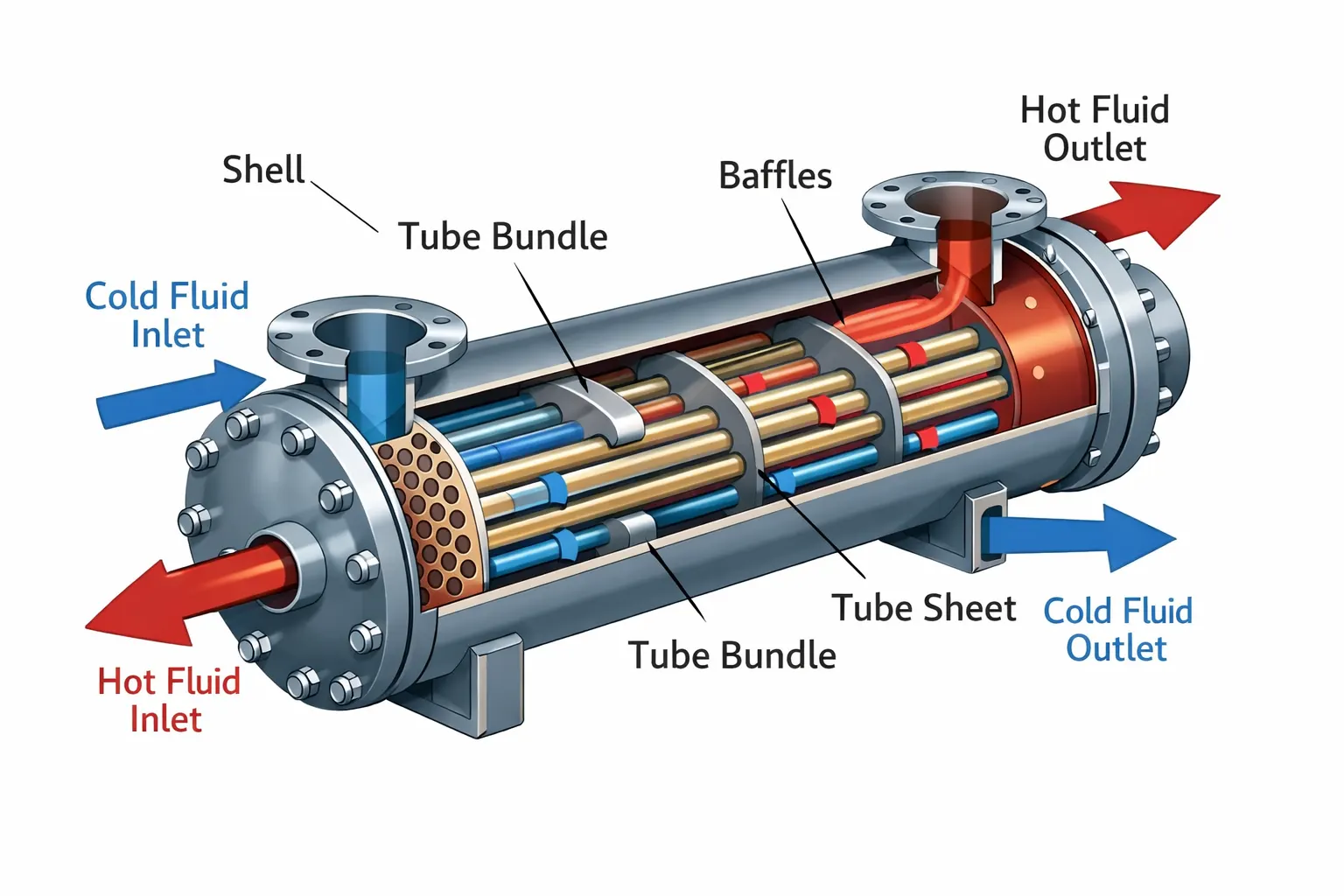
In shell and tube systems, total area depends on:A = π × D × L × N Where:
- D = Tube outer diameter
- L = Tube length
- N = Number of tubes
Shell and Tube Diagram
Air Cooled Heat Exchanger Formula
For air cooled systems:Q=h×A×ΔT
Where:
h = Air side heat transfer coefficient
Since air has low heat transfer coefficient, larger surface area is required.
Factors Affecting Heat Exchanger Formula Results
- Fouling resistance
- Fluid viscosity
- Flow type (laminar or turbulent)
- Material conductivity
- Temperature range
Common Mistakes in Heat Exchanger Calculations
- Ignoring fouling factor
- Using wrong Cp values
- Not applying correction factor for multi-pass exchangers
- Confusing LMTD with simple ΔT Avoiding these errors improves design accuracy.
Real Industrial Application Example
In a refinery:- Crude oil heated from 60°C to 120°C
- Steam used as heating medium
- Required duty: 500 kW
- Heat duty
- Required surface area
- Number of tubes
- Shell diameter
Why Correct Heat Exchanger Formula Matters
- Prevents oversizing
- Reduces manufacturing cost
- Improves energy efficiency
- Increases equipment life
- Ensures safety compliance
Frequently Asked Questions
What is the main heat exchanger formula?
The main heat exchanger formula is Q = U × A × ΔT.What is LMTD in heat exchanger?
LMTD stands for Log Mean Temperature Difference and provides accurate average temperature difference.How do you calculate heat transfer area?
Area is calculated using A = Q / (U × ΔT).What is the NTU method?
NTU method calculates heat exchanger performance when outlet temperatures are unknown.Which formula is used in shell and tube heat exchanger?
Q = U × A × LMTD is commonly used.Conclusion
Understanding the complete heat exchanger formula is essential for proper design and performance optimization. Whether you are working with shell and tube, air cooled, or plate heat exchangers, the same fundamental equations apply.By applying:
- Heat duty formula
- LMTD method
- NTU method
- Surface area calculations
If you are involved in heat exchanger manufacturing or design, mastering these formulas will significantly improve your project accuracy and industrial performance.
Heat exchangers are essential equipment in industries such as power plants, oil & gas, chemical processing, HVAC, and manufacturing. To design and size these systems correctly, engineers rely on the heat exchanger formula to calculate heat transfer rates, temperature differences, and required surface area.
In this complete guide, we will explain every important heat exchanger formula in simple language, along with practical calculation examples.


