

15-11-2024
Fixed Tube Heat Exchangers: Efficient and Durable Solutions
A fixed tube heat exchanger is widely used in industrial processes where mechanical strength, pressure resistance, and long-term operational stability are critical. This equipment is preferred in continuous-duty applications due to its rigid construction, compact design, and reliable thermal performance. Industries such as chemical processing, oil and gas, power generation, and refineries commonly select this design when operating conditions are stable and fluids are relatively clean.
What is a Fixed Tube Sheet Heat Exchanger?
A fixed tube sheet heat exchanger is a shell-and-tube type unit in which the tubes are permanently secured to tube sheets at both ends of the shell. The defining characteristic is the fixed tubesheet arrangement, which prevents axial movement of the tube bundle. In a fixed tube heat exchanger, heat is transferred between two process fluids flowing on the tube side and shell side without mixing. This fixed tubesheet exchanger is typically applied in high-pressure services where mechanical simplicity and strength are more important than ease of internal cleaning.Construction and Fixed Tubesheet Design
The construction consists of four primary components designed for strength and process reliability. The shell is a cylindrical pressure vessel that carries the shell-side fluid and directs flow across the tube bundle. Shell material and thickness are selected based on design pressure, temperature, corrosion allowance, and applicable codes.The tubes are arranged in a defined pitch (triangular or square) depending on heat transfer requirements and cleaning considerations. Tube material is selected based on process fluid compatibility, fouling tendency, and thermal conductivity. Tube diameter and length directly influence heat transfer area and pressure drop.
The tube sheets are thick metal plates into which the tubes are expanded or welded. In a fixed tubesheet design, both tube sheets are rigidly attached to the shell, creating a single integral structure. The tubesheet in heat exchanger construction serves three purposes: supporting the tubes, separating shell-side and tube-side fluids, and acting as a pressure boundary.
The channel head is mounted on the tube sheet at the tube-side inlet and outlet. It distributes the fluid evenly into the tubes and allows multiple pass arrangements such as 1–2 or 2–4 configurations. Gaskets and pass partitions inside the channel head ensure proper flow direction and sealing.
Working Principle of Fixed Tube Sheet Heat Exchanger
- Tube-Side Fluid Flow
One process fluid enters through the channel head and flows inside the tubes. The pass arrangement controls velocity, pressure drop, and residence time to achieve the required heat transfer rate. - Shell-Side Fluid Flow
The second fluid flows through the shell and passes across the outer surface of the tube bundle. Baffles guide the shell-side flow, increase turbulence, and support the tubes against vibration. - Heat Transfer Process
The working principle is based on conduction through the tube wall. Heat flows from the higher-temperature fluid to the lower-temperature fluid without direct contact, ensuring process safety and fluid separation. - Outlet Conditions
After exchanging heat, both fluids exit the exchanger at different temperatures according to the specified thermal duty and process requirements.
Fixed Tube Sheet Heat Exchanger Diagram
A typical fixed tube sheet heat exchanger diagram illustrates the shell, tube bundle, fixed tube sheets, channel head, and flow paths of both fluids. The diagram highlights the rigid attachment of the tube sheets to the shell, which distinguishes this design from floating or U-tube configurations.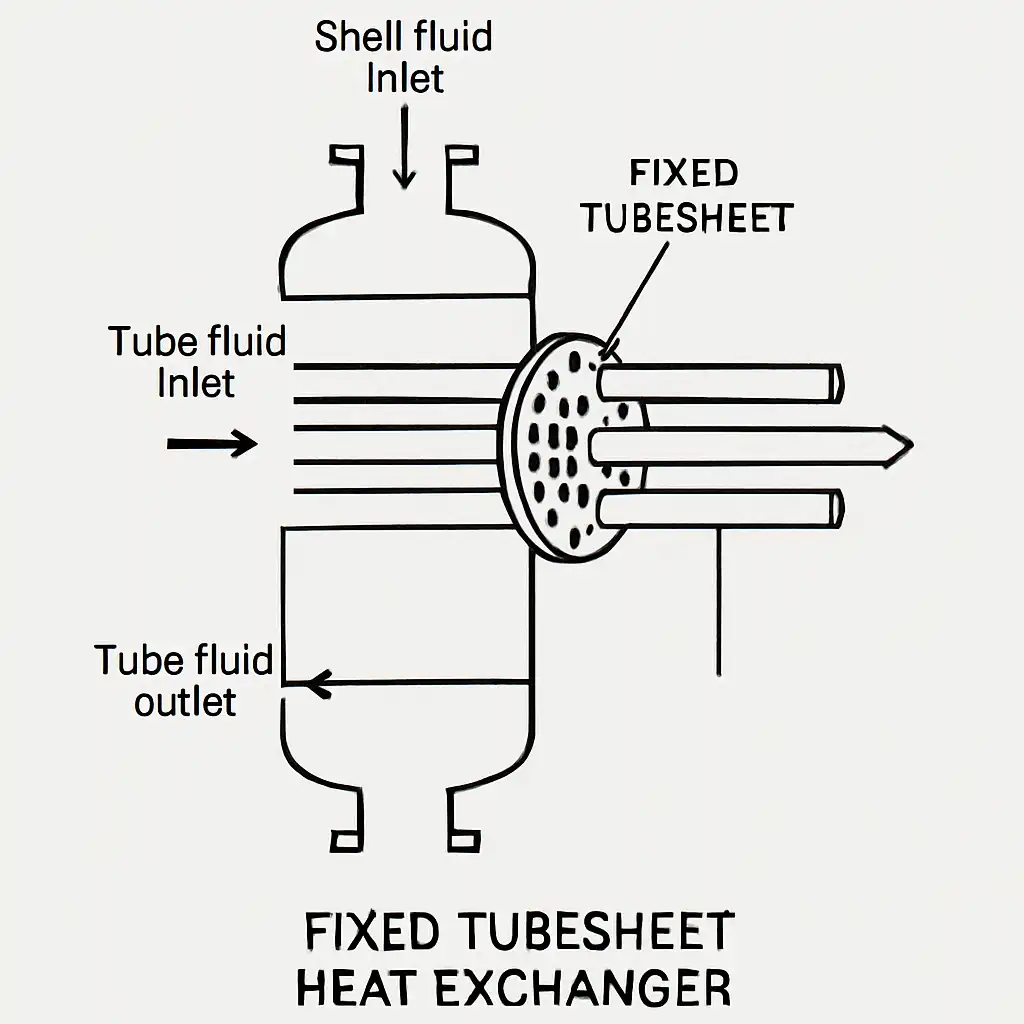
Fixed Tube Sheet vs Floating Head Heat Exchanger
The selection between fixed tube sheet and floating head designs depends on thermal expansion, maintenance needs, and operating conditions.| Parameter | Fixed Tube Sheet Heat Exchanger | Floating Head Heat Exchanger |
|---|---|---|
| Tube bundle removal | Not possible | Fully removable |
| Thermal expansion | Limited accommodation | Easily accommodated |
| Maintenance | Chemical cleaning preferred | Mechanical cleaning possible |
| Initial cost | Lower | Higher |
| Best suited for | Clean, stable services | Fouling or high temperature difference services |
Advantages and Limitations of Fixed Tube Sheet Heat Exchanger
Advantages:
- Simple and mechanically strong construction
- Lower fabrication cost compared to removable bundle designs
- Suitable for high-pressure and high-temperature service
- Compact layout with fewer sealing points
- Good reliability in continuous operation
Limitations:
- Limited ability to accommodate differential thermal expansion
- Tube-side mechanical cleaning is not possible
- Not recommended for services with heavy fouling
- Repairs on tube-to-tubesheet joints can be complex
Maintenance of Fixed Tube Heat Exchanger
Maintenance activities are mainly focused on preventing fouling and monitoring operating conditions. Since the tube bundle cannot be removed, chemical cleaning is commonly used for tube-side deposits, while the shell side can be inspected during shutdowns.Routine maintenance includes checking tube-to-tubesheet joints for leakage, monitoring pressure drop to detect fouling, and inspecting gaskets in the channel head. Proper filtration of process fluids and controlled operating conditions significantly extend service life.
Types of Heat Exchangers
Heat exchangers are selected based on thermal performance, maintenance access, and operating conditions. Common shell-and-tube configurations include:- Fixed tube sheet heat exchangers: Simple, strong, and cost-effective for clean services.
- U-tube heat exchangers: Allow thermal expansion and easier tube-side cleaning.
- Floating head heat exchangers: Enable full tube bundle removal for frequent maintenance.
- Air cooled Heat Exchanger:A fin fan cooler is an air-cooled heat exchanger that uses finned tubes and fans to dissipate process heat into the atmosphere without using water.
Each type offers specific advantages depending on temperature difference, fouling tendency, and process requirements.
Fixed Tubesheet Heat Exchanger Manufacturers
Manufacturers design fixed tubesheet heat exchangers according to recognized standards such as TEMA, ASME Section VIII, and customer-specific process specifications. Design considerations include thermal duty, allowable pressure drop, material selection, corrosion allowance, and expected operating life.Custom-built units can be supplied with a wide range of materials, including carbon steel, stainless steel, duplex steel, and special alloys. Proper design verification and fabrication quality are essential to ensure safe and efficient long-term operation.
Conclusion
The fixed tube heat exchanger remains a cornerstone technology in industrial heat transfer due to its simplicity, durability, and cost-effectiveness. When properly designed, maintained, and operated, it provides reliable thermal performance for years with minimal maintenance requirements. Ongoing innovations in material science, digital monitoring, and manufacturing methods are making these exchangers even more efficient, sustainable, and adaptable to future process challenges.For applications where thermal expansion is manageable and fluids are clean, fixed tube heat exchangers continue to deliver unmatched value, energy efficiency, and long-term reliability — making them an enduring choice across industries like petrochemical, power generation, HVAC, and process engineering.
Frequently Asked Questions (FAQs)
Q1. What is a fixed tube heat exchanger?A fixed tube heat exchanger is a type of shell-and-tube exchanger where both tube sheets are permanently welded to the shell, forming a rigid structure ideal for clean fluids and low thermal expansion conditions.
Q2. Where are fixed tube heat exchangers commonly used?
They are used in industries such as petrochemical, oil & gas, power generation, HVAC, and food processing for condensers, preheaters, and process coolers.
Q3. What are the main advantages of fixed tube heat exchangers?
They offer robust construction, leak-free performance, high pressure and temperature resistance, and low maintenance requirements, making them reliable and cost-effective.
Q4. How is thermal expansion managed in fixed tube heat exchangers?
Thermal stress is typically managed by adding an expansion joint or bellows on the shell side, allowing safe operation under varying temperature conditions.
Q5. What maintenance is required for fixed tube sheet heat exchangers?
Regular cleaning, inspection, and performance monitoring are essential. Tube-side cleaning is done mechanically or chemically, while shell-side cleaning often uses chemical circulation.
Q6. Are fixed tube heat exchangers customizable?
Yes, these exchangers can be custom-built to specific process conditions, materials, and flow requirements as per ASME, TEMA, or API standards


