

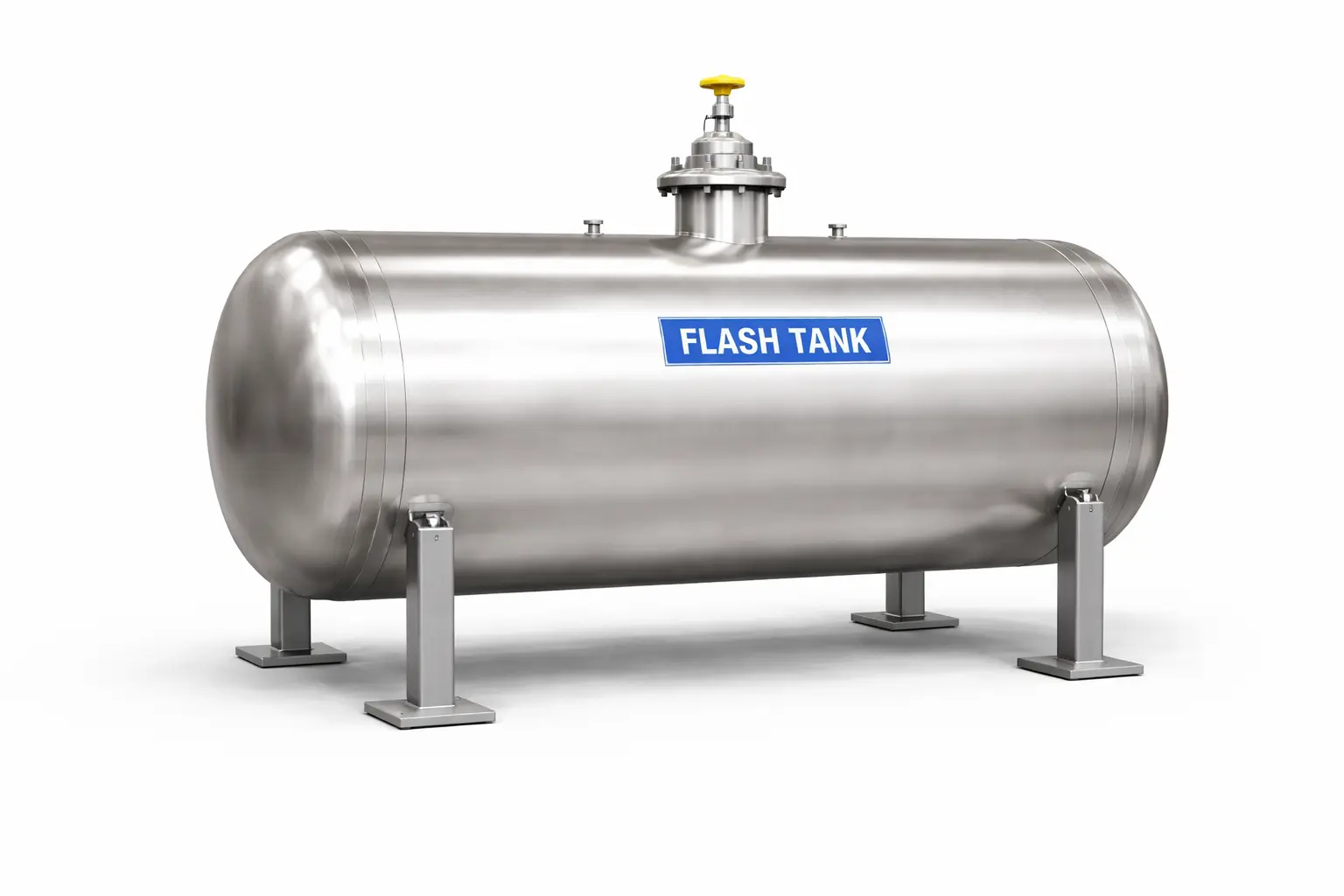
What Is a Flash Tank?
Flash tanks, also known as a flash vessel or separator, is used to separate the vapor and liquid phases of a mixture. It works by rapidly reducing the pressure on a heated liquid mixture, causing some of the liquid to vaporize or "flash" into steam. The resulting two-phase mixture of steam and liquid is then separated inside the tank — the steam is captured for further use, and the liquid is returned to the system.How Does a Flash Tanks Work?
Flash tanks serves as a collection system for a variety of condensate drain lines. It receives high-pressure condensate which is then exposed to a low-pressure steam source. When this occurs, a certain percentage of condensate will "flash" to steam at the lower pressure.Flash steam — formed when a portion of the high-pressure condensate discharged from a steam trap re-evaporates — is separated from the condensate and piped away from the top of the tank. The remaining condensate drains from the bottom of the vessel to a steam trap. The flash steam is usually added back into the low-pressure steam system.
Key Benefits of Using a Flash Tanks
One of the key benefits of flash tanks is their ability to recover flash steam for other uses.Power plant operators use flash tanks to efficiently separate liquid water from steam downstream of the turbine, improving overall system performance.The recovered steam can then be used for additional low-pressure steam applications.In oil and gas applications, installing flash tank separators may reduce air pollution by capturing emissions of volatile organic compounds and hazardous air pollutants, and also increase gas production and revenue by allowing for beneficial use of recovered gas, such as on-site fuel use or additional sale opportunities.
Types of Flash Tanks
There are several different types of flash tanks, each with their own specific advantages. Horizontal flash tanks are commonly selected for low-pressure operating conditions, while vertical flash tanks are engineered to handle the demands of high-pressure systems.Common types include:
- Vertical Flash Tanks (VAFT) — Ideal for high-pressure systems and space-constrained installations.
- Horizontal Flash Tanks (HAFT) — Designed to provide low-velocity flash steam with no water carryover, standard pressure rated to 150 psi, and covering a wide range of applications and loads.
- Flash Tank Separators — Used in the oil and gas industry during the dehydration process to remove gas absorbed by glycol in the gas contactor, reducing emissions when the captured gas is routed to beneficial use or combustion.
Materials & Construction Standards
Flash tanks are typically made of metal materials such as carbon steel, stainless steel, or aluminum. The choice of material depends on the operating conditions and the intended service life. Components such as nozzles, flanges, and attachments must be compatible with the process and materials of construction.Flash tanks are manufactured to ASME Section VIII, Div. 1 standards and are typically designed to 125 PSI.
Flash Tank Sizing Guide
Sizing a flash tank involves determining the flow rate of the liquid mixture entering the tank. A larger flow rate requires a larger tank to accommodate the increased volume of liquid and steam. The pressure drop across the flash tank, operating pressure, temperature, and available space must all be considered.The pressure rating for flash tanks is typically in the range of 150 psi to 350 psi, though this can vary depending on the specific application, the size and material of the tank, and the safety factors used in the design.
Common Applications
Flash tanks are used across multiple industries:- HVAC & Heating Systems —Flash tanks in HVAC and heating applications manage high-pressure condensate by transforming it into steam suitable for low-pressure supply mains, simultaneously controlling and cooling the steam before it re-enters the system.
- Boiler Systems — Flash tanks are used to flash steam from high-temperature condensate prior to introducing it into low-pressure lines and to flash condensate prior to returning it to the boiler or condensate tank.
- Oil & Gas / Glycol Dehydration — A flash tank separator can be used in the dehydration process to remove the gas absorbed by the glycol in the gas contactor, reducing emissions if the gas is captured through beneficial use or combustion.
What to Look for When Buying a Flash Tank
When shopping for a flash tank, consider these factors:- Pressure Rating — Look for ASME-coded and stamped vessels. Standard pressure ratings are 125/150 psi (8.6/10 bar), with other pressure ratings available.
- Capacity & Volume — Flash tanks are available in standard volumes from 13 to 180 gallons, with sparge and drop-leg designs available to meet any design condition.
- ROI & Payback — Flash tanks offer a quick payback for flash recovery investment.
- Orientation — Choose horizontal for low-pressure, vertical for high-pressure use cases.
- Brand & Certification — Top manufacturers include United Cooling Systems — all offering ASME-certified units.

