


The Complete Guide to Fin Fan Coolers: How They Work, Types, and Best Practices
Fin fan coolers, also known as air-cooled heat exchangers(ACHEs), are industrial cooling systems that reject process heat to the atmosphere using ambient air as the cooling medium. Unlike water-cooled systems that depend on a continuous water supply, fin fan coolers use large motor-driven fans to force or draw air across finned tube bundles, transferring heat from the process fluid into the surrounding air.
Large air coolers have become a cornerstone of modern process industries — from oil refineries and petrochemical plants to gas processing facilities and power generation stations. Their widespread adoption is driven by several practical advantages: they eliminate the need for cooling water (a scarce and costly resource in many regions), they require minimal chemical treatment, and they offer a simpler infrastructure footprint compared to wet cooling towers.
Understanding how fin fan coolers work, how to select the right system, and how to maintain them properly can make a significant difference in operational efficiency, energy consumption, and equipment longevity. This guide covers all those aspects in detail, whether you are an engineer evaluating a new installation, a maintenance technician troubleshooting performance issues, or a plant manager looking to optimize your cooling infrastructure.
How Fin Fan Coolers Work – Air-Cooled Heat Exchanger Operation
Basic Operating Principle
The efficiency of a fin fan cooler directly impacts energy consumption and process reliability. Well-designed fin arrangements and proper airflow management based on forced air convection, ensure that the system maintains target process temperatures even under challenging ambient conditions. This makes them ideal for continuous operations in refineries, petrochemical plants, and power stations where thermal reliability is crucial.The fundamental principle behind a fin fan cooler is forced convection. Hot process fluid enters the system through inlet headers and passes through a series of tubes that are externally covered with fins. Finned tubes dramatically increase the surface area available for heat transfer — a plain tube may have a surface area of a few square inches per foot, but a finned tube can have ten to twenty times more surface area, greatly enhancing heat rejection capability.
A large fan, typically driven by an electric motor, moves a high volume of ambient air across the finned tube bundle. As air flows over the fins and tubes, it absorbs heat from the process fluid flowing inside the tubes. The cooled process fluid exits through outlet headers and returns to the process. The heated air is discharged to the atmosphere, carrying the rejected heat away from the system.
Forced Draft vs. Induced Draft: Fin Fan Cooler Configuration Guide
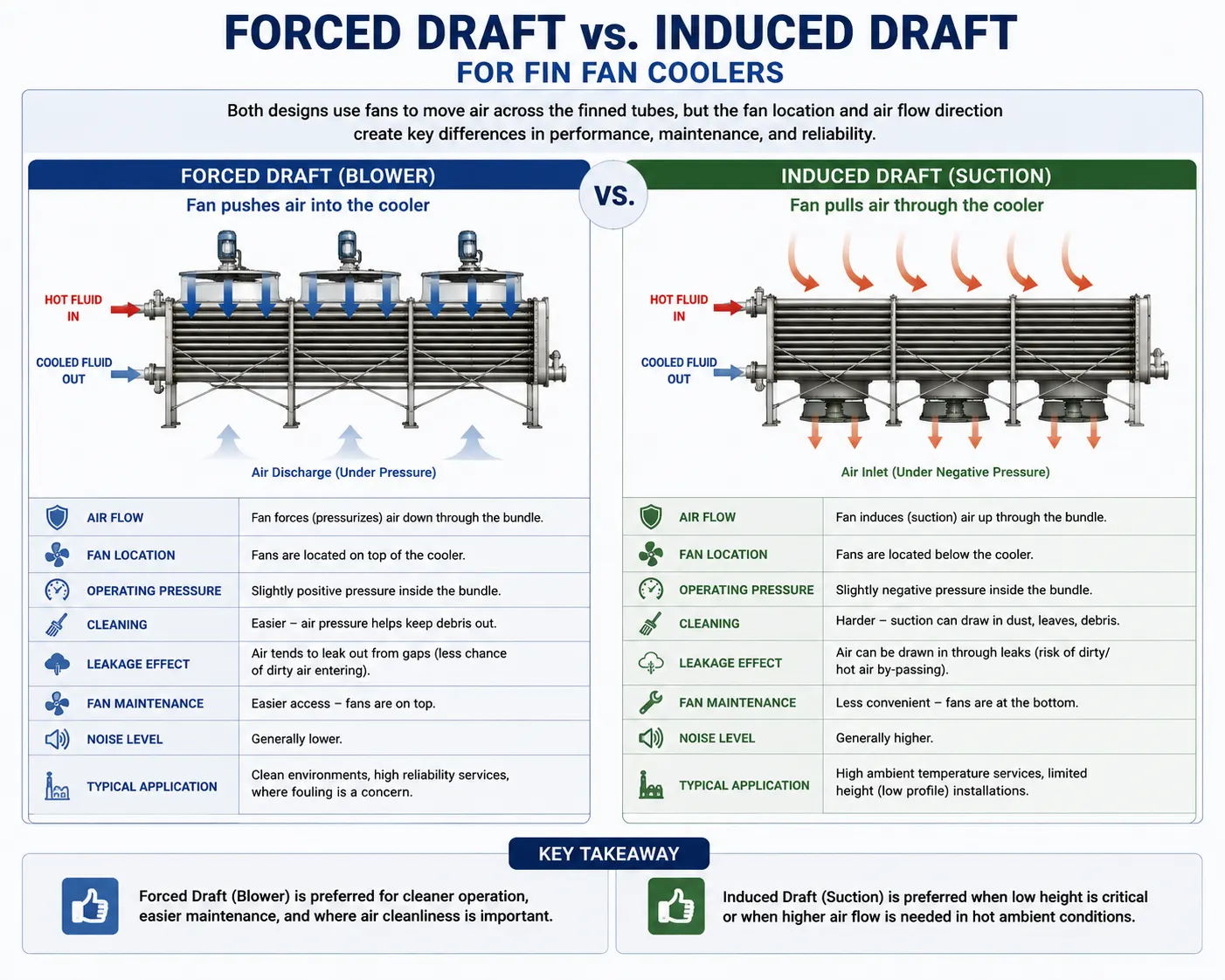 Fin fan coolers are broadly classified into two configurations based on how air is moved through the system.
Forced Draft
In a forced draft fin fan cooler, the fan is positioned below the tube bundle and pushes air upward through the finned tubes. This arrangement places the fan and motor in cooler ambient air, which is beneficial for motor and fan bearing longevity. Forced draft units are generally easier to maintain since the mechanical components are accessible at grade level. However, because the fan handles cooler, denser inlet air, it may require slightly more power and the air distribution across the bundle can be less uniform.Induced Draft
In an induced draft configuration, the fan is mounted above the tube bundle and pulls air upward through the fins. The heated exhaust air is discharged at a higher elevation, reducing the risk of hot air recirculation back into the inlet. Induced draft units provide more uniform airflow across the bundle and are better suited for high-temperature applications where the process outlet temperature is close to the fan inlet air temperature. The downside is that the fan operates in hot, less-dense air, which can stress mechanical components, and maintenance access is more challenging.Benefits of Fin Fan Coolers
- Water Conservation: Eliminates dependence on freshwater sources, reducing operational costs and environmental impact.
- Low Maintenance Requirements: Accessible fans and tube bundles simplify inspections and minimize downtime.
- Adaptability: Can be configured for horizontal, vertical, or custom plant layouts, providing flexibility for space-constrained installations.
Key Components of a Fin Fan Cooler
A fin fan cooler consists of several critical components that work together to achieve efficient heat transfer:- Tube Bundle: The core heat transfer element, consisting of tubes arranged in rows. The tubes carry the process fluid and are externally fitted with fins. Tube materials are selected based on process fluid properties and operating pressure.
- Fins: Extended surfaces attached to the outer diameter of the tubes to increase air-side heat transfer area. Fins can be wrapped, embedded, extruded, or welded depending on the design and operating temperature.
- Headers: Inlet and outlet manifolds at each end of the tube bundle that distribute process fluid into the tubes and collect it after cooling. Headers can be plug type, cover plate type, or manifold type depending on design pressure and maintenance needs.
- Fans and Motors : Comprises the fan blades, hub, drive shaft, and related hardware. Fan blades are typically made of aluminum, fiberglass, or composite materials to balance strength, weight, and corrosion resistance.
- Motor and Drive: An electric motor (or sometimes a steam turbine or hydraulic motor) drives the fan either directly or through a gearbox, V-belt, or direct-coupled arrangement.
- Fan Ring and Plenums: The fan ring directs airflow into or away from the tube bundle, while the plenum chamber helps achieve uniform air distribution.
- Structural Framework: Steel structure that supports the tube bundle,header box, fan assembly, motors,axial fans and access platforms. The structure must be designed to handle wind, seismic, and equipment loads.
- Louvers: Adjustable slats that can be opened or closed to control airflow through the bundle, enabling process temperature control or winterization in cold climates.
Types of Fins Used in Industrial Air-Cooled Heat Exchangers
The choice of fin type significantly affects heat transfer performance, fouling tendency, and cost. The most common fin types include:Tension-Wound (L-Foot) Fins
L-foot fins are made by winding a strip of aluminum or steel around the tube under tension. The foot of the L-shaped fin strip presses against the tube surface, creating mechanical contact. These are cost-effective and widely used for moderate temperature applications. The limitation is that the contact resistance between the fin foot and the tube surface increases at elevated temperatures, reducing efficiency.Embedded (G-Fin) Fins
In embedded fin construction, a helical groove is machined into the tube surface and the fin strip is wound into the groove, locking it in place. This provides excellent mechanical bond and low contact resistance, making embedded fins suitable for higher temperature services. They offer better performance retention over time compared to tension-wound fins.Extruded Fins
Extruded fins are produced by hot-rolling or extrusion processes that integrally form the fins from the tube material itself, typically aluminum. Since fin and tube are one continuous material, there is zero contact resistance, maximizing thermal performance. Extruded fins are best suited for services where the process fluid temperature is within the aluminum service range (generally below 200°C / 392°F).Welded Fins
Welded fins are metallurgically bonded to the tube by resistance or laser welding, providing excellent contact at high temperatures. These are used in high-temperature applications such as fired heaters or steam generation where carbon steel or stainless steel tubes operate above the limits of aluminum fins.Applications of Fin Fan Coolers
Fin fan coolers serve a vast range of applications across multiple industries. Their ability to cool process streams without consuming water makes them indispensable in the following sectors:oil refineries, petrochemical plants, power generation, gas turbine systems, and gas processing facilities.Oil and Gas Industry
In upstream and midstream oil and gas operations, fin fan coolers are used to cool natural gas after compression, condense overhead vapors from fractionation columns, cool produced water, and handle interstage cooling in multi-stage compressor trains. In refineries, they cool product streams such as diesel, naphtha, and kerosene from distillation units.Petrochemical Plants
Petrochemical facilities rely on fin fan coolers to handle cooling duties in reactors, distillation systems, and heat recovery networks. Ethylene plants, ammonia synthesis loops, methanol plants, and polymer production facilities all make extensive use of air-cooled heat exchangers.Power Generation
Air-cooled condensers (ACCs) used in steam power plants are a specialized form of fin fan cooler designed to condense steam exhausted from turbines. They are particularly prevalent in water-scarce regions where once-through or evaporative cooling is not feasible. Combined cycle power plants also use fin fan coolers to cool lube oil, turbine coolant, and other auxiliary streams.Chemical Processing
In chemical plants, fin fan coolers handle cooling duties for reactors, absorbers, and product coolers in processes ranging from sulfuric acid production to fertilizer manufacturing. Their chemical resistance properties (through appropriate tube and fin material selection) make them suitable even for corrosive process fluids.HVAC and Industrial Refrigeration
Air-cooled condensers in large commercial HVAC systems and industrial refrigeration are essentially fin fan coolers designed for refrigerant service. They reject heat from the refrigerant cycle to ambient air, enabling comfort cooling or low-temperature process refrigeration without water cooling infrastructure.In addition to cooling process fluids, fin fan coolers improve overall plant energy efficiency by reducing the load on downstream compressors and pumps. Their ability to operate without water is particularly valuable in remote locations or offshore platforms where water supply is limited.
Choosing the right cooling solution for your facility is critical. Our experts are here to help you evaluate performance requirements, comply with industry standards, and ensure system compatibility. Get in touch with us today to find the most suitable solution for your application.
Fin Fan Cooler Design Considerations
Thermal Design
The thermal design of a fin fan cooler involves calculating the required heat duty, determining the log mean temperature difference (LMTD) between the process fluid and cooling air, and sizing the tube bundle to achieve the target outlet temperature. Key design parameters include the overall heat transfer coefficient, the fin efficiency, the air-side and process-side fouling factors, and the pressure drop on both sides.Design ambient temperature is a critical input — the unit must be designed to achieve the required process cooling even on the hottest days of the year. A design ambient temperature is typically selected based on statistical analysis of weather data (often the 2% or 5% exceedance temperature), balancing the need for reliability against the cost of oversizing.
Mechanical Design
The mechanical design encompasses tube and header material selection, wall thickness calculations based on operating pressure and temperature, flange ratings, and structural sizing. Fin fan coolers often operate at pressures ranging from a few bar up to several hundred bar for high-pressure gas cooling applications, requiring careful pressure vessel design in accordance with applicable codes such as ASME Section VIII or EN 13445.Fan and Motor Sizing
Selecting the correct fan diameter, blade pitch, speed, and motor rating is essential for achieving the required airflow at acceptable power consumption. Fan efficiency curves, noise constraints, and variable pitch or variable speed options are evaluated during design. Energy-efficient designs often incorporate variable frequency drives (VFDs) or auto-variable pitch hubs to modulate airflow in response to process conditions and ambient temperature.Noise and Vibration
Fin fan coolers can be significant sources of noise and vibration in a plant. Fan blade tip speed is a primary driver of aerodynamic noise, and designs that limit tip speed through larger, slower-turning fans can achieve meaningful noise reductions. Structural resonance between fan blade pass frequency and natural frequencies of the supporting structure must be avoided through careful dynamic analysis.Fin Fan Cooler Maintenance Best Practices
Proper maintenance is essential to sustain the performance and extend the service life of fin fan coolers. A well-maintained unit can operate reliably for twenty to thirty years, while a neglected system may suffer premature failure and costly unplanned shutdowns.Routine Inspection
Regular visual inspections should cover the condition of fan blades (checking for cracks, erosion, or damage), belt tension and condition in belt-driven units, gearbox oil level and condition, motor vibration and temperature, and the structural integrity of the support framework. Tube bundles should be checked for fouling, fin damage from debris impact, and any signs of tube leaks through visual inspection or simple pressure testing.Fin Cleaning
Over time, fins accumulate dust, debris, pollen, insects, and other airborne deposits that reduce airflow and increase thermal resistance, degrading heat transfer performance. Regular fin cleaning — using high-pressure water washing, steam cleaning, or compressed air — is one of the most impactful maintenance activities for sustaining cooling capacity. The frequency depends on the plant environment; dusty or coastal locations may require quarterly or even monthly cleaning, while clean environments may only need annual cleaning.Tube Bundle Inspection and Testing
Tube bundles should be periodically inspected for internal fouling, corrosion, and tube wall thinning. Non-destructive testing methods such as eddy current testing, radiography, or hydrostatic pressure testing can assess tube integrity without requiring full disassembly. Early detection of tube degradation allows planned repair or replacement, avoiding unplanned leaks and production losses.Fan and Drive Maintenance
Fan blades should be inspected for cracks, erosion, or pitch change, and balanced if vibration levels exceed acceptable limits. Gearboxes require periodic oil changes and gear tooth inspection. Bearings should be greased or replaced according to the manufacturer's recommendations. Electric motors should be checked for insulation resistance, bearing condition, and alignment with the drive shaft.Winterization
In cold climates, fin fan coolers require winterization measures to prevent process fluid freezing, which can rupture tubes and headers. Strategies include installing louvers to reduce airflow and maintain process temperatures during cold ambient conditions, using recirculation ducts to mix hot exhaust air with cold inlet air, or heat tracing and insulating exposed piping. Operational procedures for controlling louver position based on ambient temperature are an important part of cold weather operations.Troubleshooting Common Fin Fan Cooler Problems
Insufficient Cooling Capacity
If a fin fan cooler fails to achieve the required process outlet temperature, the root cause is usually one of the following: fin fouling reducing effective heat transfer area, a fan operating at reduced speed due to a mechanical problem, higher-than-design ambient temperatures, reduced process flow enabling lower cooling duty with less driving force, or air recirculation where hot exhaust air is pulled back into the fan inlet. Systematic investigation — starting with checking fan speed, conducting fin cleaning, and verifying ambient conditions — usually isolates the cause.Excessive Vibration
Vibration in fin fan coolers can originate from fan imbalance (caused by bent, eroded, or broken blades), worn or improperly aligned drive components, loose structural fasteners, or resonance between the fan excitation frequency and structural natural frequencies. Vibration analysis using portable instruments can identify the frequency and source of vibration, guiding corrective action.Tube Leaks
Tube leaks allow process fluid to escape or allow air ingress depending on operating pressure. Causes include corrosion from process side or air side (coastal environments with salt-laden air are particularly aggressive), erosion from high-velocity process flow, or mechanical damage. Leaking tubes can sometimes be temporarily repaired by plugging, but systematic tube failures usually indicate a need for material upgrade or complete bundle replacement.High Power Consumption
Unusually high motor power draw can result from damaged fan blades increasing aerodynamic drag, improperly set blade pitch consuming excessive energy, or blockage in the air path increasing resistance. Energy audits comparing actual power consumption against design targets can reveal efficiency losses and guide optimization.Energy Efficiency and Sustainability in Air-Cooled Heat Exchanger Systems
Fin fan coolers, when properly designed and operated, are inherently more sustainable than water-cooled alternatives because they consume no water — a critical advantage in water-stressed regions. However, they do consume electrical energy to drive the fans, and optimizing this consumption is an important aspect of plant energy management.Variable frequency drives (VFDs) applied to fin fan cooler motors can reduce energy consumption dramatically during cooler ambient conditions or reduced process duty. A fan operating at 80% of full speed consumes only about 51% of the power required at full speed, following the fan affinity laws. Plants that implement VFD-based control on their fin fan coolers routinely achieve 20-40% reductions in cooling system energy consumption.
Auto-variable pitch fans offer an alternative to VFDs, changing blade angle to modulate airflow while the motor runs at constant speed. This approach suits environments where electrical power quality is poor or VFD installation is impractical.
High-efficiency fan blade designs — using aerofoil profiles and optimized pitch distributions — can improve aerodynamic efficiency by 10-20% compared to older flat-plate blade designs, translating directly to energy savings over the equipment lifetime.
Selecting the Right Fin Fan Cooler for Your Application
Choosing the right fin fan cooler requires careful evaluation of several factors that go beyond simple heat duty calculations. A technically sound selection ensures long service life, low operating costs, and reliable process performance.Process Requirements
Start by clearly defining the process fluid properties (composition, flow rate, inlet and outlet temperatures, operating pressure), the design ambient temperature for the site, the allowable pressure drop on the process side, and any special requirements such as fugitive emission limits or cleanability needs. These parameters drive the fundamental sizing of the tube bundle and fan system.Site Conditions
Site elevation affects air density and fan performance — installations at high altitude require fans sized for the lower air density to deliver the required mass flow. Prevailing wind direction can influence hot air recirculation risk and should be considered in unit orientation. Seismic zone classifications and wind load requirements affect structural design.Material Selection
Tube material selection depends on process fluid corrosivity, operating temperature, and pressure. Carbon steel is the most economical choice for non-corrosive services. Stainless steel (316L, duplex grades) is used for corrosive fluids. Titanium offers outstanding corrosion resistance for aggressive services such as seawater cooling. Fin material must be compatible with the tube and the environment —Additionally, the choice of fan type—such as axial or centrifugal fans—plays a crucial role in performance. aluminum fins are preferred for most services but should be avoided in coastal areas with chloride-laden air unless coated or replaced with stainless steel fins.Regulatory and Code Compliance
Fin fan coolers used in pressure service must be designed and fabricated to applicable pressure vessel codes (ASME VIII, EN 13445, or others per regional requirements). API 661 is the widely referenced industry standard for petroleum, petrochemical, and natural gas industry air-cooled heat exchangers, providing guidance on design, materials, fabrication, inspection, and testing.Choosing a Trusted Fin Fan Cooler Supplier
When investing in fin fan cooling equipment, selecting a reputable supplier with demonstrated engineering expertise is as important as the technical specification itself. The right supplier brings not just hardware, but engineering knowledge, project execution capability, and long-term aftermarket support.What to Look for in a Fin Fan Cooler Manufacturer
Look for manufacturers with a proven track record across diverse industries and applications. Key indicators of a capable supplier include ASME U-stamp certification (for pressure vessel fabrication), ISO 9001 quality management system certification, API 661 design experience, and a robust engineering team capable of performing thermal, mechanical, and structural design in-house.Ask potential suppliers about their fin tube fabrication capabilities — the best manufacturers produce their own finned tubes using controlled automated processes, ensuring consistent fin-to-tube bond quality that directly impacts long-term thermal performance. Suppliers who source finned tubes from third parties introduce an additional variable in quality control.
Total Cost of Ownership Perspective
While upfront capital cost is an important consideration, evaluating fin fan coolers on a total cost of ownership basis is essential. A lower initial cost can be quickly eroded by higher energy consumption, more frequent maintenance requirements, or shorter equipment service life. Request lifecycle cost analyses from suppliers, comparing energy consumption, predicted maintenance intervals, and expected service life across competing designs.After-Sales Support and Spare Parts
Fin fan coolers are long-life assets, often operating for twenty to thirty years. Selecting a supplier with a strong aftermarket organization — including readily available spare parts, field service engineers, and technical support — reduces operational risk over the equipment life. Before purchasing, inquire about spare parts lead times for critical components such as fan blades, gearboxes, and drive belts, as extended lead times can complicate maintenance planning.Upgrading or Retrofitting Existing Units
Many plants operate fin fan coolers that are decades old and no longer meet current performance requirements or energy efficiency standards. Retrofitting with modern high-efficiency fan blades, VFDs, or new tube bundles with enhanced fin designs can restore or even upgrading to compact or vertical-type fin fan coolers can restore or even exceed original performance at a fraction of the cost of complete replacement. Engage experienced suppliers who offer audit and upgrade services to identify the most cost-effective improvement opportunities for your existing equipment.Conclusion
Fin fan coolers are essential workhorses of the process industries, providing reliable, water-free heat rejection for a vast array of applications. Their fundamental simplicity — moving air across finned tubes — belies the engineering sophistication involved in designing high-performance, energy-efficient, and long-lived systems.Understanding the operating principles, design considerations, maintenance requirements, and troubleshooting approaches covered in this guide equips engineers, maintenance professionals, and plant operators to get the most from their fin fan cooling systems. Whether you are specifying a new installation, optimizing an existing system, or troubleshooting a performance issue, a solid grounding in fin fan cooler fundamentals is invaluable.
As energy costs rise and water availability constraints tighten in many regions, the role of air-cooled heat exchangers in sustainable industrial operations will only grow. Investing in efficient, well-maintained fin fan coolers — and working with knowledgeable, quality-focused suppliers — is a sound strategy for reliable and cost-effective plant cooling for decades to come.


