

22-10-2026
What is a cooling tower?
A cooling tower is a specialized heat exchanger that rejects waste heat from industrial processes, power plants, or commercial air conditioning systems into the atmosphere.
How It Works
- Warm Water Inlet: Hot water from industrial machinery or a building's chiller enters the top of the tower.
- Distribution & Fill Media: Spray nozzles distribute the water over internal "fill media," which spreads the water into a thin film to maximize surface area.
- Airflow & Evaporation: Fans pull or force ambient air through the cascading water. A small fraction of the water evaporates, releasing latent heat and sharply lowering the temperature of the remaining water.
- Collection Basin: The cooled water gathers in a basin at the bottom and is pumped back to absorb more heat.
Main Types of Cooling Towers
- Natural Draft: Uses large, often hyperbolic concrete structures where warm, buoyant air naturally rises to pull in fresh air at the base, common in large power plants.
- Mechanical Draft: Uses motor-driven fans to force or induce airflow. They are split into:
• Induced Draft: Fans sit at the top, pulling air up through the tower (negative pressure).
• Forced Draft: Fans sit at the air inlet, pushing air in (positive pressure). - Crossflow vs. Counterflow: Classified by how the air moves relative to the water either flowing horizontally across the falling water (crossflow) or moving vertically upward against the falling water (counterflow).
- Wet vs. Dry Systems: Wet towers rely directly on evaporation, whereas dry towers use closed-loop radiators similar to a car's engine radiator without direct water evaporation.
Main Components
- Fill media: Plastic or wood sheets that increase water-to-air contact time and surface area.
- Fan assembly: Blows or draws air through the tower structure.
- Water distribution system: Pipes and nozzles that spread warm water evenly over the fill.
- Drift eliminators: Baffles that trap and stop liquid water droplets from escaping out with the exhaust air.
- Cold water basin: A reservoir at the base that holds the chilled water before recirculation.
2. History and Evolution of Cooling Towers
- Late 1800s: Early cooling towers were developed in Europe to cool water used in steam engine condensers, replacing the practice of dumping hot water directly into rivers.
- Early 1900s: Natural draft towers were adopted by power stations as electricity generation scaled up, since large volumes of cooling water were needed for steam turbine condensers.
- 1930s-1950s: Mechanical draft (fan-assisted) towers became common as industries needed more compact, controllable cooling with smaller footprints than natural draft towers.
- 1960s onward: Introduction of FRP (fiberglass-reinforced plastic) as a construction material made towers lighter, corrosion-resistant, and easier to install compared to timber and concrete.
- 1980s-2000s: Growing environmental awareness led to drift eliminators, better water treatment programs, and Legionella-focused design and maintenance standards.
- 2010s-2020s: Focus shifted to water conservation, hybrid wet/dry systems, VFD-based fan control, and IoT-based remote monitoring for predictive maintenance.
3. How a Cooling Tower Works (Working Principle)
The working principle of a cooling tower is based on evaporative cooling the same principle that cools your skin when sweat evaporates.Step-by-Step Process
- Hot water enters the tower. Water that has absorbed heat from a condenser, chiller, or industrial process (typically 35-45°C) enters the top of the cooling tower through inlet piping.
- Water is distributed evenly. A distribution system (spray nozzles or gravity-fed troughs) spreads the hot water evenly over the fill material to maximize surface area.
- Water flows down through the fill. As water trickles or splashes down through the fill (packing), it breaks into thin films or fine droplets, dramatically increasing the water's exposed surface area.
- Air is drawn or pushed through the tower. A fan (mechanical draft) or natural buoyancy of warm air (natural draft) moves ambient air through the fill, either counter to the water flow (counterflow) or across it (crossflow).
- Evaporation occurs. A small fraction of the water (roughly 1-2% of total flow at typical operating conditions) evaporates. Because evaporation requires energy (latent heat), this heat is drawn from the remaining liquid water, cooling it significantly.
- Sensible heat transfer also occurs. In addition to evaporation, some heat transfers directly from the warmer water to the cooler air through contact (sensible heat), though this is a smaller contributor than evaporation.
- Drift eliminators capture water droplets. Before the moist air exits the tower, drift eliminators remove entrained water droplets, minimizing water loss and preventing fine mist from escaping into the surroundings.
- Cooled water collects in the basin. The now-cooled water (often 5-10°C cooler than the entering water) falls into the cold water basin at the base of the tower.
- Cold water is recirculated. Pumps send this cooled water back to the condenser, chiller, or process equipment, where it absorbs heat again — and the cycle repeats continuously.
- Makeup water replaces losses. Water lost to evaporation, drift, and blowdown is continuously replaced by a makeup water supply to maintain the correct water level in the basin.
Why Evaporation Cools Water So Effectively
Evaporating just 1% of a water stream's mass can lower the temperature of the remaining 99% by roughly 5-6°C, because water has a very high latent heat of vaporization (~2,260 kJ/kg). This is what makes cooling towers far more space- and energy-efficient than dry, air-only heat exchangers for rejecting large heat loads.4. Types of Cooling Towers
Cooling towers can be classified in several overlapping ways: by draft mechanism, by air-water flow direction, by construction material, and by water contact method.A. Based on Draft Type
1. Natural Draft Cooling Tower
- Relies purely on the density difference between warm, moist air inside the tower and cooler ambient air outside to create upward airflow no fans required.
- Typically built as large hyperbolic concrete structures, 100-200 meters tall, seen at power plants.
- Advantages: no fan power required, very low operating cost for airflow, extremely durable.
- Disadvantages: massive capital cost, large land footprint, performance is weather-dependent, only viable at very large capacities.
2. Mechanical Draft Cooling Tower
- Uses electric-motor-driven fans to force airflow through the tower, giving precise, controllable performance regardless of weather.
- Forced Draft: Fan is mounted at the air inlet (bottom), pushing air into the tower. Fans handle drier air, so they last longer, but this design is prone to recirculation of exhaust (warm, humid) air back into the intake.
- Induced Draft: Fan is mounted at the air outlet (top), pulling air through the tower and discharging it upward at high velocity, which reduces recirculation. This is the most common configuration in industrial and commercial cooling towers today.
3. Fan-Assisted Natural Draft (Hybrid Draft)
- Combines a natural draft tower shell with fans to boost airflow during high-load or high-ambient-temperature periods less common, used in select large-scale plants.
B. Based on Air-Water Flow Direction
1. Counterflow Cooling Tower
- Air flows vertically upward through the fill, directly opposite to the downward flow of water.
- Generally offers better thermal efficiency because the coolest air meets the coolest water (maximizing driving force for heat transfer).
- Requires higher fan static pressure and pump head; nozzles can be prone to clogging since they spray upward or sideways into the airstream.
2. Crossflow Cooling Tower
- Air flows horizontally across the tower while water falls vertically through the fill.
- Uses gravity-fed distribution decks instead of pressurized spray nozzles, making maintenance and inspection easier (you can walk on the distribution deck).
- Slightly lower thermal efficiency per unit of fill compared to counterflow, but often has lower pumping energy requirements.
C. Based on Construction Material
- RCC (Reinforced Cement Concrete) Towers – Extremely durable and used for large natural draft towers in power plants; high capital cost, long service life (40+ years).
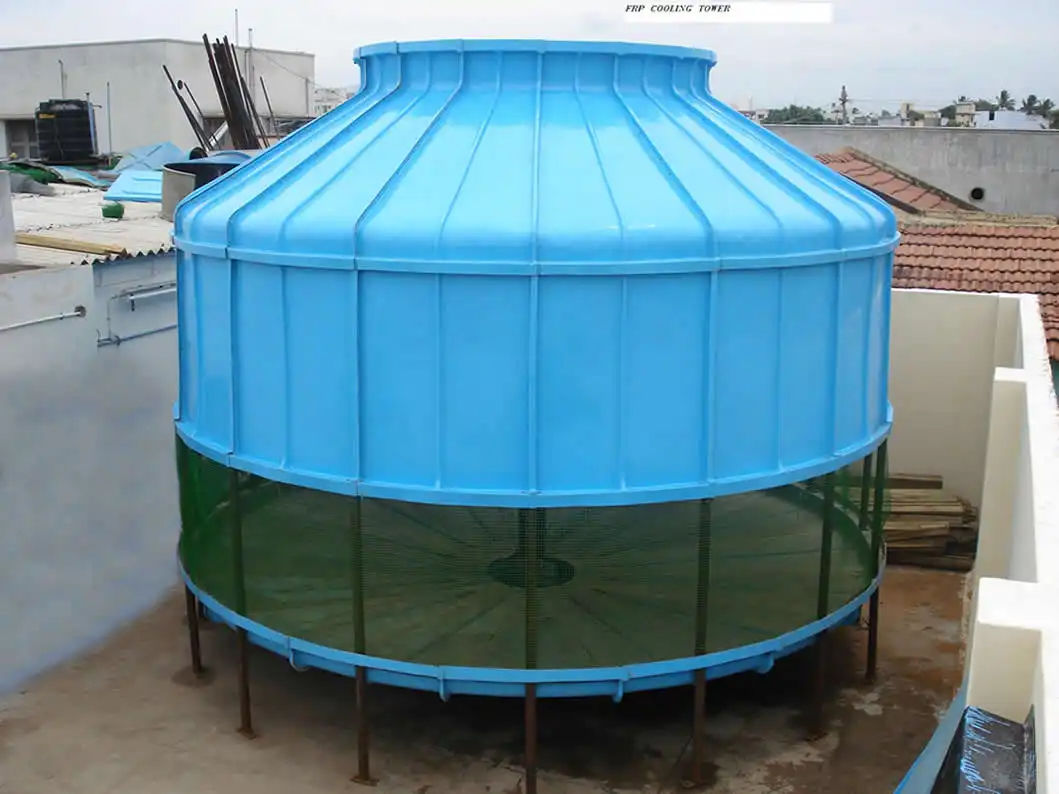
- FRP (Fiberglass Reinforced Plastic) Towers – Lightweight, corrosion- and UV-resistant, low maintenance; the most common choice for industrial and commercial mechanical draft towers today.
- Timber Cooling Towers – Historically common due to natural resistance to some chemicals, but largely phased out due to fire risk, rot, and high maintenance needs.
- Galvanized/Stainless Steel Towers – Used where high structural strength or specific chemical resistance is required; stainless steel is preferred in corrosive or high-purity environments (e.g., pharma, food processing).
D. Based on Water Contact Type
- Wet (Open) Cooling Tower – Water directly contacts air; the most common, cost-effective, and thermally efficient type, but consumes water continuously.
- Dry Cooling Tower – Hot water (or process fluid) flows through finned tube heat exchangers, and air is blown across the outside of the tubes with no direct water-air contact. Zero evaporative water loss, but lower efficiency, especially in hot climates, and higher capital cost.
- Hybrid (Wet-Dry) Cooling Tower – Combines a dry section and a wet section in the same unit. It can run in dry mode when ambient conditions allow, switch to wet mode under high heat loads, and blend both to reduce visible vapor plumes popular in water-stressed or plume-sensitive locations (e.g., near airports or residential areas).
5. Key Components of a Cooling Tower
| Component | Function | Notes |
|---|---|---|
| Fill / Packing | Increases water-air contact surface area and time for better heat and mass transfer. | Splash fill (bars/grids) or film fill (thin PVC sheets); film fill is more efficient but requires cleaner water. |
| Fan | Moves air through the tower (mechanical draft towers). | Axial fans are common; blade pitch and speed affect airflow and noise. |
| Drift Eliminators | Capture and return water droplets carried in the exhaust air stream. | Typically reduce drift loss to below 0.001–0.005% of circulating water flow. |
| Water Distribution System | Distributes incoming hot water evenly over the fill. | Uses pressurized spray nozzles (counterflow) or gravity flow basins/troughs (crossflow). |
| Cold Water Basin | Collects and stores cooled water before it is pumped back to the process. | Includes a sump, strainer, and overflow/drain connections. |
| Casing / Shell | Provides structural support and protects internal components from weather. | Manufactured from FRP, steel, or concrete depending on the cooling tower type. |
| Louvers | Direct airflow into the tower while minimizing water splash-out. | Commonly used in crossflow cooling towers. |
| Motor, Gearbox, and Drive Shaft | Supply power and transmit rotational force to the fan. | Available in gear-driven or belt-driven designs; VFDs are increasingly used for speed control. |
| Makeup Water System | Replenishes water lost through evaporation, drift, and blowdown. | Usually controlled by a float valve or electronic level sensor. |
| Blowdown / Bleed Line | Removes a controlled amount of concentrated water to limit mineral buildup. | Often automated using conductivity-based control systems. |
| Access Ladders / Platforms | Provide safe access for inspection, maintenance, and servicing. | Required by safety standards for cooling towers above certain heights. |
| Vibration Cut-Out Switch | Automatically shuts down the fan motor when excessive vibration is detected. | Protects the cooling tower from mechanical damage caused by fan imbalance or failure. |
6. Cooling Tower Performance Terms (Thermal Design Basics)
Understanding these terms is essential for specifying, evaluating, and troubleshooting a cooling tower.- Range (°C or °F): The temperature difference between the hot water entering the tower and the cold water leaving it. Range = Hot Water Temp − Cold Water Temp. It reflects the heat load and flow rate, not the tower's efficiency by itself.
- Approach (°C or °F): The difference between the cold water leaving temperature and the ambient wet-bulb temperature. Approach = Cold Water Temp − Wet-Bulb Temp. A smaller approach means the tower is performing closer to the theoretical minimum possible temperature and generally means a larger, more expensive tower.
- Wet-Bulb Temperature: The lowest temperature air can be cooled to by evaporating water into it at constant pressure. This is the theoretical limit a cooling tower can approach, and it's the single most important climate input for tower design — not dry-bulb (regular) air temperature.
- Drift Loss: Fine water droplets physically carried out with the exhaust air (not evaporated). Modern drift eliminators limit this to a very small fraction of circulating flow, both to save water and to reduce the risk of spreading waterborne bacteria like Legionella.
- Evaporation Loss: Water lost to the atmosphere as vapor — this is the mechanism that actually cools the water and is unavoidable by design. Roughly 1% of circulating flow evaporates for every 6-7°C of cooling range.
- Blowdown (Bleed-off): Deliberate, controlled discharge of a portion of the circulating water to prevent dissolved solids from concentrating to damaging levels.
- Cycles of Concentration (COC): The ratio of dissolved solids concentration in the circulating water versus the makeup water. Higher COC means more water reuse and less makeup/blowdown water needed, but too-high COC increases scaling and corrosion risk. Most systems target 3-6 cycles.
- L/G Ratio (Liquid-to-Gas Ratio): The ratio of water mass flow rate (L) to air mass flow rate (G) through the tower a core design parameter that determines the required fill volume and tower size for a given heat load.
- Heat Load (Duty): The total amount of heat the tower must reject, usually expressed in kW, tons of refrigeration (TR), or BTU/hr. Heat Load = Flow Rate × Range × specific heat of water.
- Effectiveness: Sometimes expressed as (Range) / (Range + Approach) × 100%, indicating how close the tower gets to the theoretical maximum cooling possible.
7. Applications of Cooling Towers
Cooling towers serve a critical role across nearly every heavy industry and many commercial settings:- Power Plants (Thermal, Nuclear, Combined-Cycle): Reject heat from steam turbine condensers — often the single largest cooling water user in a facility.
- HVAC Systems: Cool the condenser water in water-cooled chillers for large commercial buildings, hospitals, malls, airports, and campuses.
- Chemical and Petrochemical Plants:Cool reactors, distillation columns, and process fluids to maintain safe and efficient reaction conditions.
- Oil Refineries: Cool process streams throughout the refining process, from crude distillation to catalytic cracking units.
- Steel and Metal Industries: Cool furnaces, rolling mills, and continuous casting equipment.
- Food and Beverage Processing: Support pasteurization, refrigeration, and process cooling while maintaining strict hygiene standards.
- Data Centers: Cool chilled water loops that in turn cool server rooms increasingly critical as data center density and AI compute loads grow.
- Pharmaceutical Manufacturing: Maintain tight temperature control for sensitive fermentation, synthesis, and sterilization processes.
- Textile and Paper Mills: Cool process water used in dyeing, drying, and pulp processing.
- Injection Molding and Plastics: Cool molds and hydraulic systems to maintain product quality and cycle times.
8. Cooling Tower Water Treatment
Because cooling towers continuously evaporate water and concentrate minerals, they are naturally prone to scaling, corrosion, fouling, and biological growth. A solid water treatment program is not optional; it directly determines tower lifespan, efficiency, and safety.Key Problems Addressed
- Scaling: Formation of mineral deposits (commonly calcium carbonate, calcium sulfate, or silica) on fill, pipes, and heat exchange surfaces as water evaporates and concentrates dissolved minerals. Scale acts as an insulator, reducing heat transfer efficiency significantly even at small thicknesses.
- Corrosion:Electrochemical or chemical attack on metal components (pipes, heat exchangers, structural steel) caused by dissolved oxygen, low pH, chlorides, or galvanic effects between dissimilar metals.
- Biological Growth: Cooling towers are warm, wet, and sunlit — ideal conditions for algae, bacteria, and biofilm. Of particular concern is Legionella pneumophila, the bacteria responsible for Legionnaires' disease, which can become airborne through drift if not controlled.
- Fouling: Accumulation of dirt, dust, silt, and organic debris (leaves, insects) drawn in with the air or present in makeup water, which clogs nozzles and reduces fill efficiency.
Common Treatment Methods
- Chemical Dosing: Scale inhibitors, corrosion inhibitors, biocides (oxidizing like chlorine/bromine, and non-oxidizing), and dispersants, dosed automatically based on conductivity or on a timed schedule.
- Side-Stream Filtration: Continuously filters a portion of the circulating water to remove suspended solids before they cause fouling.
- Blowdown Control: Automated conductivity-based blowdown keeps cycles of concentration within a safe range, preventing scale-forming minerals from over-concentrating.
- UV and Ozone Treatment: Chemical-free or chemical-reduced disinfection options that are increasingly popular for reducing chemical handling and environmental discharge concerns.
- Routine Water Testing: Regular monitoring of pH, conductivity, total dissolved solids (TDS), hardness, alkalinity, chloride, and microbial counts (including Legionella testing) to catch issues early.
- Passivation: Initial chemical treatment of new metal surfaces (especially galvanized steel) to form a protective oxide layer before normal operation begins.
9. Common Problems and Troubleshooting
| Problem | Possible Causes | Recommended Solution |
|---|---|---|
| Reduced cooling capacity / High cold water temperature | Fouled or scaled fill, low airflow, fan issues, poor water distribution. | Clean the fill, inspect and repair fans, check nozzle spray pattern, and review the water treatment program. |
| Excessive drift / Visible mist beyond the tower | Damaged, missing, or poorly fitted drift eliminators; excessive fan speed. | Inspect and replace drift eliminators and verify the correct fan speed setting. |
| High water / Makeup water consumption | Poor cycles of concentration, leaks in piping or basin, excessive blowdown. | Optimize blowdown control, inspect for leaks, and recalibrate the conductivity controller. |
| Fan or motor vibration / Noise | Fan imbalance, worn bearings, loose belts, misaligned drive shaft. | Balance fan blades, replace bearings, re-tension or replace belts, and check shaft alignment. |
| Algae or slime buildup | Inadequate biocide dosing, sunlight exposure, stagnant water zones. | Improve the chemical dosing program and add tower covers or screens where possible. |
| Scale deposits on fill or pipes | High cycles of concentration, hard water, inadequate scale inhibitor dosing. | Increase blowdown, adjust the scale inhibitor dosage, and consider softened makeup water. |
| Corrosion of metal parts | Low pH, high chloride content, galvanic corrosion between dissimilar metals. | Adjust water chemistry, add corrosion inhibitors, and use compatible materials. |
| Uneven water distribution over fill | Clogged or damaged spray nozzles, blocked distribution troughs. | Clean or replace spray nozzles and remove debris from distribution troughs. |
| Cold water basin overflow | Faulty makeup water float valve, blocked overflow drain. | Repair or replace the float valve and clear the overflow drain blockage. |
| Ice formation in winter (cold climates) | Low heat load combined with high airflow during freezing conditions. | Reduce fan speed or cycle the fans, use basin heaters, and adjust the operating sequence. |
10. Cooling Tower Maintenance Checklist
Daily / Weekly Checks
- Check makeup water system and float valve operation
- Visually inspect for leaks, unusual noise, or vibration
- Monitor hot water inlet and cold water outlet temperatures (range and approach)
- Check chemical dosing pump operation and chemical tank levels
Monthly Checks
- Inspect fill for fouling, scaling, or biological growth
- Check fan belts, bearings, motor, and gearbox condition and lubrication
- Test water chemistry: pH, conductivity, hardness, chloride
- Inspect drift eliminators for damage or misalignment
- Clean strainers and basin screens
Quarterly Checks
- Deep-clean the cold water basin and remove accumulated sediment
- Inspect and clean spray nozzles or distribution decks
- Check structural components for corrosion, cracks, or loose fasteners
- Verify vibration cut-out switch functionality
- Conduct Legionella risk assessment sampling (as per local regulation or ASHRAE 188)
Annual Checks
- Full mechanical overhaul: gearbox oil change, bearing replacement if due, motor insulation testing
- Complete structural inspection, including casing, ladders, and platforms
- Review and update the water treatment program with a water treatment specialist
- Performance test against original design specifications (range, approach, flow rate)
- Repaint or recoat structural steel components if corrosion is present A documented maintenance log is strongly recommended not just for reliability, but for regulatory compliance and insurance purposes.
11. Energy Efficiency and Sustainability
Cooling towers are often one of the larger energy and water consumers in a facility, so efficiency improvements can have a real impact on operating cost and environmental footprint.- Variable Frequency Drives (VFDs): Allow fan speed to be modulated based on actual cooling load and ambient wet-bulb temperature instead of running fans at full speed constantly, cutting fan energy use significantly during partial-load and cooler periods.
- High-Efficiency Fill Media: Film fill designs increase surface area and improve heat transfer per unit volume compared to older splash fill, allowing smaller towers or better performance from existing ones.
- Optimized Water Treatment: Running at higher (but safe) cycles of concentration reduces blowdown and makeup water consumption significantly.
- Leak Detection and Repair: Even small, unnoticed leaks in piping or the basin can waste large volumes of water over a year.
- Hybrid or Dry Cooling Systems: In water-stressed regions, hybrid systems reduce water consumption by switching to dry mode when ambient conditions allow.
- Plume Abatement: Reduces visible vapor plumes, which is both an aesthetic/regulatory benefit and, in hybrid designs, often correlates with reduced water use.
- Waste Heat Recovery: In some facilities, heat that would otherwise be rejected via the cooling tower can be partially recovered for preheating or other low-grade heat needs before reaching the tower.
- Smart Monitoring (IoT/BMS Integration): Real-time sensors for temperature, flow, vibration, and water chemistry feed into building management systems (BMS) for predictive maintenance and automatic optimization.
12. Cooling Tower vs Other Cooling Systems
| Feature | Cooling Tower | Air-Cooled Chiller | Dry Cooler |
|---|---|---|---|
| Water Usage | Moderate to high (continuous evaporation). | None. | None. |
| Cooling Efficiency | High — leverages evaporative cooling and can approach the wet-bulb temperature. | Moderate — limited by the dry-bulb air temperature. | Lower in hot climates — also limited by the dry-bulb air temperature. |
| Footprint | Larger; typically requires outdoor space with adequate airflow clearance. | Compact; often installed on rooftops. | Compact. |
| Capital Cost | Moderate. | Higher for equivalent cooling capacity in most applications. | Higher for equivalent cooling capacity. |
| Operating Cost | Lower energy consumption, but requires water and chemical treatment. | Higher energy consumption with no water treatment cost. | Higher energy consumption with minimal water-related cost. |
| Best Suited For | Large industrial and commercial applications where water is available. | Facilities with water restrictions or smaller cooling loads. | Water-scarce locations and cooler climates. |
| Maintenance Focus | Water treatment, fill cleaning, drift eliminators, and biological control. | Refrigerant circuit and compressor maintenance. | Fan and coil cleaning, along with refrigerant or process fluid circuit maintenance. |
13. Cooling Tower Sizing and Capacity Calculation
Proper sizing avoids both undersized towers (which can't maintain process temperatures during peak load) and oversized towers (which waste capital and can operate inefficiently at part load).Basic Sizing Inputs Needed
- Heat load (duty): Total heat to be rejected, in kW, tons of refrigeration (TR), or BTU/hr.
- Water flow rate: Usually expressed in liters per second (L/s), cubic meters per hour (m³/hr), or gallons per minute (GPM).
- Design range: The required temperature drop across the tower.
- Design wet-bulb temperature: Based on local climate data (typically the 0.4% or 1% design wet-bulb temperature for the location, meaning it's exceeded only a small percentage of hours per year).
- Design approach: The desired gap between cold water leaving temperature and design wet-bulb temperature (smaller approach = larger, costlier tower).
Simplified Heat Load Formula
Heat Load (kW) = Water Flow Rate (L/s) × Range (°C) × 4.186(4.186 kJ/kg·°C is the specific heat of water.)
Rule-of-Thumb Reference
A common HVAC benchmark: 1 ton of refrigeration (TR) of cooling tower capacity ≈ 3 GPM (US) of condenser water flow at a typical 5.5°C (10°F) range and 6°C (11°F) approach. This is a simplified rule of thumb, only actual sizing should always be done using manufacturer thermal performance curves or CTI-certified software, since real performance depends heavily on local wet-bulb conditions.It's strongly recommended to involve a cooling tower manufacturer or thermal design engineer for final sizing, since fill type, altitude, air density, and site-specific airflow obstructions all affect actual performance.
14. How to Select the Right Cooling Tower
Key factors to evaluate when selecting a cooling tower:- Heat load — the total cooling duty the tower must handle (in TR or kW).
- Design wet-bulb temperature — based on the specific site's climate data, not just general regional temperature.
- Required range and approach — driven by the connected equipment's design requirements (chillers, condensers, process equipment).
- Water availability and quality — hardness, mineral content, and availability of makeup water affect both tower design and water treatment needs.
- Available space, height restrictions, and noise limits — especially important for rooftop installations in commercial buildings.
- Draft type — natural draft only makes sense at a very large scale; mechanical draft (forced or induced) suits most industrial/commercial needs.
- Flow configuration — counterflow for higher thermal efficiency in a smaller footprint, or crossflow for easier maintenance access.
- Material of construction — FRP for general-purpose corrosion resistance, stainless steel for aggressive or high-purity environments, concrete for very large-scale natural draft towers.
- Energy efficiency features — VFD compatibility, high-efficiency fill, and fan design affect long-term operating cost.
- Budget — balance upfront capital cost against long-term operating, water, and maintenance costs; a cheaper tower with a poor approach or inefficient fan can cost far more over its lifetime.
- Regulatory and environmental requirements — local rules on drift emissions, blowdown discharge, and Legionella risk management may influence design choice (e.g., requiring hybrid/dry systems in sensitive locations).
15. Installation Best Practices
- Site orientation: Position the tower so prevailing winds don't cause recirculation of warm, moist exhaust air back into the fresh air intake.
- Clearances: Maintain manufacturer-recommended clearance from walls, adjacent equipment, and other towers to ensure adequate airflow.
- Foundation and structural support: Ensure the foundation is designed for the tower's full operating weight (including water fill weight), plus wind and seismic loads as applicable.
- Vibration isolation: Use proper vibration isolators/mounts for fan and motor assemblies to reduce noise transmission to the building structure.
- Piping design: Avoid excessive elbows and ensure proper pipe sizing to minimize pump head losses; include isolation valves for maintenance.
- Access and safety: Provide adequate ladders, platforms, and guardrails for safe inspection and maintenance access, in line with local safety codes.
- Electrical and controls: Ensure fan motors, VFDs, and control panels are properly rated for outdoor/wet environments (appropriate IP rating).
- Commissioning: Perform a start-up water balance, verify makeup and blowdown operation, and conduct an initial performance test against design specifications before full operational handover.
16. Cooling Tower Costs (Capital and Operating)
Capital Costs typically depend on:
- Tower capacity (TR or kW)
- Material of construction (FRP vs concrete vs steel)
- Draft type (mechanical towers are generally cheaper upfront than large natural draft towers, though natural draft becomes economical only at very large power-plant scale)
- Site-specific factors: foundation work, piping runs, electrical infrastructure, and structural supports
Operating Costs typically include:
- Fan motor electricity consumption (often the largest ongoing cost)
- Pump energy for water circulation
- Water costs (makeup water for evaporation, drift, and blowdown losses)
- Water treatment chemicals and dosing equipment maintenance
- Routine and preventive maintenance labor
- Periodic component replacement (fill, drift eliminators, bearings, motors)
17. Safety, Health, and Environmental Considerations
- Legionella Risk: Cooling towers are a recognized potential source of Legionella bacteria, which can cause Legionnaires' disease if contaminated water droplets (aerosols) are inhaled. Proper water treatment, regular cleaning, effective drift elimination, and routine testing are essential risk controls.
- Chemical Handling: Biocides, scale inhibitors, and corrosion inhibitors must be stored, handled, and dosed according to manufacturer safety data sheets (SDS) and local regulations, with appropriate PPE for personnel.
- Confined Space and Fall Hazards: Basin cleaning and internal inspections may involve confined space entry procedures; ladders and platforms must meet fall-protection standards.
- Electrical Safety: Fan motors and control panels operate in wet, outdoor environments and must be properly grounded, rated, and lockout-tagout (LOTO) procedures followed during maintenance.
- Noise: Fan and water splash noise can affect nearby occupied spaces; acoustic enclosures or low-noise fan designs may be required near residential or noise-sensitive areas.
- Discharge/Blowdown Regulations: Blowdown water often contains concentrated minerals and treatment chemicals and may require permits or pre-treatment before discharge to sewer or surface water, depending on local environmental regulations.
- Visible Plume Concerns: In cold climates or near sensitive locations (airports, residential zones), visible vapor plumes from wet cooling towers can be a nuisance or safety concern (reduced visibility); plume abatement or hybrid towers can mitigate this.
18. Cooling Tower Standards and Regulations
- CTI (Cooling Technology Institute): Publishes widely referenced standards for cooling tower testing (thermal performance certification), nomenclature, and best practices; CTI-certified towers have third-party-verified performance ratings.
- ASHRAE Standard 188: Provides guidance for Legionella risk management in building water systems, including cooling towers, and is widely referenced in facility water management plans.
- Local Environmental Regulations: Govern permitted blowdown discharge quality/volume and drift emission limits; these vary significantly by country, state, and municipality.
- Local Health Department Requirements: Many jurisdictions require registration of cooling towers and periodic Legionella testing/reporting, especially following major outbreak events in various cities worldwide.
- OSHA / Local Occupational Safety Codes: Cover structural safety, fall protection, confined space entry, and electrical safety requirements for cooling tower installation and maintenance.
- Seismic and Wind Load Codes: Structural design codes relevant to the installation region must be followed for tower foundation and support design, especially in earthquake- or hurricane-prone areas.
19. Emerging Trends in Cooling Tower Technology
- IoT-Enabled Smart Cooling Towers: Real-time sensors track temperature, flow, vibration, and water chemistry, feeding data into cloud dashboards or building management systems for predictive maintenance and remote monitoring.
- AI-Based Optimization: Predictive algorithms adjust fan speed, blowdown rate, and chemical dosing dynamically based on load and weather forecasts to minimize energy and water use.
- Water-Conserving Hybrid Designs: Increasing adoption of wet-dry hybrid towers, especially in water-stressed regions and data centers, to balance efficiency with sustainability goals.
- Advanced Fill Materials: New film fill geometries and antimicrobial-treated fill materials aim to improve heat transfer while reducing biological fouling.
- Low-GWP and Chemical-Free Treatment: Growing use of UV, ozone, and electrochemical water treatment to reduce reliance on traditional biocide chemicals.
- Modular and Prefabricated Towers: Factory-assembled modular towers reduce on-site installation time and improve quality control compared to fully field-erected units.
- Noise-Reduced Fan Designs: New blade geometries and variable-pitch fans reduce noise output, important for towers near residential or noise-sensitive zones.
20. Frequently Asked Questions (FAQs)
Q1: What is the main function of a cooling tower?
A cooling tower removes waste heat from industrial processes or HVAC systems by transferring it to the atmosphere, primarily through the evaporation of a small fraction of the circulating water.Q2: How much water does a cooling tower lose?
Typically 1-3% of the circulating water flow is lost through evaporation, drift, and blowdown combined, though the exact figure varies with tower design, climate, and cycles of concentration.Q3: What causes Legionella growth in cooling towers?
Warm, stagnant water combined with inadequate water treatment, organic debris, and biofilm creates favorable conditions for Legionella bacteria to multiply; poor drift control can then allow contaminated aerosols to be released.Q4: What's the difference between counterflow and crossflow cooling towers?
In counterflow towers, air moves upward opposite to the falling water, generally giving higher thermal efficiency per unit of fill. In crossflow towers, air moves horizontally across falling water, offering easier maintenance access via walkable distribution decks, often at the cost of a slightly larger footprint for equivalent performance.Q5: How often should a cooling tower be cleaned?
Basins and fill should be inspected monthly and deep-cleaned at least twice a year under normal conditions; facilities in dusty environments, or with poor water quality, may need more frequent cleaning.Q6: Can cooling towers work without water?
Yes — dry cooling towers use air-cooled heat exchangers with no direct water-air contact, though they're generally less efficient than wet towers, especially in hot climates, and typically cost more for the same capacity.Q7: What is the difference between a cooling tower and a chiller?
A chiller is a machine that actively cools water or another fluid using a refrigeration cycle, while a cooling tower is a passive-to-semi-active heat rejection device that removes the heat the chiller's condenser absorbs, cooling the condenser water so it can be reused. Most large water-cooled chiller systems require a cooling tower to function efficiently.Q8: How long do cooling towers last?
With proper maintenance, FRP mechanical draft towers commonly last 20-25 years, while well-maintained concrete natural draft towers can last 40+ years. Poor water treatment and neglected maintenance can significantly shorten this lifespan.Q9: Why does a cooling tower produce a visible white plume?
The plume is condensed water vapor forming as warm, saturated exhaust air meets cooler ambient air, especially common in cold or humid weather — it is not smoke or pollution, though it can be a visibility or aesthetic concern near sensitive sites.Q10: What are the ideal cycles of concentration for a cooling tower?
Most systems target 3-6 cycles of concentration as a balance between water conservation and controlling scale/corrosion risk, though the ideal number depends on makeup water quality and the specific water treatment program in place.21. Glossary of Key Terms
- Approach: Difference between cold water leaving temperature and ambient wet-bulb temperature.
- Blowdown: Deliberate discharge of concentrated water to control dissolved solids.
- COC (Cycles of Concentration): Ratio of dissolved solids in circulating water vs. makeup water.
- Drift: Water droplets carried out of the tower with exhaust air.
- Fill/Packing: Material inside the tower that increases water-air contact area.
- Induced Draft: Fan positioned at air outlet, pulling air through the tower.
- Forced Draft: Fan positioned at air inlet, pushing air into the tower.
- L/G Ratio: Ratio of water flow to air flow through the tower.
- Makeup Water: Fresh water added to replace losses from evaporation, drift, and blowdown.
- Range: Temperature difference between hot water inlet and cold water outlet.
- Wet-Bulb Temperature: Lowest temperature achievable through evaporative cooling at given conditions; the design limit for tower performance.
22. Conclusion
A cooling tower is far more than a simple box that "makes water cold" — it's a carefully engineered heat rejection system built around the physics of evaporative cooling, and it plays a critical role in power plants, HVAC systems, factories, and data centers around the world. Getting the most out of a cooling tower means understanding its working principle, choosing the right type and size for the application, maintaining strong water treatment discipline, and following a consistent maintenance schedule.Facilities that invest in proper design, regular maintenance, and modern efficiency upgrades (like VFDs and optimized water treatment) consistently see lower energy costs, lower water consumption, longer equipment life, and reduced health/safety risk from issues like Legionella. Whether you're specifying a new tower, troubleshooting an existing one, or simply trying to understand how your building's HVAC system stays cool, this guide should give you a genuinely complete, A-to-Z picture of how cooling towers work and how to manage them well.
Need help with a specific cooling tower decision — sizing for your heat load, comparing counterflow vs crossflow for your site, building a maintenance schedule, or drafting a water treatment SOP? Tell me your application (HVAC, power plant, process cooling, data center, etc.) and I'll put together a tailored recommendation.


