

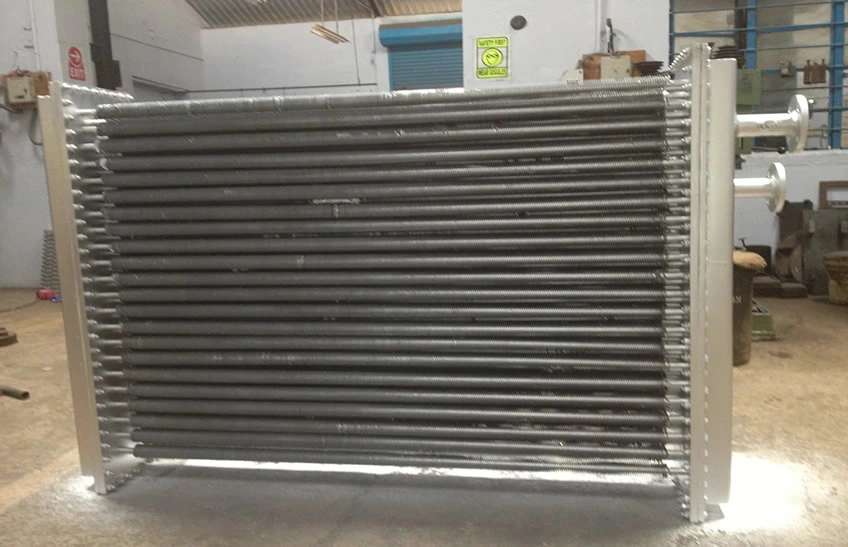
Fin Tube Bundle
Fin tube bundles are an essential component in heat exchangers, designed to maximize thermal efficiency by increasing surface area with extended fins. Widely used in power plants, refineries, petrochemicals, HVAC, and marine applications, they ensure reliable cooling and heating performance in compact designs. At United Cooling Systems Pvt. Ltd., we manufacture high-quality fin tube bundles engineered to meet international standards. With decades of expertise, advanced technology, and a commitment to innovation, our solutions deliver durability, energy savings, and long service life. This guide explores their features, types, benefits, applications, and maintenance for optimized industrial performance.
What Are Fin Tube Bundles?
Fin tube bundles are highly efficient heat transfer components used in a wide range of industrial applications. They are made up of tubes fitted with extended surfaces, known as fins, which significantly increase the available surface area for heat exchange. By enhancing this contact area, fin tube bundles improve the transfer of heat between fluids, making them ideal for both heating and cooling processes.These bundles are commonly found in power plants, petrochemical facilities, refineries, HVAC systems, and marine applications, where reliable and compact thermal solutions are required. Their design not only improves energy efficiency but also reduces operating costs, making fin tube bundles a preferred choice for industries seeking long-lasting and high-performance heat exchanger equipment.
Key Features
- Enhanced Heat Transfer – Fins increase surface area, leading to improved thermal performance.
- Durable Construction – Built with high-quality metals such as carbon steel, stainless steel, copper, or aluminum.
- Compact Design – High heat exchange capacity in limited space.
- Versatility– Can be tailored for heating, cooling, or condensing applications.
- Cost-Efficiency – Reduced energy consumption due to better heat transfer efficiency.
Configurations of Fin Tube Bundles
Fin tube bundles come in multiple configurations designed to meet different industrial requirements. Selecting the right configuration depends on factors such as thermal performance, space constraints, and fluid properties.Straight Tube Bundles
Straight tube bundles have a simple, linear layout that makes them easy to install, clean, and maintain. Their straightforward design is ideal for applications where routine inspection and maintenance are important, such as HVAC systems and standard heat exchangers.U-Tube Bundles
U-tube bundles feature tubes bent into a U-shape, allowing them to handle thermal expansion efficiently. This design reduces stress on the tubes caused by temperature fluctuations, ensuring durability and reliability in processes with frequent heating and cooling cycles.Helical Fin Bundles
Helical fin bundles are equipped with spiral fins that wrap around the tubes. This design promotes turbulence in the fluid flow, which enhances heat transfer efficiency and ensures uniform temperature distribution. Helical fin bundles are often used in high-performance applications where maximum thermal efficiency is required.Custom Configurations
Custom fin tube bundles are tailored to meet specific project requirements. These designs may include unique tube arrangements, specialized fin shapes, and material selections. Custom solutions are particularly valuable in industries such as petrochemicals, power generation, and marine engineering, where standard designs may not meet operational needs.By understanding the different configurations of fin tube bundles, industries can choose the design that provides optimal heat transfer, long-term reliability, and cost-efficient performance.
How Does a Fin Tube Bundle Work?
Fin tube bundles operate on the principle of enhancing heat transfer by increasing surface area. The extended fins attached to the tubes allow more contact between the fluid inside the tubes and the surrounding medium, improving thermal efficiency. This design makes them ideal for both heating and cooling applications.Fluid Flow Inside Tubes
Hot or cold fluid flows through the tubes, carrying energy that needs to be transferred. The controlled flow ensures consistent temperature exchange and prevents hotspots, maintaining optimal system performance.Heat Transfer via Fins
The fins attached to the tubes increase the contact area with the surrounding fluid, such as air or gas. This added surface accelerates heat dissipation or absorption, making the heat transfer process highly efficient.Enhanced Efficiency and Applications
By combining internal tube flow with fin-enhanced surfaces, fin tube bundles provide compact, energy-efficient solutions. They are widely used in industries such as power generation, petrochemicals, HVAC, and marine systems.Performance Optimization of Fin Tube Bundles
Optimizing the performance of fin tube bundles is crucial for achieving maximum heat transfer efficiency and operational reliability. United Cooling Systems Pvt. Ltd. incorporates advanced engineering practices to ensure every fin tube bundle performs at peak levels.Key Optimization Strategies:
- Enhanced Fin and Tube Design: Precision-engineered fins and high-conductivity materials improve heat exchange efficiency.
- Flow Distribution Control: Proper alignment and spacing of tubes and fins ensure uniform fluid flow, reducing pressure drop and hotspots.
- Turbulence Promotion: Helical or staggered fin arrangements increase turbulence for superior thermal performance.
- Fouling Prevention:Smooth tube surfaces, optimal fluid velocity, and anti-fouling coatings minimize scaling and deposits.
- Thermal Simulation & Software Design: Computational models predict temperature profiles and optimize fin density, tube spacing, and fluid flow paths.
- Regular Inspection & Cleaning: Quick access to fin tubes allows timely cleaning, maintaining consistent heat transfer efficiency.
Types of Fin Tube Bundles
Fin tube bundles are available in several types, each designed to meet specific performance, durability, and application requirements. Choosing the right type ensures optimal heat transfer and long-term reliability.1.Extruded Fin Tube Bundles
Extruded fin tube bundles are highly durable and ideal for corrosive or high-temperature environments. The fins are formed directly from the tube material, providing excellent bonding and resistance to wear.2.Welded Fin Tube Bundles
In welded fin tube bundles, the fins are attached to the tube surface through a welding process, enhancing strength and longevity. They are commonly used in heavy-duty applications where structural integrity is critical.3.Embedded Fin Tube Bundles
Embedded fin tube bundles have fins that are integrated into the tube wall, creating a strong mechanical bond. This design ensures efficient heat transfer while maintaining durability under demanding industrial conditions.4.Integral Fin Tube Bundles
Integral fin tube bundles are manufactured by forming the fins directly from the tube material, creating a seamless design. This type offers superior thermal performance and is suitable for applications requiring compact and efficient heat exchangers.Components of a Fin Tube Bundle
A finned tube bundle consists of several key components, each playing a vital role in efficient heat transfer and reliable operation. Understanding these parts helps in proper design, maintenance, and performance optimization.- Base Tubes - Base tubes serve as the primary channels for fluid flow. They carry the hot or cold fluid through the bundle, allowing energy to be transferred to or from the surrounding medium efficiently.
- Fins - Fins are the extended surfaces attached to the tubes, which increase the heat exchange area. By enhancing contact with air, gas, or another fluid, they improve the thermal efficiency of the bundle.
- Tube Sheets -Tube sheets act as the support structure for holding the tubes in place. They maintain the alignment of the tubes, ensuring secure installation and uniform heat transfer across the bundle.
- Headers and Manifolds -Headers or manifolds direct the flow of fluids into and out of the tube bundle. They ensure even distribution, minimizing pressure drops and maintaining consistent thermal performance.
- Baffles -Baffles guide fluid flow across the tubes to enhance heat transfer. By creating controlled turbulence, they improve the efficiency of the heat exchanger and prevent hotspots within the bundle.
Fin Tubes and Their Applications
Finned tubes are the core elements of a fin tube bundle, responsible for maximizing heat transfer efficiency. Their design allows them to perform effectively across a wide range of industrial applications.- Power Plants-In power plants, finned tubes are commonly used in steam condensers, boilers, and air heaters. They help maintain optimal temperature control, improve energy efficiency, and support continuous plant operations.
- Oil & Gas Industry-Finned tubes are critical in refinery heat exchangers and coolers, where they manage the transfer of heat in harsh and high-temperature environments. Their durability ensures reliable performance over long operational periods.
- HVAC Systems-In HVAC applications, finned tubes are used in air handling units and cooling coils. They enhance the heat exchange between air and fluid, contributing to effective climate control and energy savings.
- Marine Industry-Marine systems rely on finned tubes for engine cooling and other thermal management needs. Their compact design and high efficiency make them ideal for space-constrained shipboard applications.
- Chemical Plants-Finned tubes are widely applied in process heat recovery and cooling systems within chemical plants. They help maintain controlled reaction temperatures and improve overall process efficiency.
Benefits of Using Fin Tube Bundles
- Increased Thermal Efficiency – Fins expand the surface area, allowing faster and more effective heat transfer.
- Lower Energy Costs – Improved heat exchange reduces energy consumption across heating and cooling systems.
- Compact Design – Space-saving layout makes them ideal for installations with limited room.
- Long Service Life—Durable materials and design ensure reliable operation over extended periods.
- Adaptable Across Industries – Suitable for various fluids and a wide range of industrial applications.
- Reduced Operating Costs – Efficiency and durability combine to lower maintenance and operational expenses.
Specifications of Fin Tube Bundles
- Tube Material – Fin tube bundles are made from high-quality materials such as carbon steel, stainless steel, copper alloys, or titanium, depending on the application and operating conditions.
- Fin Material – Fins are typically constructed from aluminum, copper, or stainless steel to provide optimal heat transfer and durability.
- Fin Density—The number and spacing of fins are customized based on the heat duty requirements, ensuring maximum thermal efficiency.
- Tube Diameter – Tubes usually range from 12.7 mm to 50.8 mm in diameter, allowing for precise control over fluid flow and heat exchange.
- Operating Temperature – Fin tube bundles can operate at temperatures up to 600°C, depending on the materials and industrial application.
- Pressure Rating – Pressure capabilities are designed to meet standards such as ASME or TEMA, or as specified by the client, ensuring safe and reliable performance.
Design Standards & Certifications
United Cooling Systems Pvt. Ltd. manufactures fin tube bundles following internationally recognized standards to ensure safety, durability, and consistent performance.- ASME Section VIII: Ensures pressure vessel design compliance for safe operation under high-pressure conditions.
- TEMA (Tubular Exchanger Manufacturers Association): Guarantees mechanical integrity and maintainability.
- ISO 9001:2015: Certified quality management system for consistent manufacturing quality.
- ISO 14001:2015 & ISO 45001:2018: Compliance for environmental management and occupational safety.
- NDT & Pressure Testing: Radiography, ultrasonic testing, hydrostatic, and pneumatic tests validate structural strength and leak-proof operation.
Applications of Fin Tube Bundles
- Petrochemical Plants – Used for heating, cooling, and condensing processes to maintain optimal reaction temperatures.
- Power Generation Units – Employed in boilers, condensers, and air heaters to improve energy efficiency and system reliability.
- Fertilizer Industries – Help regulate temperatures in chemical processes, ensuring consistent production quality.
- Marine Engineering – Applied in engine cooling systems and other shipboard heat transfer applications for reliable performance.
- Air Conditioning and Refrigeration – Used in coils and air handling units to enhance heat exchange and energy efficiency.
- Waste Heat Recovery Systems – Capture and reuse heat from industrial processes, reducing energy consumption and costs.
Comparing Fin Tube Bundles
| Type/Material | Key Features | Ideal Use |
|---|---|---|
| Extruded Fin Tubes | Excellent corrosion resistance and long service life | Harsh and corrosive environments |
| Welded Fin Tubes | Cost-effective and reliable | Standard industrial applications |
| U-Tube Bundles | Handles thermal expansion efficiently | Applications with fluctuating temperatures |
| Straight Tube Bundles | Easy to clean, inspect, and maintain | Industries requiring frequent servicing |
| Aluminum Fins | Lightweight and economical | General-purpose heat transfer |
| Copper Fins | High thermal conductivity | Demanding applications requiring fast heat transfer |
Case Studies / Real Applications
Case Study 1: Power Plant – Maharashtra, India
Challenge: A condenser required improved heat transfer for turbine cooling.Solution: United Cooling Systems supplied a helical fin tube bundle with optimized fin density.
Result: Achieved 20% higher thermal efficiency and reduced maintenance downtime by 30%.
Case Study 2: Petrochemical Refinery – Gujarat, India
Challenge: Frequent fouling in heat exchangers affected processing efficiency.Solution: Delivered an extruded fin tube bundle made from stainless steel with smooth surface finish for fouling resistance.
Result: Extended operational cycles and improved heat transfer consistency.
Case Study 3: HVAC System – Delhi, India
Challenge: Compact cooling units required maximum efficiency in limited space.Solution: Provided U-tube fin bundles with optimized staggered fin layout.
Result: Reduced energy consumption by 15% while maintaining temperature control.
These examples highlight the versatility and proven performance of fin tube bundles across industries like power, petrochemicals, HVAC, and marine applications.
How to Buy Fin Tube Bundles—A Step-by-Step Guide
Purchasing the right fin tube bundle is crucial for maximizing efficiency, reducing maintenance, and ensuring long-term reliability. Following a structured approach helps industries select the most suitable solution for their specific needs.- Define Application Needs-Start by identifying the primary purpose of the fin tube bundle, whether it’s for heating, cooling, or condensing. Understanding the process requirements ensures optimal performance and avoids oversizing or underperformance.
- Choose Materials-Select tube and fin materials based on corrosion resistance, operating temperature, and fluid type. The right materials improve durability, energy efficiency, and long-term cost savings.
- Decide Configuration-Choose the configuration that best fits your system, such as U-tube, straight tube, helical, or custom designs. The layout affects thermal performance, space utilization, and maintenance requirements.
- Check Industry Standards-Ensure that the selected bundle complies with recognized standards such as ASME or TEMA. Compliance guarantees safety, reliability, and adherence to international quality norms.
- Get Custom Design Support-Collaborate with experienced manufacturers to obtain tailored solutions. Custom design support ensures the bundle meets specific thermal requirements, fluid compatibility, and installation constraints.
- Request Technical Documentation-Always request complete technical documentation, including drawings, specifications, and certificates. This verifies quality, ensures proper installation, and provides reference for future maintenance or replacement.
Installation Guidelines
Proper installation and routine maintenance ensure long-term reliability and optimal heat transfer for fin tube bundles.- Pre-Installation Inspection: Check fin tube bundle for any damage or deformities before placement.
- Correct Orientation: Install according to design specifications (horizontal or vertical) to maintain flow efficiency.
- Secure Mounting: Ensure headers, manifolds, and tube sheets are properly aligned and bolted.
- Fluid Connections: Verify inlet and outlet connections to avoid leaks or pressure drops.
- Avoid Mechanical Stress: Handle bundles carefully to prevent bending or damage to fins.
Fin Tube Bundle Replacement and Maintenance Services
Proper replacement and maintenance of fin tube bundles are essential to ensure efficient heat transfer and long-term reliability. Regular servicing helps prevent downtime and maintains optimal system performance.- Tube Cleaning and Descaling-Over time, tubes can accumulate scale, deposits, or debris that reduce efficiency. Regular cleaning and descaling restore heat transfer performance and maintain consistent operational output.
- Fin Repair or Replacement-Damaged or bent fins can significantly impact thermal efficiency. Repairing or replacing fins ensures uniform heat exchange and prolongs the bundle’s service life.
- Tube Sheet Inspection-Tube sheets provide structural support to the bundle. Regular inspection helps identify corrosion, cracks, or leaks, ensuring safe and reliable operation.
- Pressure Testing for Leaks-Pressure testing detects potential leaks in tubes or joints. Conducting routine leak tests safeguards the system, prevents fluid loss, and ensures operational safety.
- Re-Tubing Services-Over time, some tubes may require replacement. Re-tubing services restore full functionality of the bundle without the need for a complete system replacement, saving cost and downtime.
How to Clean a Fin Tube Bundle in a Cooling Tower
Proper cleaning of fin tube bundles in cooling towers is essential to maintain optimal heat transfer efficiency and prolong service life. Following a systematic process ensures safety and effectiveness.- Isolate the Unit-Before starting, shut down operations and isolate the cooling tower to ensure the safety of personnel and equipment. Proper isolation prevents accidents during cleaning.
- Remove the Bundle-Carefully detach the fin tube bundle from its housing. Handle the bundle with care to avoid damaging the fins or tubes during removal.
- Mechanical Cleaning-Use brushes, water jets, or other mechanical methods to remove deposits from inside the tubes. This step helps restore efficient fluid flow and heat transfer.
- Chemical Cleaning-If fouling or scale is severe, apply chemical descaling agents. Follow manufacturer guidelines to avoid damaging the tubes or fins.
- Fin Surface Cleaning-Clean the fin surfaces using low-pressure air or water. Gentle cleaning preserves the fin structure while removing dirt or debris.
- Reinstallation-After cleaning, inspect the bundle and reinstall it with proper sealing. Ensure connections are tight and aligned to maintain optimal performance.
Why Choose United Cooling Systems Pvt. Ltd.?
United Cooling Systems Pvt. Ltd. is a trusted name in heat exchanger and fin tube bundle manufacturing, backed by decades of expertise and a strong commitment to quality. With advanced facilities and precision engineering, the company delivers products that ensure high efficiency and long-term reliability.They specialize in custom-built solutions tailored to diverse industries, from power generation and petrochemicals to HVAC and marine applications. Every product follows strict international standards like ASME and TEMA, ensuring performance and safety.
Along with manufacturing, United Cooling Systems provides excellent after-sales support, including maintenance, inspection, and replacement services—making them a dependable partner for all your heat transfer needs.
Conclusion
Fin tube bundles are a crucial component in enhancing heat transfer efficiency and reducing operational costs across industries such as power generation, petrochemicals, marine, and HVAC. With the right configuration, material selection, and proper maintenance, they deliver long-lasting performance and energy savings.Choosing United Cooling Systems Pvt. Ltd. means partnering with a manufacturer known for reliability, precision engineering, and custom-built solutions that meet international standards.
👉📞 Contact United Cooling Systems today to discuss your fin tube bundle requirements and discover how our expertise can enhance your system’s efficiency and durability.
Frequently Asked Questions (FAQ) – Fin Tube Bundles
1. What is a fin tube bundle?A fin tube bundle is a collection of tubes that have been organized in a certain pattern and equipped with exterior fins to enhance heat transfer. These bundles are widely used in air-cooled systems, condensers, and closed-loop coolers where space and thermal efficiency are critical. Multiple bundles may be combined to form a complete heat exchanger unit depending on the required capacity.
2. What is the Purpose of a Fin Tube?
The main purpose of a fin tube is to increase the surface area available for heat exchange. By adding metal fins to the outer surface of the tube, the rate of heat transfer between the fluid inside the tube and the surrounding air or gas is significantly improved. This allows for more compact and energy-efficient heat exchanger designs.
3. What is the difference between a fin tube and a finned tube?
The terms are often used interchangeably, but technically:
- Fin tube is a broader term and can refer to any tube designed with fins, including both integral and attached types.
- Finned tube usually refers specifically to tubes with added external fins for enhanced thermal performance.
4.What are fin tubes used for?
Fin tubes are used in a variety of heat exchange applications where one side of the system has a much lower heat transfer coefficient, such as air or gas cooling. They are commonly found in:
- Air-cooled heat exchangers (ACHE)
- Radiators and oil cooler
- Condensers and evaporators
- Waste heat recovery units
- Power plants, chemical processing, and HVAC systems
5.Difference Between Finned Tube Bundle and Finned Pipe Bundle
| Feature | Finned Tube Bundle | Finned Pipe Bundle |
|---|---|---|
| Size | Uses smaller tubes (typically ≤ 2 inches in diameter). | Uses larger pipes (> 2 inches in diameter). |
| Application | Found in compact heat exchangers, economizers, and refrigeration units. | Used in large industrial heat exchangers, power plants, and process industries. |
| Fluid Flow | Handles lower fluid flow rates. | Designed for higher flow rates and larger fluid volumes. |
| Construction | More delicate, tightly packed tubes with thin fins. | More robust pipes with heavier fins, often spaced further apart. |
| Common Materials | Stainless steel, copper, aluminum. | Special alloys, stainless steel, or carbon steel for high-temperature applications. |
| Heat Transfer Efficiency | Higher efficiency in small-scale applications due to more compact design. | Effective for large-scale heat exchange but may require more space. |
6. What are the components of a fin tube bundle?
A typical finned tube bundle includes:
- Finned tubes – the primary heat transfer medium
- Headers or tube sheets – connect and control the flow of fluid through the tubes
- Support frame or structure – ensures the tubes remain in fixed alignment
- Elbows or manifolds – for fluid direction or row connections
7. What are fins on tubes?
Fins on tubes are extended surfaces—usually made of aluminum, copper, or steel—attached to the outer surface of the tube. Their purpose is to increase the effective surface area in contact with air or gas, allowing for better heat dissipation or absorption. The type, thickness, spacing, and material of the fins affect the overall thermal performance and pressure drop.
8. How are fin tubes bundled together?
There are two main arrangements for fin tubes:
- Staggered arrangement: Tubes are offset in a zigzag pattern, which disturbs airflow and increases heat transfer.
- Inline arrangement: Tubes are aligned in straight rows, offering lower resistance but reduced thermal performance.
9. How do you choose the right tube header design?
The header or tube box design is influenced by internal pressure, flow characteristics, and temperature differences:
- Round headers: Ideal for high-pressure systems like boiler.
- Square headers: Common in air-cooled units for connecting multiple rows.
- Decomposition headers: Used when thermal expansion may cause stress.
- Elbows: Often used between intermediate rows for flexible connections.

